
High-interest debt can feel like an anchor holding back your financial progress. Whether it is credit card balances, personal loans, or high-rate auto financing, the monthly interest payments often eat away at your ability to save or invest.
Right now, homeowners across the country are discovering a powerful tool to fight back: the Home Equity Line of Credit, or HELOC.
If you own a home in states like Alabama, Missouri, or Florida, you likely have a significant amount of "trapped" wealth in your property. This equity represents the difference between what your home is worth and what you owe on your mortgage.
Using a HELOC for debt consolidation is essentially a strategic maneuver to trade high-interest, "bad" debt for lower-interest, "smart" debt. It is a financial blitz designed to clear your balance sheets and improve your monthly cash flow immediately.
Understanding the Technical Landscape
Before diving into the strategy, it is important to understand the mechanics of this tool. A HELOC functions differently than a traditional second mortgage or a home equity loan.
HELOC (Home Equity Line of Credit): A revolving credit line secured by the equity in your primary residence or investment property.
Practical Application: You can draw funds, pay them back, and draw them again, much like a credit card, but usually at a much lower interest rate.
LTV (Loan-to-Value): The ratio between the total amount of debt secured by the property and the current market value of that property.
Practical Application: Lenders use this to determine how much you can borrow; for example, many allow you to go up to 80% or 85% of your home’s value.
Draw Period: The initial phase of the loan, typically lasting 5 to 10 years, during which you can access your credit line.
Practical Application: During this time, many programs allow for interest-only payments, which keeps your monthly obligations low while you focus on aggressive debt repayment elsewhere.
The Math Behind the Debt Blitz
The primary reason why so many people are looking for an Alabama HELOC lender or a Missouri HELOC lender right now is the sheer mathematical advantage.
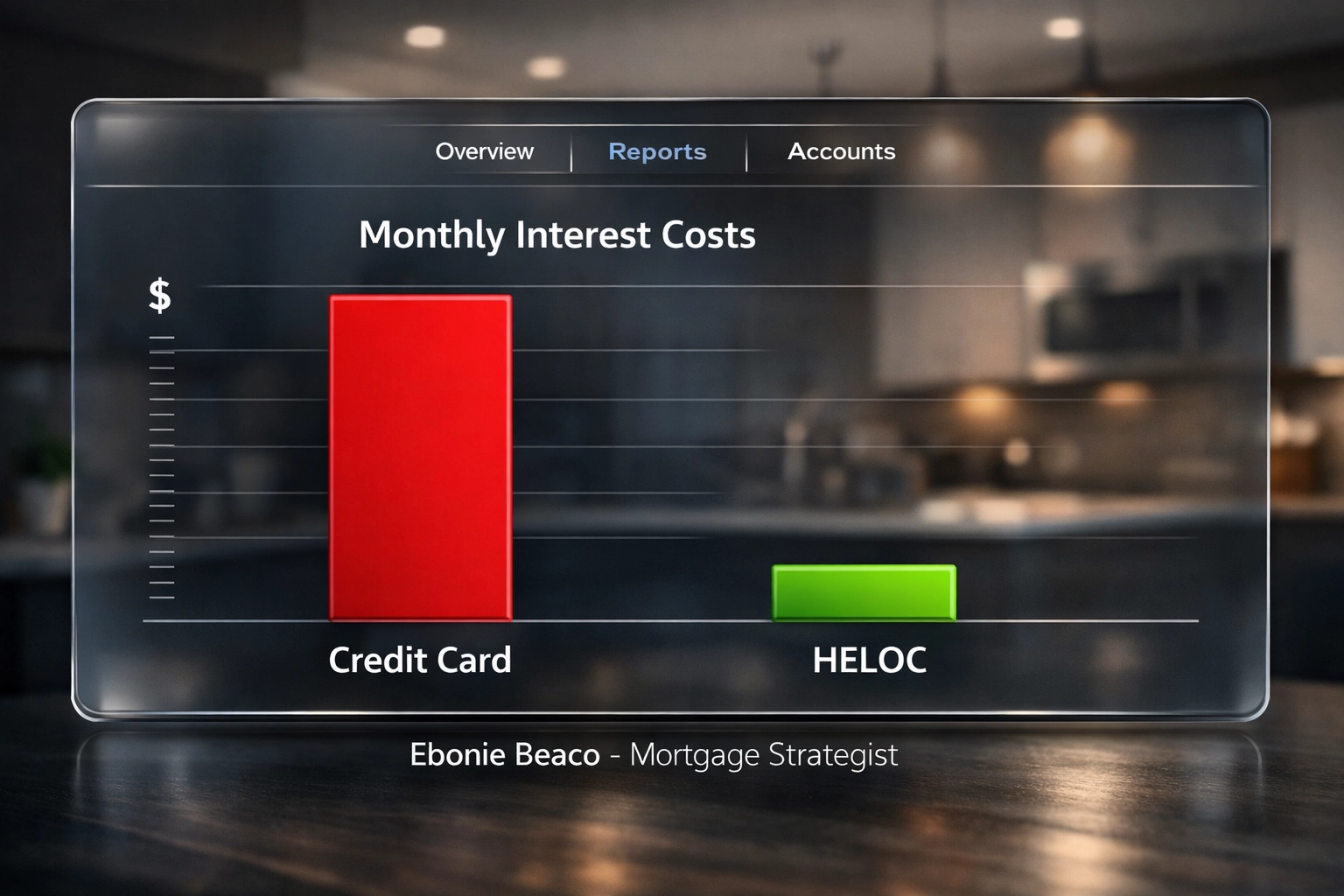
Consider a homeowner with $40,000 in credit card debt. The average credit card interest rate often hovers around 22% to 24%.
Current Scenario (Credit Cards):
- Total Debt: $40,000
- Average Interest Rate: 22%
- Annual Interest Paid: $8,800
- Monthly Interest Payment: $733.33
Now, let's look at the same scenario using a HELOC at a 9% variable rate.
New Scenario (HELOC Blitz):
- Total Debt: $40,000
- HELOC Interest Rate: 9%
- Annual Interest Paid: $3,600
- Monthly Interest Payment: $300.00
In this real-world example, the homeowner saves $433.33 every single month. Over a single year, that is $5,200 staying in your pocket instead of going to a bank’s profits.
Why Homeowners in the Sun Belt and Midwest are Switching
The real estate markets in Florida, Georgia, and Virginia have seen steady appreciation over the last several years. Similarly, markets in Illinois and Michigan have remained resilient. This appreciation has created a massive pool of equity for residents.
If you are a landlord in Chicago or an Airbnb investor in Virginia Beach, you might be using high-interest business lines or personal credit to fund repairs or bridge the gap between guests. Consolidating that debt into a single, low-rate HELOC allows you to stabilize your portfolio's cash flow.
In Alabama, property values in areas like Huntsville and Birmingham have provided homeowners with a unique opportunity to access capital that was previously unavailable. Working with an Alabama HELOC lender who understands the local market can help you maximize the amount of equity you can access.
Missouri homeowners are seeing similar trends. A Missouri HELOC lender can help you navigate the appraisal process to ensure your home’s current value reflects the most recent market gains, giving you the largest possible line of credit.
The Strategy: How to Start Your Blitz Today
Executing a debt consolidation blitz requires a disciplined approach. You are not just moving debt around; you are creating a path to eliminate it.
Step 1: Audit Your Current Debt
List every debt you have outside of your primary mortgage. Include the total balance, the interest rate, and the minimum monthly payment. Focus heavily on those with rates above 15%.
Step 2: Determine Your Available Equity
You can use mortgage calculators to get a rough idea of your current LTV.
- Take your estimated home value.
- Multiply it by 0.85 (85% LTV).
- Subtract your current mortgage balance.
- The result is your potential HELOC limit.
Step 3: Access Your Credit Line
Explore loan programs to find a HELOC that fits your needs. Some offer interest-only payments during the draw period, while others might have fixed-rate draw options.
Step 4: Execute the Payoff
Once your HELOC is funded, use the funds to pay off your high-interest credit cards and loans in full. This immediately stops the high interest from accruing.
Step 5: Reinvest the Savings
This is the most critical step. Take the $433.33 (from our previous example) that you saved in interest and apply it directly toward the principal of your HELOC. This speeds up the debt elimination process significantly.

Navigating Potential Risks
While a HELOC is a powerful tool, it is not without risks. At Home Loans Network, we believe in full transparency regarding your financial choices.
Variable Interest Rates: Most HELOCs have variable rates, meaning your payment could increase if market rates rise. You must ensure your budget can handle a potential increase in the future.
Home as Collateral: Unlike a credit card, which is unsecured debt, a HELOC is secured by your home. If you fail to make payments, the lender could potentially foreclose on the property.
The Temptation to Spend: Debt consolidation only works if you stop using the credit cards you just paid off. If you clear your balances and then run them up again, you will end up with twice the debt.
Strategic Uses for Real Estate Investors
Investors often use HELOCs as a "ready-to-go" fund for new opportunities. Whether you are following the BRRRR (Buy, Rehab, Rent, Refinance, Repeat) strategy or looking for fix and flip financing, having a HELOC in place allows you to act quickly.
If you have equity in a primary residence in California or Georgia, you can use a HELOC to provide the down payment for a DSCR investor loan on a rental property. This allows you to scale your portfolio using the wealth you have already built.

Technical Terms to Know
Appraisal: A professional assessment of a property's market value.
Practical Application: The appraisal determines the "Value" part of your Loan-to-Value calculation.
Debt-to-Income (DTI): The percentage of your gross monthly income that goes toward paying debts.
Practical Application: Lenders look at your DTI to ensure you can comfortably afford the new HELOC payment along with your existing obligations.
Closing Costs: Fees associated with finalizing the loan, which may include appraisal fees, title searches, and attorney fees.
Practical Application: Some HELOC programs offer low or no closing costs, making them more attractive for smaller consolidation amounts.
Is This the Right Move for You?
Choosing to consolidate debt is a major financial decision. It requires a stable income and a commitment to long-term financial health. If you are a homeowner in Arkansas, Kentucky, or Virginia, the current market dynamics may offer a window of opportunity to reorganize your finances.
If your goal is to simplify your life with a single monthly payment and reduce the amount of interest you pay to big banks, a HELOC is one of the most effective strategies available today.
Jump in and select a loan officer to discuss your specific scenario and see how much equity you can put to work.

Access Your Equity Now
The process of unlocking your home’s value is more straightforward than many believe. From the initial application to the final funding, the loan process is designed to get you the capital you need to start your debt blitz.
Whether you are looking for an Alabama HELOC lender to help consolidate credit cards or a Missouri HELOC lender to fund a property renovation, the key is to act while your home value is high and your equity is accessible.
Compare your options, run the numbers, and decide if today is the day you stop paying high interest and start building real wealth.
Schedule a 1 on 1 at https://calendly.com/homeloansnetwork
Ebonie Beaco
Mortgage Strategist | Senior Loan Officer
Home Loans Network powered by Loan Factory Inc.
NMLS #2389954
HomeLoansNetwork.com
312-392-0664