
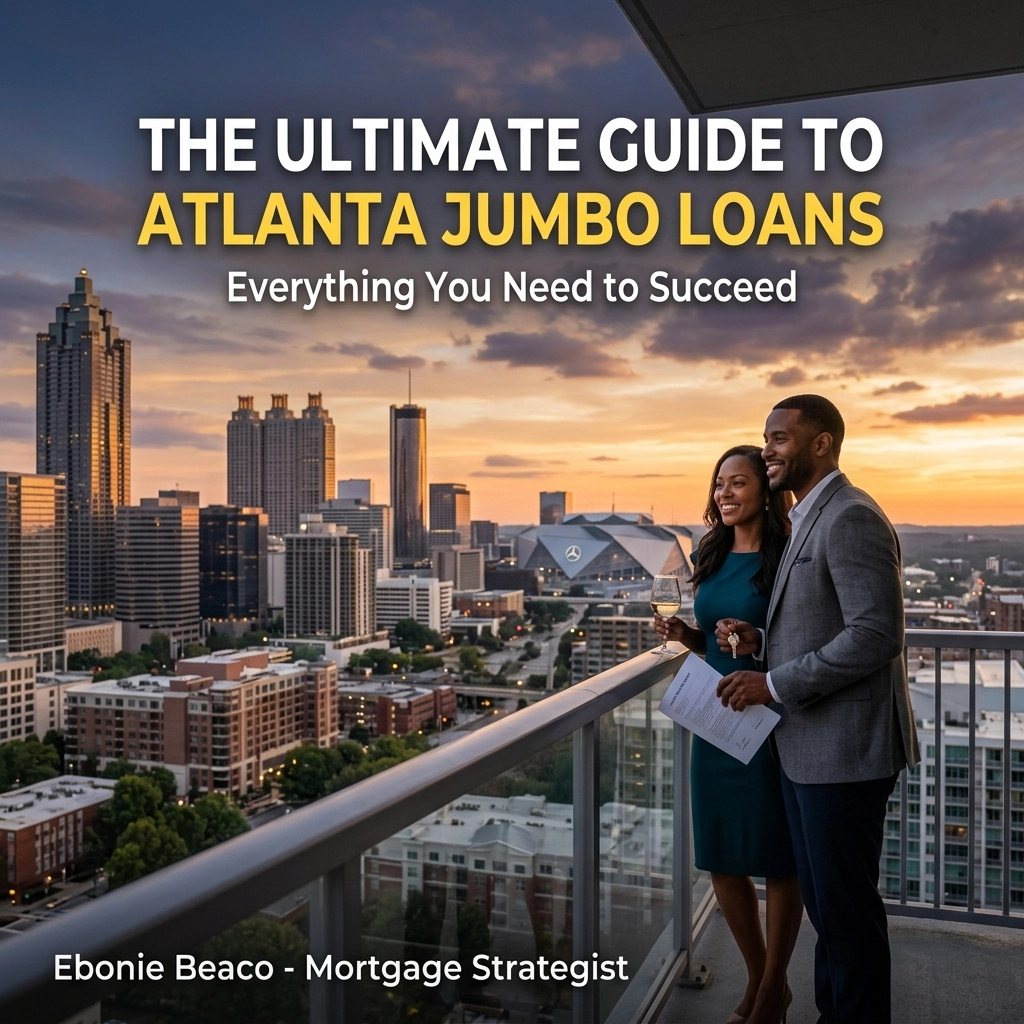
Buying a home in Atlanta has changed. Whether you are looking at a historic estate in Buckhead or a modern masterpiece in Midtown, the price of luxury has moved upward. When the price of your dream home exceeds the standard limits set by the government, you enter the territory of jumbo loans.
Navigating the world of high balance financing can feel intimidating. Between higher credit requirements and larger down payments, there is a lot to coordinate. This guide breaks down everything you need to know about securing a jumbo loan in Atlanta, while also touching on how these programs function in high value markets like California, Florida, and Chicago.
Defining the Jumbo Loan
A jumbo loan is a type of financing that exceeds the conforming loan limits set by the Federal Housing Finance Agency (FHFA). Because these loans are too large to be purchased or guaranteed by Fannie Mae or Freddie Mac, they are considered non-conforming. This means lenders take on more risk, leading to stricter qualification standards for you as the borrower.
In 2026, the baseline conforming loan limit for a single family home is $832,750. If your loan amount is even one dollar over this threshold, you are looking at a jumbo product. You can explore different options on our loan programs page to see how these differ from standard financing.
How to Qualify for an Atlanta Jumbo Loan
Because Home Loans Network operates with full transparency, it is important to understand that jumbo loans are not one size fits all. Lenders look for a "clean" profile. They want to see that you have the income to support the debt and the discipline to manage your credit.
Credit Score Requirements
While you might get a conventional loan with a 620 score, jumbo lenders typically look for a minimum of 680 to 700. To access the most competitive rates and lower down payment options, aiming for a score of 740 or higher is your best bet.
Debt to Income Ratio (DTI)
Your DTI is the percentage of your gross monthly income that goes toward paying debts. For most jumbo programs, lenders prefer to see this capped at 43% to 45%. This ensures you have plenty of breathing room in your budget after the mortgage is paid.
Cash Reserves
This is where many buyers get caught off guard. Lenders often require "reserves," which is liquid cash left over after you pay your down payment and closing costs. For an Atlanta jumbo loan, you might need anywhere from 3 to 18 months of mortgage payments sitting in a bank account or brokerage account.

Understanding Down Payment Tiers
The myth that you always need 20% down for a jumbo loan is simply not true. While 20% is standard and often gives you the best pricing, there are other paths available.
- 5% Down Jumbo: This is excellent for high earners who want to keep their liquidity. These programs usually cap the loan amount around $1.5 million and require top tier credit scores.
- 10% Down Jumbo: A very common middle ground. This allows for loan amounts up to $2.5 million in many cases and is often available for second homes or vacation properties.
- 15% to 20% Down Jumbo: This is the "sweet spot" for interest rates. When you put more skin in the game, the lender lowers the rate, which can save you thousands over the life of the loan.
You can use our mortgage calculators to see how different down payment amounts affect your monthly commitment.
Luxury Financing in Different Markets
While our focus today is Atlanta, jumbo loan strategies remain similar across other high end markets.
- California Jumbo Loans: In cities like Los Angeles or San Francisco, home prices are notoriously high. Many counties in California are considered "high cost areas," meaning their conforming limits are actually higher than the $832,750 baseline. However, even with those higher limits, jumbo financing is the norm for the luxury coastal market.
- Florida Jumbo Loans: From Miami to Palm Beach, the Florida luxury market relies heavily on jumbo products. Investors often use these for high end vacation rentals, sometimes pairing them with interest only mortgage options to maximize cash flow.
- Chicago Jumbo Loans: The Chicago market offers a mix of high rise luxury and sprawling suburban estates. Buyers here often look for flexibility in underwriting, especially self-employed individuals who may need bank statement programs to qualify.
Real World Example: The Atlanta High Balance Buy
Let’s look at a practical scenario to see how the numbers play out. Imagine you are eyeing a luxury home in Alpharetta with a purchase price of $1,100,000.
- Purchase Price: $1,100,000
- Down Payment (15%): $165,000
- Loan Amount: $935,000
- Loan Type: Jumbo (since it is above $832,750)
- Estimated Credit Score: 760
- Required Reserves (12 months): If your PITI (Principal, Interest, Taxes, and Insurance) is $6,500, you would need $78,000 in liquid assets remaining after closing.
In this case, because the loan is over the conforming limit, you would work with a mortgage loan officer to lock in a jumbo rate. If you were to put down a larger amount to bring the loan below $832,750, you could transition into a fixed rate mortgage under conforming guidelines.

Special Programs for Complex Income
Not every high end buyer has a standard W2 job. If you are a business owner or a real estate investor, your tax returns might show a lot of deductions that lower your "taxable income," making it hard to qualify for a traditional jumbo loan.
This is where Non-QM (Non-Qualified Mortgage) loans come in. These include:
- Bank Statement Loans: Lenders look at your average monthly deposits over 12 to 24 months to determine your ability to pay, rather than just looking at the bottom line of your tax return.
- DSCR Loans: For investors buying luxury rentals, the Debt Service Coverage Ratio loan focuses on the income the property generates rather than your personal income. If the rent covers the mortgage, you are in business.
- Asset Depletion: If you have significant wealth but low monthly income, lenders can use a formula to "deplete" those assets over the life of the loan to create a qualifying income figure.
Jump in and explore our mortgage basics to understand how these non-traditional paths can work for your specific financial profile.
Property Types and Appraisals
When you deal with high value real estate, the property itself is under a microscope. Most jumbo lenders will require a very detailed appraisal, and for loans over $1.5 million or $2 million, they often require two separate appraisals from different companies to confirm the value.
Eligible properties usually include:
- Single Family Residences (Primary)
- Townhomes
- Warrantable Condos
- Planned Unit Developments (PUDs)
Investment properties and second homes are also eligible for jumbo financing, though they typically require a higher down payment (often 20% to 25%) and higher interest rates compared to a primary residence.
Comparison: Jumbo vs. Conforming
| Feature | Conforming Loan | Jumbo Loan |
|---|---|---|
| Loan Limit (2026) | Up to $832,750 | Above $832,750 |
| Minimum Credit | 620 | 680-700+ |
| Down Payment | As low as 3% | Typically 5-20% |
| Appraisals | Usually one | Often two for high values |
| Reserves | Often 0-2 months | 3-18 months typical |
Compare these options carefully. Sometimes it makes sense to take a jumbo loan, and other times, it might be smarter to use a "piggyback" loan (a first mortgage at the conforming limit and a second mortgage for the remainder) to avoid jumbo requirements. You can read more about standard options on our conventional loans page.
Strategies for Success in the Atlanta Market
To succeed in the Atlanta luxury market, you need to be prepared before you even step foot in a showing.
First, get a verified pre-approval. In the jumbo world, a simple pre-qualification letter isn't enough. Sellers of multi-million dollar homes want to know that a lender has already reviewed your bank statements and tax returns.
Second, consider the loan structure. If you plan on moving in five to seven years, an adjustable rate mortgage (ARM) might offer a significantly lower interest rate than a 30-year fixed, saving you a massive amount of interest in the short term.
Third, verify your gift funds. If a family member is helping with the down payment, jumbo lenders have strict rules about how that money is documented. Access our loan process page to see the steps involved in documenting your funds correctly.

Final Thoughts on Atlanta High Balance Loans
The Atlanta real estate market continues to be a land of opportunity for those who understand how to leverage the right financing. Whether you are navigating Florida Jumbo Loans, Chicago Jumbo Loans, or California Jumbo Loans, the principles of transparency and preparation remain the same.
High end buyers have unique needs, and jumbo loans are the tool designed to meet those needs. By understanding the limits, the credit requirements, and the reserve needs, you position yourself as a strong buyer in a competitive market.
If you are ready to explore your specific scenario or if you have questions about how a jumbo loan fits into your investment strategy, we are here to provide the guidance you need.
Schedule a 1 on 1 at https://calendly.com/homeloansnetwork
Ebonie Beaco
Mortgage Strategist | Senior Loan Officer
Home Loans Network powered by Loan Factory Inc.
NMLS #2389954
HomeLoansNetwork.com
312-392-0664