

It is a quiet Sunday morning in April, and you are probably sitting there with a cup of coffee, looking at your home and thinking about the "hidden" bank account inside your walls. If you live in Illinois, Michigan, or Virginia, you have likely seen your property value climb over the last few years.
That equity is a powerful tool. It can fund a DSCR rental property acquisition, renovate your kitchen, or consolidate high-interest debt. But here is the transparent truth: most homeowners are draining their equity without realizing it.
At Home Loans Network, we see people treat their homes like ATMs every day. Some do it right. Many do it wrong.
Explore these seven common mistakes so you can protect your wealth and use your equity to build a future, not just fund a weekend.
1. Treating Your Equity Like a Piggy Bank for Lifestyle Upgrades
The most common mistake we see in markets like Chicago or Northern Virginia is using a HELOC to fund depreciating assets.
HELOC (Home Equity Line of Credit): A revolving line of credit secured by your home that allows you to borrow, repay, and borrow again during a set draw period.
If you use that line of credit to buy a boat or fund a lavish vacation to the Florida Keys, you are trading permanent equity for temporary pleasure. The equity should ideally be used for things that provide a return on investment.
Think about using it as a down payment for a fix and flip project or as the "buy" phase in a BRRRR strategy. When you use equity to buy more real estate, you are using your home to build a legacy. When you use it for a luxury SUV, you are just shrinking your net worth.
2. Ignoring the "Hidden" Costs of Tapping Into Equity
Many homeowners focus entirely on the interest rate. While the rate is relevant, it is not the only cost.
When you open a California HELOC or a Florida HELOC, you need to account for:
- Appraisal fees.
- Title search fees.
- Annual membership fees for the line of credit.
- Closing costs (which often range from 2% to 5% of the loan amount).
If you are only borrowing a small amount, these fixed costs can make the effective "price" of that money much higher than the advertised interest rate. Access our mortgage calculators to see how these numbers shake out before you sign the dotted line.
3. Overestimating Your Home's Current Value
In Michigan and Illinois, we often see "Equity Optimism." You might see a house down the street sell for a record price and assume your home is worth the same.
However, lenders use strict appraisal standards. If you plan your entire investment strategy around having $200,000 in equity and the appraiser says you only have $120,000, your plans for that DSCR investor loan could crumble.
Always keep a conservative buffer. If you think your home is worth $500,000, run your numbers as if it is worth $475,000. This protects your strategy from market shifts.
4. Failing to Understand the "Draw" vs. "Repayment" Shock
A HELOC typically has two phases.
Draw Period: The initial phase (often 10 years) where you can take money out and usually only make interest-only payments.
Repayment Period: The phase (often 15 to 20 years) where you can no longer borrow money and must pay back both principal and interest.
The mistake? Homeowners in Virginia and Georgia often get comfortable with the low interest-only payments during the draw period. When the repayment period hits, the monthly payment can double or triple.
This "payment shock" can lead to foreclosure if you aren't prepared. Always have an exit strategy or a plan to refinance into a fixed-rate mortgage before the repayment period starts.

5. Consolidating Debt Without Fixing the Root Problem
Using home equity to pay off $50,000 in credit card debt is a popular move in high-cost areas like California and Florida. It feels great to see those balances hit zero and your monthly payments drop.
But if you haven't changed the spending habits that created the debt, you will likely run those cards back up. Now, instead of just having credit card debt, you have credit card debt and a larger loan against your house.
Transparency is key here: if you use equity to consolidate debt, you must commit to a strict budget. Otherwise, you are just putting your home at risk for a temporary fix.
6. Choosing the Wrong Product for the Goal
Not every equity need requires a HELOC. Sometimes, a cash-out refinance or a second mortgage is a better fit.
- HELOC: Best for ongoing projects where you don't need all the cash at once (like a staged renovation).
- Cash-Out Refi: Best when you need a lump sum and want the security of a fixed interest rate.
- Bridge Loan: Best for moving from one property to another quickly.
If you are a Georgia HELOC lender seeker looking to fund a single, one-time investment, a fixed-rate second mortgage might save you from the rising interest rates of a variable HELOC. Compare your loan programs carefully.
7. Forgetting the Impact on Your DTI
DTI (Debt-to-Income Ratio): A percentage that shows how much of your monthly gross income goes toward paying debts.
When you open a large line of credit, even if you don't use it, some lenders look at that available credit as potential debt. This can impact your ability to qualify for other loans.
If you are an active real estate investor in Alabama or Indiana trying to scale a portfolio using DSCR rental property loans, a massive unused HELOC on your primary residence might complicate your next acquisition. Always consult with a mortgage strategist to see how one move affects the next.
Calculating Your Potential Equity
Let’s look at a real-world scenario. Suppose you own a property in a growing neighborhood in Richmond, VA, or a suburb of Chicago.
The Scenario:
- Current Home Value: $500,000
- Current Mortgage Balance: $280,000
- Lender Max Combined Loan-to-Value (CLTV): 85%
The Calculation:
- Calculate Max Total Debt: $500,000 x 0.85 = $425,000.
- Subtract Current Mortgage: $425,000 - $280,000 = $145,000.
- Available Equity: $145,000.
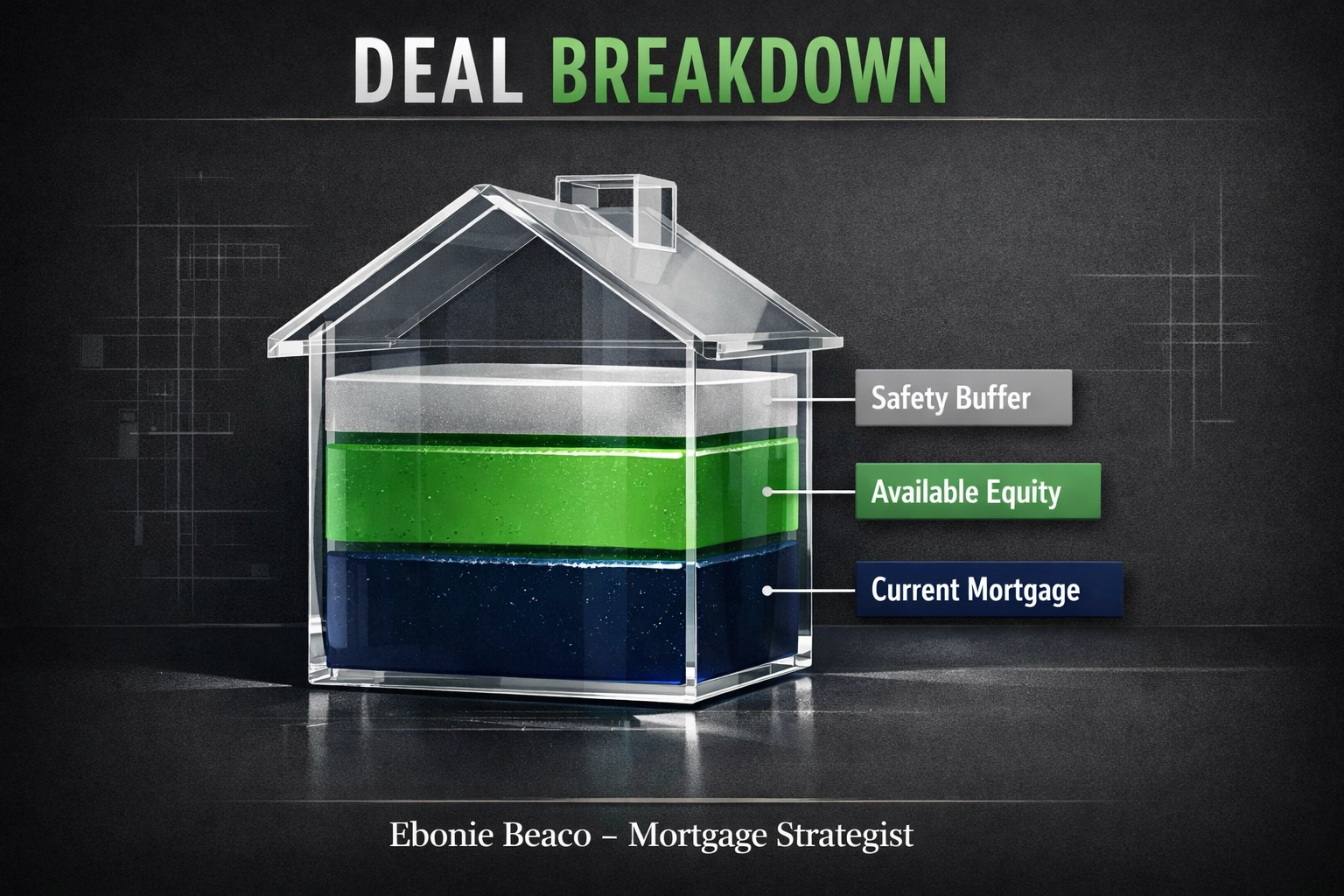
With $145,000, you could potentially fund the down payment on two or three DSCR rental properties in markets like Little Rock, AR, or Indianapolis, IN. This is how smart investors use their primary residence to build a rental empire.
The Local Nuance: Why IL, MI, and VA are Unique Right Now
The real estate markets in these three states are behaving differently, and your equity strategy should reflect that.
Illinois and Chicago
Chicago has seen steady growth, but property taxes are a significant factor. When you take out a HELOC in Illinois, your total monthly housing expense increases. Make sure your "net" cash flow remains positive if you are using that money for investment properties.
Michigan
In Michigan, specifically the Detroit metro area, we see a lot of investors using equity to fund fix and flip projects. The barrier to entry is lower, but the cost of materials and labor is rising. Using a HELOC provides the flexibility to pay contractors in stages.
Virginia
Virginia, especially the areas near D.C., has incredibly resilient property values. This makes it a great place to hold equity. However, because values are high, your jumbo loans or high-balance HELOCs require excellent credit scores to get the best terms.
How to Avoid These Mistakes
- Define the Purpose: Before you touch a dime, write down exactly what that money is for. If it isn't for an appreciating asset or high-interest debt consolidation, think twice.
- Check the Math: Use our mortgage calculators to simulate the repayment period, not just the draw period.
- Consult a Strategist: Don't just talk to a "loan officer" who wants to sell a product. Talk to a strategist who understands the loan process and how it fits into your long-term wealth.
- Review Your Documents: Understand the difference between an adjustable-rate mortgage and a fixed-rate option.
Your Next Move
Your home is more than a roof over your head; it is a financial engine. Whether you are looking for a California HELOC to start your investment journey or a Florida HELOC to renovate a vacation rental, the strategy you choose today will dictate your financial freedom five years from now.
Stop guessing and start planning. If you want to see exactly how much equity you can safely access and how to deploy it effectively in today’s market, let’s have a conversation.
Schedule a 1 on 1 at https://calendly.com/homeloansnetwork
Ebonie Beaco
Mortgage Strategist | Senior Loan Officer
Home Loans Network powered by Loan Factory Inc.
NMLS #2389954
HomeLoansNetwork.com
312-392-0664
But there is one more thing most lenders won't tell you about equity in a rising-rate environment: and it could be the difference between a successful investment and a total loss. We'll be diving into the "Rate-Lock Trap" in our next update... stay tuned.