

Speed defines the success of a real estate investor in the California market. When a distressed property hits the market in Los Angeles, San Diego, or San Francisco, the window to secure the deal closes in hours, not weeks. Traditional bank financing often takes 30 to 45 days to clear underwriting, which is why savvy investors turn to specialized funding strategies.
Explore the mechanics of hard money lending to understand how professional flippers bypass the red tape of conventional mortgages. This guide breaks down the "secrets" of rapid funding and how you can leverage these tools to scale your portfolio across California, Florida, and the Chicago area.
Defining the Essentials of Hard Money
Before diving into the speed of the process, you must understand the vocabulary used by mortgage strategists and private lenders.
Hard Money Loan A short-term, asset-based loan secured by real property rather than the creditworthiness of the borrower. Practical application: Investors use hard money to acquire and renovate properties quickly, often exiting the loan through a sale or a home refinance into a long-term rental loan.
Loan-to-Value (LTV) A ratio used by lenders to express the amount of a loan as a percentage of the total value of the property. Practical application: In hard money, LTV typically ranges from 65% to 75%, providing a safety cushion for the lender while requiring the investor to have skin in the game.
After Repair Value (ARV) The estimated market value of a property after all planned renovations and improvements are completed. Practical application: Many California fix and flip loans are structured around the ARV, allowing you to borrow a portion of the future value to cover construction costs.
Points Upfront fees paid to the lender at closing, where one point equals one percent of the total loan amount. Practical application: These fees compensate the lender for the risk and the speed of the capital deployment.

The 7-Day Funding Timeline: How It Works
The primary secret to funding a flip in under seven days is the elimination of traditional "hoops." Conventional lenders focus on your debt-to-income (DTI) ratio, tax returns, and employment history. Hard money lenders prioritize the asset.
Day 1: Submission and Initial Review
Jump in by providing the property address and your renovation budget. Direct hard money lenders evaluate the purchase price against the local market data immediately.
Day 2: Letter of Intent (LOI)
Once the basic numbers align, you receive an LOI. This document outlines the interest rate, points, and terms of the loan.
Day 3: Valuation and Inspections
Unlike a full interior appraisal that can take two weeks, hard money lenders often use "drive-by" appraisals or Broker Price Opinions (BPOs). This speeds up the valuation process significantly.
Day 4-5: Underwriting and Title Review
The focus here is on the title of the property and the feasibility of the renovation. The lender ensures there are no hidden liens that could hinder the project.
Day 6: Document Preparation
Loan documents are generated and sent to the escrow or title company. You review the final numbers to ensure transparency.
Day 7: Closing and Funding
You sign the documents, the lender wires the funds, and the deed is recorded. You now own the property and can begin construction.
Why Asset-Based Lending Outperforms Conventional Options
Traditional mortgage programs, such as fixed-rate mortgages or conventional loans, are designed for long-term stability, not short-term speed.
Florida fix and flip loans and California hard money programs thrive because they ignore the factors that slow down banks.
Credit Scores are Secondary While a basic credit check is performed, a low score is rarely a deal-breaker. If the property has enough equity, the loan can move forward.
No Income Verification You do not need to provide years of tax returns or W-2s. This is ideal for self-employed investors or those between projects.
Flexible Draw Schedules Renovation funds are often held in escrow and released in "draws." This ensures the project stays on track and the lender’s investment is protected as the property value increases.
Comparing Fix and Flip Strategies Across Major Markets
While the principles of hard money remain consistent, the market dynamics in California differ from those in the Southeast or the Midwest.
California
In cities like Los Angeles or San Jose, property values are high, requiring significant capital. Investors often look for jumbo loans or high-limit hard money to cover acquisition costs.
Florida
The Florida market, including Miami and Tampa, sees a high volume of distressed properties. Florida fix and flip loans are frequently used for "wholetailing" or rapid renovations to meet the demand for move-in-ready homes.
Chicago
The Chicago fix and flip loans market often focuses on multi-unit buildings or brick bungalows. Investors in Chicago frequently use bridge loans to transition from a quick flip into a long-term landlord loan after the renovation is complete.

Financial Breakdown: A Real-World California Flip Scenario
To see how the numbers work in practice, let’s look at a typical investment scenario in a California suburb.
Property Purchase Price: $500,000 Renovation Budget: $100,000 After Repair Value (ARV): $800,000
Hard Money Loan Structure:
- LTV on Purchase: 75% ($375,000)
- Renovation Funding: 100% ($100,000)
- Total Loan Amount: $475,000
- Interest Rate: 10% (Interest-only)
- Points: 2 ($9,500)
Investor Contribution:
- Down Payment: $125,000
- Closing Costs & Points: $15,000
- Total Cash to Close: $140,000
Projected Profit:
- Sale Price: $800,000
- Less Loan Payback: $475,000
- Less Selling Costs (6%): $48,000
- Less Holding Costs (6 months): $23,750
- Net Profit: $253,250
Explore how different interest rates impact your bottom line by using our mortgage calculators.
Preparing for Success: What You Need Ready
To hit the 7-day funding goal, you must have your "investor folder" ready before you find the deal.
- Entity Documents: Most hard money lenders require you to close in an LLC or Corp. Ensure your Articles of Organization and EIN are ready.
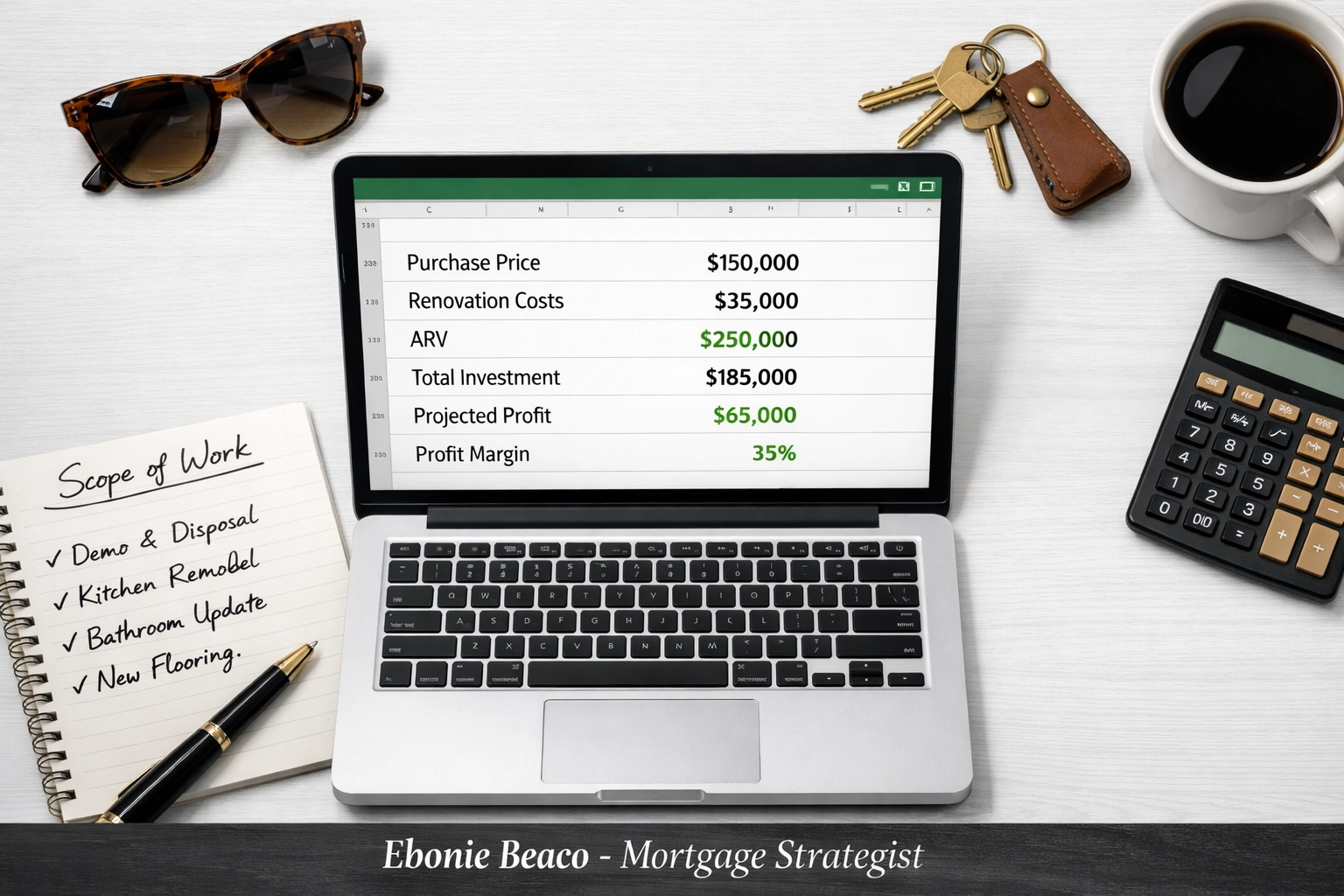
- Scope of Work (SOW): A detailed, line-item budget for the renovation.
- Proof of Funds: You must show that you have the cash for the down payment and the first phase of construction.
- Experience Bio: A summary of your past projects. Even if you are a first-time flipper, a solid plan can mitigate the lack of experience.
Access the online forms to begin organizing your application data.
The Role of the Mortgage Strategist
Navigating hard money is not just about finding the lowest rate; it is about finding the right structure for your specific exit strategy. A mortgage strategist helps you compare options between a short-term hard money loan and more traditional paths like adjustable-rate mortgages if you plan to hold the property long-term.
In California, the regulatory environment is unique. Working with a professional who understands the legal landscape ensures your transaction remains compliant while moving at the speed of business.

Transitioning to Long-Term Wealth
Many investors use the BRRRR method (Buy, Rehab, Rent, Refinance, Repeat). Once the flip is complete, instead of selling, they refinance into a DSCR investor loan. This allows you to pull your initial capital out and move on to the next project in Florida, Georgia, or Illinois.
Compare the benefits of an interest-only mortgage during the holding phase to maximize your monthly cash flow.

Take Action on Your Next Deal
California real estate moves fast, but your financing can move faster. By focusing on the asset and working with a transparent lender, you can secure the capital needed to turn a distressed property into a high-value asset in a matter of days.
If you are looking at a deal in California, Florida, or Atlanta and need a clear path to funding, let's look at the numbers together.
Schedule a 1 on 1 at https://calendly.com/homeloansnetwork
Ebonie Beaco Mortgage Strategist | Senior Loan Officer Home Loans Network powered by Loan Factory Inc. NMLS #2389954 HomeLoansNetwork.com 312-392-0664