
Real estate investing is often a game of momentum. To build a significant portfolio, you need to keep your capital working for you rather than losing a large portion of your profits to the Internal Revenue Service (IRS).
The 1031 Exchange is a powerful tax-deferral strategy named after Section 1031 of the Internal Revenue Code. It allows an investor to sell an income-producing property and reinvest the proceeds into a new property while deferring capital gains taxes.
Navigating the financing side of these transactions requires a strategic approach. You must align your new mortgage with IRS requirements to ensure the exchange remains valid and your tax liability stays at zero.
Defining the 1031 Exchange
1031 Exchange: A swap of one investment property for another that allows capital gains taxes to be deferred. Practical Application: This strategy lets you move equity from a low-performing asset into a high-growth property without losing 15% to 20% of your profit to immediate taxation.
Like-Kind Property: A term used by the IRS to describe properties of the same nature or character, even if they differ in grade or quality. Practical Application: You can exchange a single-family rental in Chicago for an apartment building in Florida or a retail space in California for an industrial warehouse in Virginia.
Qualified Intermediary (QI): A third-party entity that holds the funds from the sale of the relinquished property until the purchase of the replacement property is complete. Practical Application: You cannot touch the proceeds from your sale; if the funds hit your personal bank account, the exchange is disqualified, and taxes become due immediately.
Explore more about the fundamentals of property transition at Home Loans Network Mortgage Basics.
The Role of Debt Replacement
One of the most misunderstood aspects of the 1031 Exchange is how debt impacts your tax liability. To achieve full tax deferral, the IRS generally requires that you follow two main rules regarding value and debt.
First, the replacement property must be of equal or greater value than the property you sold. If you sell a duplex for $500,000, your new investment must cost at least $500,000.
Second, you must replace the debt. If your original property had a mortgage of $200,000, your new property must also have at least $200,000 in financing.
If you decrease your debt level without adding more cash to the deal, the IRS considers that "debt relief." This relief is treated as "boot", a fancy term for taxable gain.
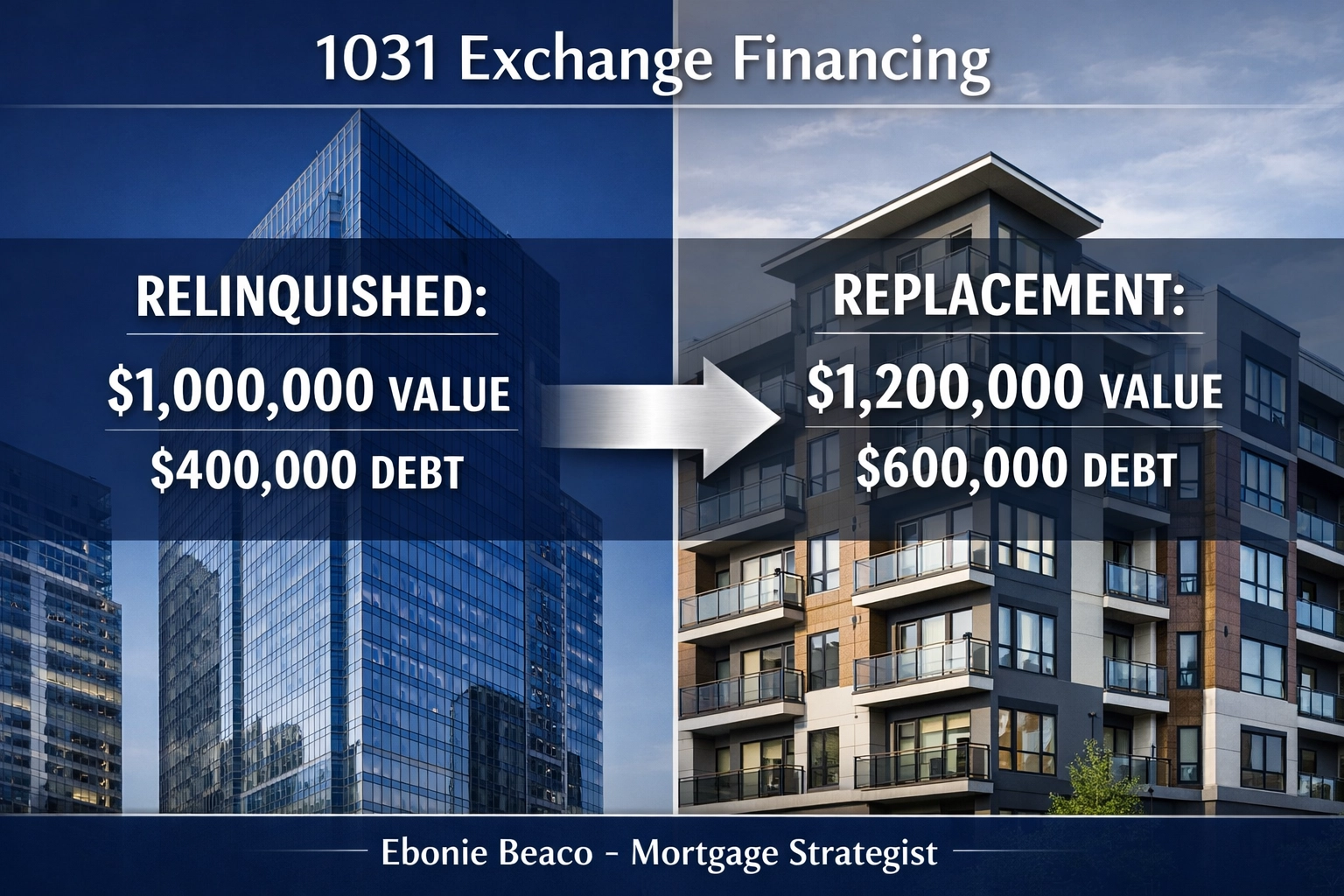 Title: 1031 Exchange Financing. Ebonie Beaco - Mortgage Loan Officer. Visualizing the Equal or Greater Value Rule: Sale Price $1,000,000 | Existing Debt $400,000 | Replacement Purchase $1,200,000 | New Debt $600,000.
Financing Strategies for 1031 Investors
Securing the right loan for your replacement property is essential for a smooth transition. Many investors use specialized products to meet the strict IRS timelines.
DSCR Investor Loans
Debt Service Coverage Ratio (DSCR) Loans: A financing option where qualification is based on the property’s rental income rather than the borrower’s personal income. Practical Application: This is an ideal solution for 1031 investors who are self-employed or have complex tax returns. If the rental income from the new property in Georgia or Michigan covers the mortgage payment, you can often secure financing quickly.
Bridge Loans
Bridge Loan: A short-term financing tool used to "bridge" the gap between the sale of one asset and the acquisition of another. Practical Application: If your 1031 funds are tied up but you need to close on a replacement property in California immediately, a bridge loan provides the necessary liquidity to secure the deal.
Conventional and Non-QM Loans
Non-QM (Non-Qualified Mortgage): Loans that do not follow standard federal lending guidelines, often used for investors with unique financial profiles. Practical Application: Investors scaling portfolios in Alabama or Arkansas use these to bypass the restrictive debt-to-income limits of traditional banks.
Compare different loan options to see which fits your reinvestment strategy at Home Loans Network Loan Process.
Critical Timing and Deadlines
The IRS is strict regarding the timeline of a 1031 Exchange. There are no extensions for these deadlines, so your financing must be lined up and ready to go.
- The 45-Day Identification Period: From the day you sell your property, you have exactly 45 days to identify potential replacement properties in writing to your Qualified Intermediary.
- The 180-Day Exchange Period: You must close on the replacement property within 180 days of the sale of the first property, or by the due date of your tax return (including extensions), whichever is earlier.
If you are looking for a property in competitive markets like Miami or Chicago, having a pre-approval from a mortgage strategist is vital. Use the Home Loans Network Mortgage Calculators to estimate your new debt requirements before your 45-day window closes.
Identifying Potential "Boot"
When executing an exchange, any value you receive that is not "like-kind" property is considered boot. Boot is taxable.
- Cash Boot: This occurs if you don't reinvest all the net proceeds from your sale. If you keep $20,000 from the sale to cover personal expenses, that $20,000 is taxed as a capital gain.
- Mortgage Boot: This occurs when you do not replace the debt on the replacement property. If your old mortgage was $300,000 and your new mortgage is $250,000, the $50,000 difference is taxable.
To avoid mortgage boot, you can either take out a larger loan or inject more of your own cash into the purchase. Most investors prefer to use leverage to maximize their buying power.
Market-Specific Considerations
The strategy for a 1031 Exchange often shifts depending on where you are buying.
- Florida and Georgia: Many investors are moving capital from high-tax states into the Southeast to take advantage of population growth and landlord-friendly regulations.
- California and Illinois: In these higher-priced markets, investors often use a 1031 Exchange to move from high-maintenance "fixer-uppers" into "turn-key" properties or NNN (Triple Net) commercial leases.
- Indiana and Missouri: These states offer excellent opportunities for investors looking for high-yield cash flow properties, where a DSCR loan can easily cover the debt service.
Access more information about state-specific opportunities and our services on our About Us page.
Real-World Example: Moving from a Single Family to a Multi-Unit
Imagine an investor named Sarah who owns a single-family rental in Virginia. She bought it years ago for $200,000, and it is now worth $500,000. She has a mortgage balance of $150,000.
If Sarah sells the property, she has $350,000 in equity. After closing costs, she might have $320,000 in net proceeds.
Sarah decides to use a 1031 Exchange to buy a 4-unit apartment building in Kentucky for $800,000.
The Math:
- Replacement Value: $800,000 (Greater than $500,000 - PASS)
- Equity Reinvested: $320,000 (All proceeds used - PASS)
- New Debt Needed: $480,000 (Greater than $150,000 - PASS)
By using a DSCR loan for the $480,000 balance, Sarah successfully defers all her capital gains taxes and triples her rental unit count.
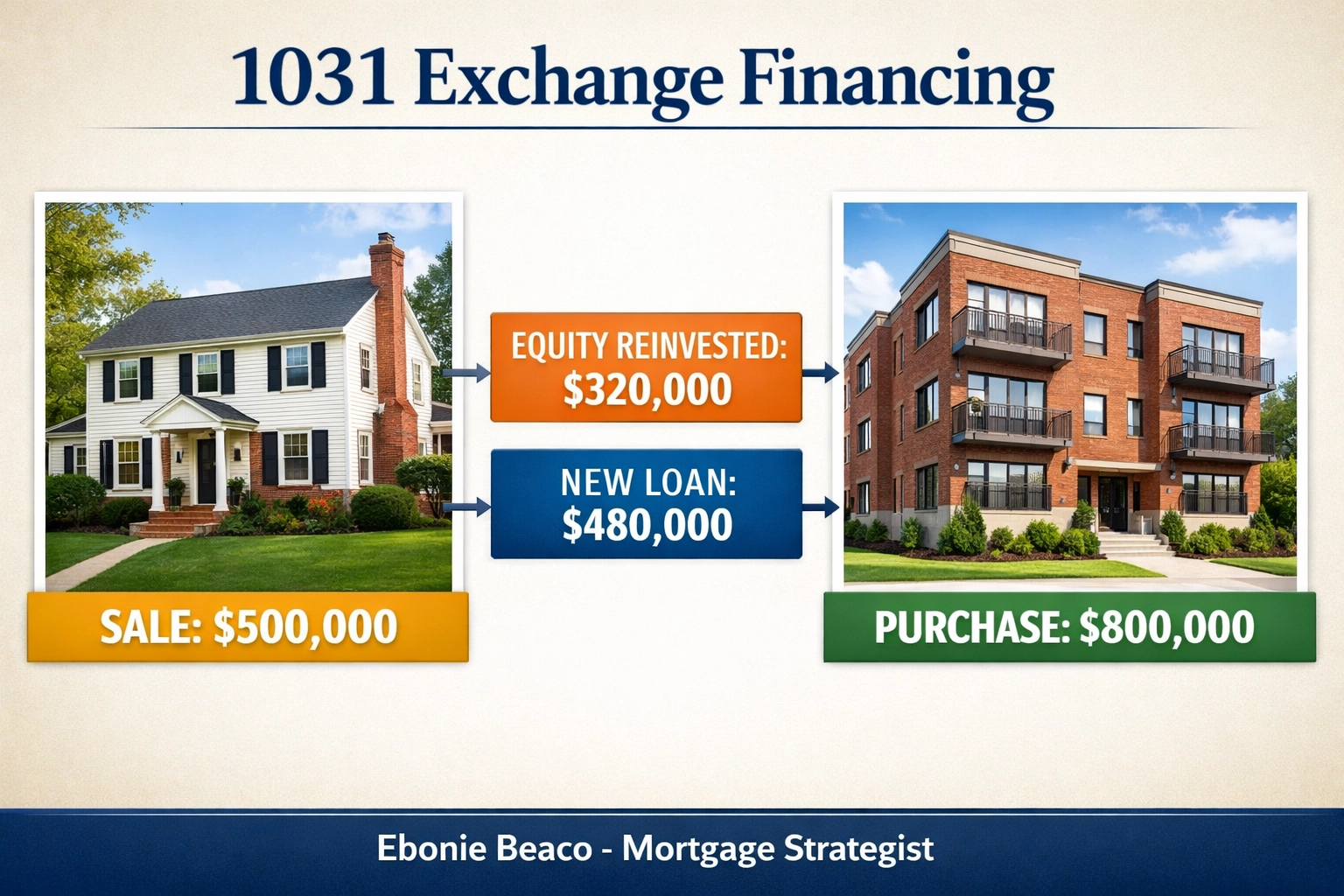 Title: 1031 Exchange Financing. Ebonie Beaco - Mortgage Loan Officer. Sarah's Transition: Sale $500k | Debt $150k | Equity $320k. New Purchase $800k | New Loan $480k | Tax Liability $0.
Frequently Asked Questions
Can I do a 1031 Exchange on my primary residence? No. This strategy is strictly for properties held for investment or used in a productive trade or business.
Can I use a 1031 Exchange for a vacation home? Only if the vacation home is rented out and treated as an investment property following specific IRS "safe harbor" rules regarding personal use and rental days.
What happens if I can't find a property in 45 days? If you fail to identify a property within the 45-day window, the exchange fails. The Qualified Intermediary will return your funds, and you will owe capital gains taxes on your profit for that tax year.
Jump in and get your questions answered by visiting our FAQ page.
Partnering with a Mortgage Strategist
A 1031 Exchange is a complex financial maneuver. It involves tight deadlines, legal intermediaries, and specific lending requirements. You need a partner who understands the nuances of investor financing and the importance of debt replacement.
Whether you are a seasoned landlord or an aspiring investor looking to scale, proper guidance is the difference between a successful tax-free transition and a massive tax bill.
If you are planning a sale and want to explore your reinvestment options, let’s look at your scenario together. We can compare loan programs like DSCR, bank statement loans, or traditional investment financing to see which helps you reach your goals.
Schedule a 1 on 1 at https://calendly.com/homeloansnetwork
Ebonie Beaco Mortgage Strategist | Senior Loan Officer Home Loans Network powered by Loan Factory Inc. NMLS #2389954 HomeLoansNetwork.com 312-392-0664
For more information on how we handle your data and our commitment to service, please review our Privacy Policy and Accessibility Statement.