Say Goodbye to Monthly Payments: The Financial Freedom of Reverse Mortgages

For many homeowners in their 60s, the dream of a peaceful retirement is often shadowed by the weight of a recurring monthly mortgage payment. If you are living in a high-value market like Chicago, Illinois, or the sun-drenched coastal cities of Florida and California, you likely have a significant amount of equity locked within your four walls.
A reverse mortgage is a specialized financial tool designed to unlock that equity and transform it into usable cash flow. This strategy allows you to remain in your home while effectively cancelling your obligation to make monthly principal and interest payments to a lender.
Explore how this transition can redefine your financial profile and provide the stability needed to enjoy your retirement years without the stress of a traditional mortgage bill.
Defining the Reverse Mortgage Framework
Before diving into the strategic benefits, it is essential to understand the technical mechanics of these loans. In the world of real estate finance, clarity leads to better decision-making.
HECM (Home Equity Conversion Mortgage): A federal program insured by the Federal Housing Administration (FHA) that allows homeowners aged 62 or older to borrow against their home equity. Practical Application: This is the most common form of reverse mortgage, providing consumer protections and flexible payout options for seniors.
Principal Limit: The total amount of money a borrower can access through a reverse mortgage based on age, interest rates, and home value. Practical Application: Knowing your principal limit helps you determine how much debt you can pay off or how much cash you can receive.
Non-Recourse Loan: A lending agreement where the borrower (or their heirs) will never owe more than the home is worth at the time of sale. Practical Application: This feature provides a safety net, ensuring that even if the housing market dips in Virginia or Georgia, your estate is protected from personal liability for a loan balance that exceeds the property value.
Access more detailed definitions in our mortgage glossary to build your foundational knowledge.
The Immediate Impact: Eliminating Monthly Mortgage Payments
The most visible benefit of a reverse mortgage is the immediate boost to your monthly cash flow. For a homeowner in Michigan or Indiana who is still paying $1,500 or $2,000 a month toward a traditional 30-year fixed mortgage, that expense often represents the largest drain on their retirement savings.
When you transition to a reverse mortgage, the new loan pays off your existing mortgage in full. From that moment forward, you are no longer required to send a monthly check for principal or interest to a bank.
This change does not mean you lose ownership of the home. You remain the owner and hold the title. Your only ongoing financial responsibilities are to stay current on property taxes, homeowners insurance, and basic maintenance.
Jump in and use our mortgage calculators to see how much your current payment is costing you over the long term.

Strategic Equity Access for Real Estate Investors
While often viewed as a tool for traditional homeowners, reverse mortgages offer unique advantages for seasoned real estate investors and landlords. If you own your primary residence in a market like Alabama or Arkansas and want to expand your rental portfolio, a reverse mortgage can serve as a primary funding source.
Imagine a scenario where an investor has a primary residence valued at $600,000 with a $100,000 remaining mortgage. By utilizing a reverse mortgage, they can pay off the $100,000 debt and access an additional $200,000 in a line of credit.
That $200,000 can be used as a down payment on multiple DSCR rental property loans or to fund a fix and flip project in a growing neighborhood. Because the reverse mortgage on the primary residence requires no monthly payments, the investor’s personal debt-to-income ratio remains favorable, making it easier to qualify for additional investment financing.
Flexibility in Payout Options
One of the most powerful aspects of a reverse mortgage is the ability to choose how you receive your funds. Unlike a traditional cash-out refinance, which typically provides a single lump sum, the HECM program offers several structures tailored to your specific goals.
- Lump Sum: Receive a large portion of your equity upfront. This is often used to pay off existing high-interest debt or fund a major home renovation.
- Tenure Payments: Receive equal monthly payments for as long as at least one borrower lives in the home as a primary residence. This functions like a private pension.
- Line of Credit: This is perhaps the most strategic option. You only pay interest on the money you actually use, and the unused portion of the line of credit actually grows over time.
- Term Payments: Receive fixed monthly payments for a specific number of years.
For individuals in high-growth areas of Florida or California, the growing line of credit option is particularly attractive. As property values rise, the available credit can increase, providing a massive financial cushion for future healthcare costs or unexpected expenses.

A Real-World Financial Example: The Chicago Homeowner
Let's look at how the numbers actually work in a real scenario. Consider a 70-year-old homeowner in Chicago with a property valued at $500,000.
- Current Mortgage Balance: $120,000
- Monthly Payment (P&I): $950
- Estimated Reverse Mortgage Proceeds: $280,000
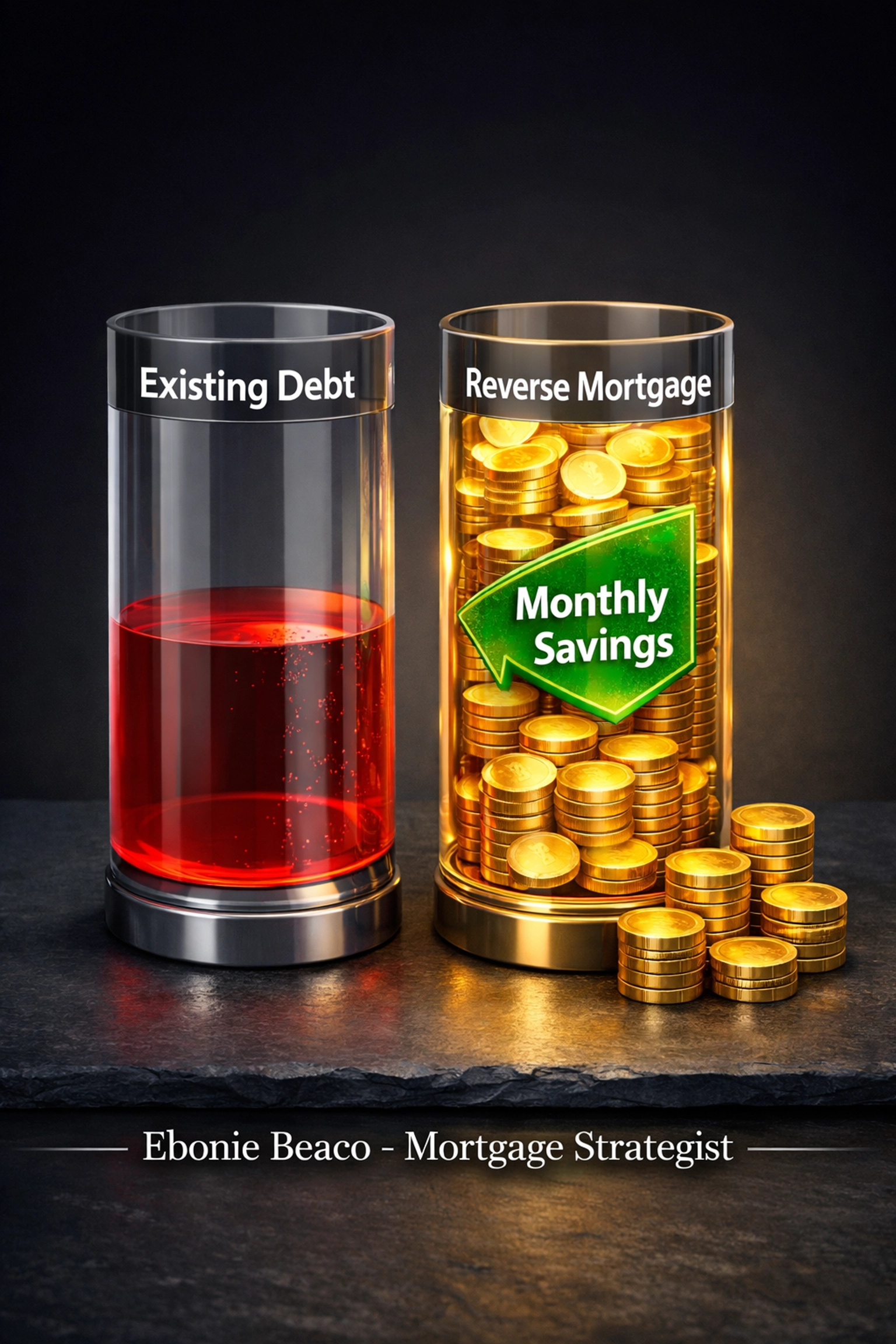
In this case, the first $120,000 of the reverse mortgage pays off the existing loan. This immediately saves the homeowner $950 per month, or $11,400 per year. The remaining $160,000 can be placed into a standby line of credit.
| Category | Before Reverse Mortgage | After Reverse Mortgage |
|---|---|---|
| Home Value | $500,000 | $500,000 |
| Mortgage Debt | $120,000 | $120,000 (repaid) |
| Monthly Payment | $950 | $0 |
| Available Cash/Credit | $0 | $160,000 |
| Annual Savings | $0 | $11,400 |
This homeowner has effectively increased their annual spendable income by over $11,000 while gaining access to a $160,000 emergency fund. This strategy provides a level of financial freedom that traditional refinancing simply cannot match for those on a fixed income.
Enhancing Retirement Longevity
Many retirees worry about outliving their savings. By eliminating a mortgage payment, you significantly reduce your "burn rate": the speed at which you spend your retirement nest egg.
Instead of withdrawing funds from a 401(k) or IRA to pay the bank every month, you can leave those investments untouched, allowing them more time to potentially grow. Furthermore, the proceeds from a reverse mortgage are typically considered loan advances and not taxable income. This can keep you in a lower tax bracket and protect your Social Security benefits from being taxed at a higher rate.
Review our application checklist to see what documentation you need to start exploring this path.
Protecting Your Estate and Your Heirs
A common misconception is that the bank "takes the house" in a reverse mortgage. This is factually incorrect. You retain the title and ownership.
The non-recourse protection is a massive benefit for your heirs. If you pass away or move into a long-term care facility, your heirs have the option to pay off the loan balance and keep the home, or sell the home to satisfy the debt.
If the home sells for more than the loan balance, the remaining equity goes to your heirs. If the home is worth less than the balance, the FHA insurance covers the gap. Your estate is never on the hook for the difference. This transparency ensures that your family is protected regardless of future market fluctuations in Virginia or Missouri.
Compare your options and about us to understand how we prioritize your long-term financial health.

Qualification Requirements and Next Steps
To access this financial freedom, there are specific criteria you must meet. These standards are in place to ensure the program is used responsibly and that homeowners are set up for success.
- Age: At least one homeowner must be 62 or older.
- Property Type: The home must be your primary residence. Single-family homes, 2-4 unit properties (if one unit is occupied by the owner), and FHA-approved condos qualify.
- Equity: You must have significant equity in the home, typically at least 50%.
- Counseling: All borrowers must complete a session with a HUD-approved counselor to ensure they fully understand the loan terms.
- Financial Assessment: Lenders will perform a basic check of your ability to pay property taxes and insurance.
If you are a homeowner in Kentucky or Indiana looking to stabilize your future, or an investor in Florida wanting to leverage your primary residence for a bridge loan or new acquisition, the reverse mortgage is a powerful tool.
Explore your options today and see how much equity you can unlock.
Schedule a 1 on 1 at https://calendly.com/homeloansnetwork
Ebonie Beaco Mortgage Strategist | Senior Loan Officer Home Loans Network powered by Loan Factory Inc. NMLS #2389954 HomeLoansNetwork.com 312-392-0664