How to Grow Your Chicago Portfolio with DSCR Loans (No Tax Returns Required!)
Scaling a real estate portfolio in a city as dynamic as Chicago requires more than just finding the right deal in Logan Square or Bronzeville.
It requires a financing strategy that aligns with the way modern investors operate.
Traditional bank loans often create a bottleneck for high-growth investors because they rely heavily on personal income and debt-to-income ratios.
If you are self-employed or utilize significant tax deductions to manage your wealth, your "on-paper" income might not reflect your true purchasing power.
This is where the Debt Service Coverage Ratio (DSCR) loan becomes a game-changer for the Chicago market.
As a Chicago DSCR loan lender, we focus on the property's ability to pay for itself rather than your personal tax history.
Explore how this asset-based lending model allows you to bypass the red tape of traditional financing and accelerate your path to portfolio growth.
What is a DSCR Loan?
DSCR Loan: A specialized mortgage product for real estate investors that uses the rental income of the subject property to qualify for the loan.
The practical benefit is that the lender does not require tax returns, pay stubs, or employment verification.
Instead of looking at your personal debt-to-income (DTI) ratio, the lender looks at the property’s cash flow.
If the rental income covers the monthly mortgage payment, taxes, insurance, and HOA fees, the property qualifies.
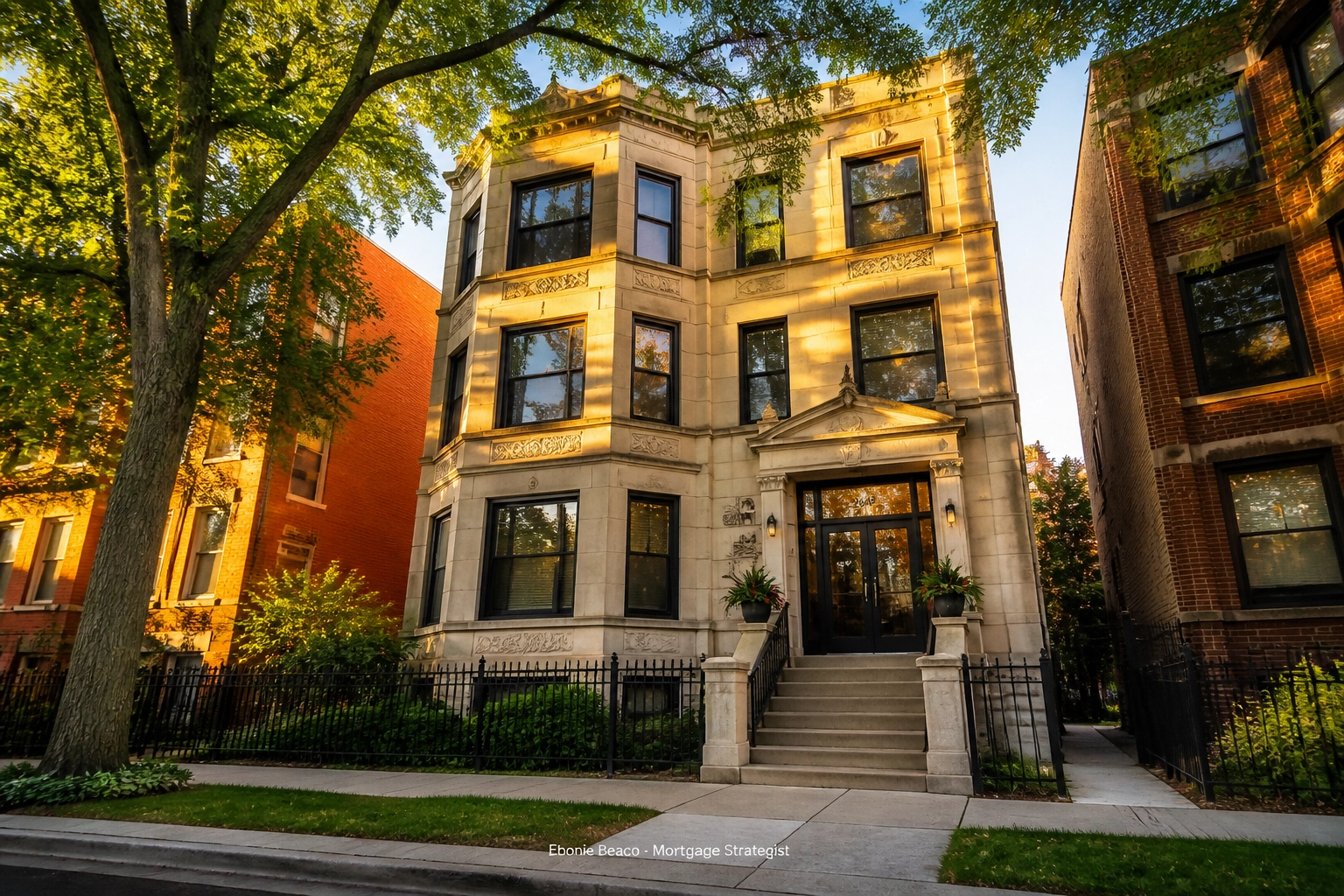 Vibrant, borderless professional real estate photograph of a classic Chicago greystone building in a sunlight-filled neighborhood.
The Mechanics of the Calculation
To understand if a property qualifies for Chicago investment property loans, you must understand the ratio itself.
The formula is straightforward: Gross Rental Income divided by the Monthly Debt Service (PITIA).
PITIA: An acronym for Principal, Interest, Taxes, Insurance, and Association fees.
For example, if a 4-unit building in Chicago generates $8,000 in monthly rent and the total mortgage payment (including taxes and insurance) is $6,000, the calculation is:
$8,000 / $6,000 = 1.33 DSCR.
Most lenders look for a ratio of 1.20 or 1.25, though some programs allow for "no-ratio" or "low-ratio" options depending on the investor's credit profile and down payment.
Why Chicago Investors Choose DSCR Financing
Bypass Personal Income Scrutiny Traditional lenders often struggle to approve investors who have complex tax returns or multiple business entities. DSCR loans remove this hurdle entirely.
Rapid Closing Timelines Because there is no need to verify personal employment or income history, the underwriting process is significantly streamlined.
Unlimited Property Count Conventional financing often caps an investor at 10 properties. DSCR programs typically have no limit on the number of financed properties you can hold.
Flexible Entity Ownership You can close these loans in the name of an LLC or a Corporation, which is a standard practice for sophisticated investors seeking liability protection.
Jump in and compare these benefits against conventional loans to see which fits your current growth stage.
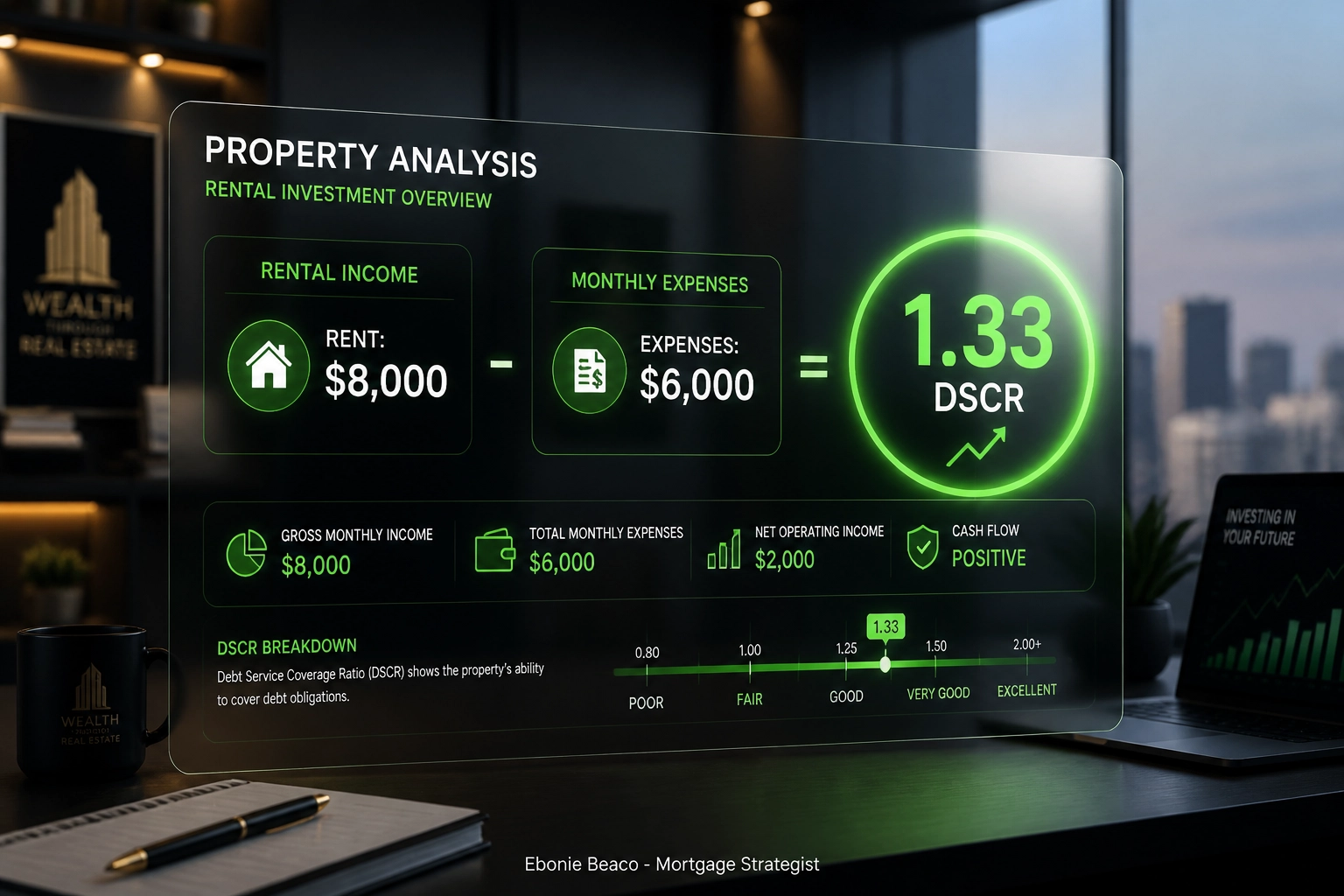 Vibrant, borderless graphic showing a financial breakdown of a DSCR calculation: Rent $8,000 / Expenses $6,000 = 1.33 Ratio.
Case Study: Marcus and the Logan Square 4-Unit
Marcus is an experienced investor who had his sights set on a 4-unit building in Logan Square, one of Chicago's most competitive rental markets.
Marcus is self-employed as a consultant and uses various legal deductions to minimize his taxable income.
When he approached a traditional bank for Chicago rental property financing, he was denied because his personal tax returns didn't show enough "income" to support a new mortgage, despite having significant cash reserves.
The Scenario
- Property Type: 4-Unit Multifamily
- Location: Logan Square, Chicago
- Purchase Price: $950,000
- Monthly Rental Income: $7,500
- Estimated PITIA: $6,000
The DSCR Solution
Marcus worked with a Chicago DSCR loan lender to secure financing.
The lender calculated his DSCR at 1.25 ($7,500 / $6,000).
Because the property cash-flowed at a 1.25x ratio, Marcus was approved without providing a single tax return or W-2.
He closed the deal in 21 days and is now collecting passive income while the property appreciates in a high-demand neighborhood.
 Vibrant, borderless image of a modern interior of a renovated Chicago apartment, showcasing high-end finishes and bright lighting.
How to Qualify for a DSCR Loan in Chicago
While the property income is the primary focus, there are still basic requirements you must meet to secure the best rates.
Credit Score Requirements A minimum credit score of 660 is typically required, though higher scores (720+) unlock more favorable interest rates and lower down payment options.
Access your current credit profile to understand your standing before applying. You can learn more about how credit impacts your loan on our credit basics page.
Down Payment Guidelines Most DSCR programs require a 20% to 25% down payment.
The larger the down payment, the lower the ratio requirement often becomes.
Property Appraisal and Rent Schedule The lender will order a standard appraisal along with a Form 1007 (for single-family) or Form 1025 (for multi-family) to verify the fair market rent in the Chicago area.
Liquid Reserves Lenders want to see that you have "skin in the game" and enough cash to cover 3 to 6 months of mortgage payments in case of a vacancy.
 Vibrant, borderless photo of a diverse group of professionals discussing a real estate deal over a laptop in a bright office space.
Scaling Your Portfolio: From 1 to 10 Doors
The true power of Chicago rental property financing through DSCR is the ability to scale.
Once you have one property performing well, you can use a cash-out refinance to pull equity out of that property and use it as a down payment for the next acquisition.
Because the lender isn't looking at your personal DTI, the debt from your first property doesn't "clog" your ability to get a second, third, or tenth loan.
As long as each property is "debt-serviceable" (the rent covers the mortgage), you can continue to expand throughout the city and suburbs.
This strategy is frequently used by BRRRR (Buy, Rehab, Rent, Refinance, Repeat) investors who need to exit a hard money loan into a long-term, fixed-rate solution.
Comparing DSCR to Other Investor Options
| Feature | DSCR Loan | Conventional Investment Loan |
|---|---|---|
| Income Verification | Property Cash Flow | Personal Tax Returns & W-2s |
| DTI Limits | None | Typically 43% - 50% |
| Max Properties | Unlimited | Usually 10 |
| Closing Speed | 15-30 Days | 30-45+ Days |
| Closing Entity | LLC or Individual | Individual Only |
Compare these options to see which aligns with your specific goals. If you are a first-time investor, you might also look into FHA loans for house-hacking, but for pure portfolio expansion, DSCR is often the superior choice.
 Vibrant, borderless aerial shot of the Chicago skyline at sunset, emphasizing the density and opportunity of the urban rental market.
Navigating the Chicago Market
Chicago is a unique market with specific landlord-tenant laws and varying property tax assessments.
When seeking Chicago investment property loans, it is vital to work with a strategist who understands the local landscape.
From the nuances of the Cook County tax cycles to the rental demand in neighborhoods like West Loop or Pilsen, having a partner who knows the territory can help you avoid costly mistakes.
If you are ready to stop letting tax returns dictate your investment future, it is time to explore the flexibility of DSCR financing.
Contact Ebonie Beaco at Home Loans Network to scale your Chicago portfolio.
Whether you are looking to purchase your first duplex or refinance a 20-unit portfolio, we provide the transparency and expertise you need to succeed in the Chicago real estate market.
Schedule a 1 on 1 at https://calendly.com/homeloansnetwork
Ebonie Beaco Mortgage Strategist | Senior Loan Officer Home Loans Network powered by Loan Factory Inc. NMLS #2389954 HomeLoansNetwork.com 312-392-0664