7 Mistakes You’re Making with a California HELOC (and How to Fix Them Before Your Morning Coffee)

Grab your coffee.
If you are a homeowner in California, Florida, or Georgia, you are sitting on a goldmine of equity.
Home values across the country, from the suburbs of Chicago to the coastal reaches of Virginia, have climbed significantly over the last few years.
A Home Equity Line of Credit (HELOC) is one of the most flexible tools to tap into that wealth.
However, many homeowners and investors in Michigan and Alabama treat a HELOC like a standard credit card.
This approach often leads to expensive errors that can jeopardize your financial future.
Explore these seven common mistakes and learn how to navigate your home equity journey with transparency and confidence.
1. The Variable Rate Mirage: Ignoring the Index
The first mistake most homeowners make is focusing only on the introductory "teaser" rate.
Most HELOC products operate on a variable interest rate structure.
Variable Interest Rate: A mortgage interest rate that fluctuates over time based on an underlying financial index, such as the U.S. Prime Rate.
Practical Application: Checking the index regularly allows you to anticipate payment changes and adjust your budget before your monthly statement arrives.
In high-value markets where a California HELOC might involve a significant balance, even a 1% increase in the Prime Rate can result in hundreds of dollars in additional monthly interest.
If you prefer stability, you might want to compare this with a fixed rate mortgage to see which aligns better with your long term goals.
2. The Secret Home Equity Drain: The Velocity Banking Black Hole
You may have heard of "velocity banking" as a way to pay off your mortgage faster using a HELOC.
This strategy involves dumping your entire paycheck into your HELOC and using the line of credit to pay all your bills.
While it sounds efficient, it often becomes a mathematical trap if the HELOC interest rate is significantly higher than your primary mortgage rate.
Amortization: The process of paying off a debt over time through regular installments of principal and interest.
Practical Application: Comparing the effective interest cost of your HELOC against your primary mortgage helps you avoid accidentally increasing your total interest expense.
Using a 9% HELOC to pay down a 3% primary mortgage rarely makes sense.
Jump in and review your current mortgage terms at Home Loans Network before trying complex debt maneuvers.
3. The Principal Payment Pitfall: Misreading the Statement
Many lenders in states like Arkansas and Kentucky do not automatically apply extra payments to your principal balance.
If you send an extra $500, the bank might simply treat it as an early payment for next month's interest.
Principal: The original sum of money borrowed in a loan, separate from the interest charged.
Practical Application: Specifying "principal only" on extra payments ensures you are actually reducing your debt and saving on future interest charges.
Always verify with your lender how they handle overpayments.
If you are unsure about your current credit standing or how it impacts your payments, visit our guide on credit basics.
4. The Georgia and Florida LTV Ceiling: Over-leveraging Your Assets
If you are looking for a Georgia HELOC lender or a Florida HELOC, you must understand Loan-to-Value (LTV) limits.
Many homeowners try to borrow up to 95% or 100% of their home's value.
LTV (Loan-to-Value): A ratio used by lenders to express the amount of a first mortgage lien as a percentage of the total appraised value of real property.
Practical Application: Maintaining an LTV below 80% often helps you secure a lower interest rate and avoid additional fees.
In volatile markets, borrowing too much can leave you "underwater" if property values take a slight dip.
Access our appraisal guide to understand how your home’s value is determined before you apply.
Understanding Your Equity Access
To see how this works in a real world scenario, let's look at a homeowner in Virginia or Illinois.
Imagine a property valued at $600,000 with an existing mortgage balance of $350,000.
Most lenders allow an 80% Combined Loan-to-Value (CLTV).
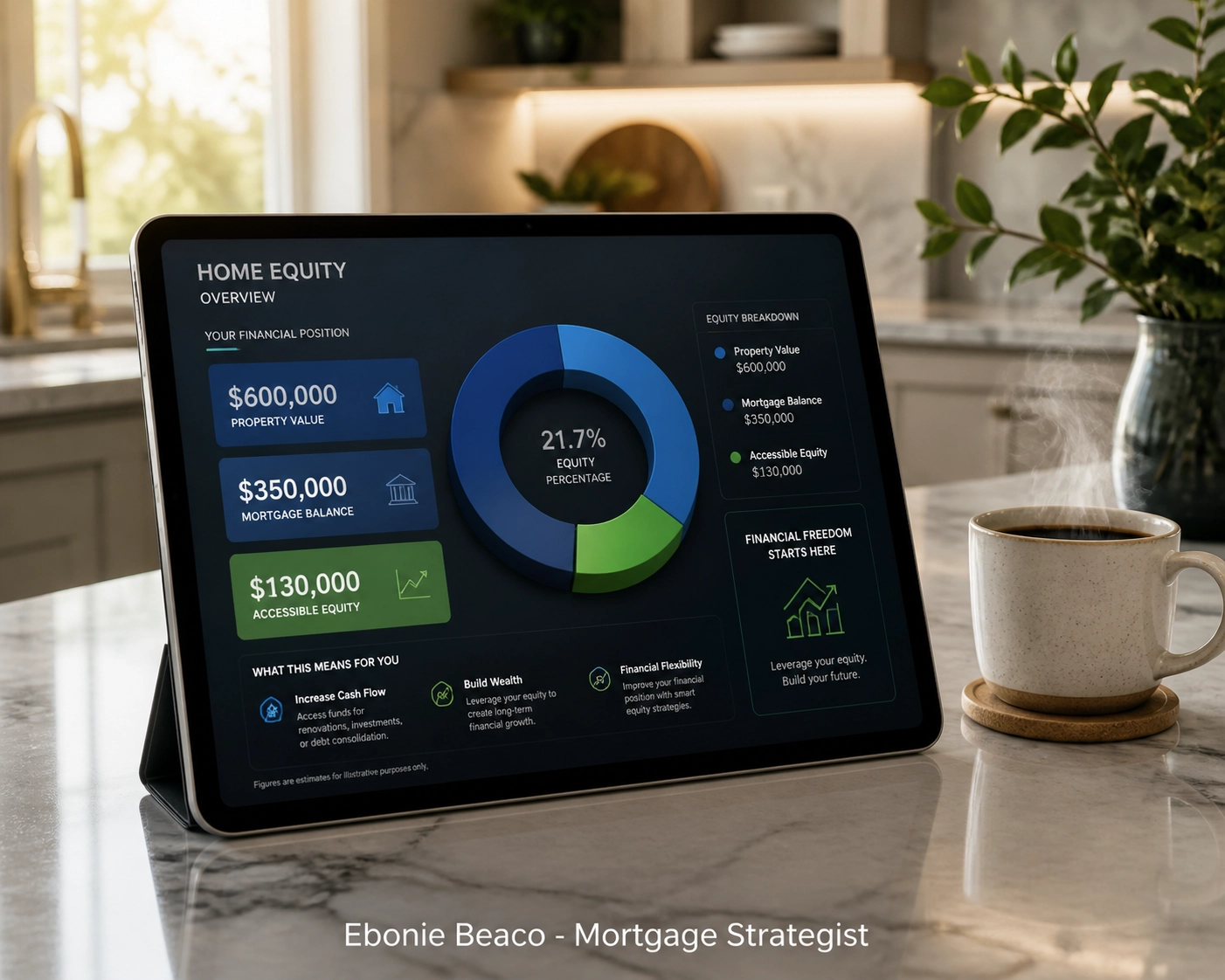
As shown in the calculation above, the homeowner could potentially access $130,000 in equity.
However, taking the full $130,000 might not be the best strategy if you do not have a specific plan for the funds.
5. The Lifestyle Inflation Anchor: Using Equity for Consumables
One of the biggest mistakes seen in Missouri and Indiana is using a HELOC to fund a lifestyle that your income cannot support.
Using home equity to buy a luxury car or go on an expensive vacation is risky because you are securing a depreciating asset with your home.
Secured Debt: A loan backed by collateral, such as a home, which the lender can seize if the borrower defaults.
Practical Application: Restricting HELOC use to home improvements or high-return investments ensures that the debt contributes to your overall net worth.
Real estate investors often use HELOCs for fix and flip financing or as a down payment on a DSCR rental property.
These are productive uses of equity because they aim to generate more income or value than the cost of the interest.
6. The Closing Cost Blindspot: Forgetting the "Hidden" Fees
A HELOC is not free to set up.
Even if a lender advertises "no closing costs," they often recoup those expenses through higher interest rates or early termination fees.
Closing Costs: Fees paid at the end of a real estate transaction, which can include appraisal fees, title insurance, and attorney fees.
Practical Application: Requesting a full breakdown of all potential fees allows you to calculate the true cost of the loan over its entire lifespan.
Homeowners in Michigan and Virginia should look out for annual participation fees and inactivity fees.
If you decide the fees are too high, a home refinance might be a more cost-effective way to access cash.
7. The Draw Period Cliff: Forgetting the Repayment Phase
A HELOC typically has two phases: the draw period and the repayment period.
During the draw period (usually 10 years), you might only be required to pay interest.
The mistake happens when the draw period ends, and the loan enters the repayment phase.
Draw Period: A set period during which a borrower can take money from a line of credit.
Practical Application: Establishing a repayment plan during the draw period prevents the "payment shock" that occurs when you are suddenly required to pay back both principal and interest.
If you find yourself approaching the end of a draw period with a large balance, you may need to look into conventional loans to refinance that debt into a predictable monthly payment.

Strategic Home Equity Management
Managing a HELOC requires the same discipline as managing a business.
Whether you are a landlord in Alabama or a first time investor in Virginia, your home equity is a tool that should be used with precision.
Avoid the common pitfalls by staying informed and working with a mortgage strategist who understands the nuances of the local markets in California, Georgia, and Florida.
If you find that a variable rate line of credit is too unpredictable, you can always explore other options like FHA loans or VA loans for different types of property acquisitions.
The key is to act before the market shifts or your financial needs become urgent.
Compare your options, run the numbers, and ensure your equity is working for you, not against you.
But what happens when the bank decides to freeze your line of credit unexpectedly?
In our next deep dive, we will reveal the three triggers that cause lenders to shut down your HELOC without warning... and how you can protect your access to cash.
Schedule a 1 on 1 at https://calendly.com/homeloansnetwork
Ebonie Beaco
Mortgage Strategist | Senior Loan Officer
Home Loans Network powered by Loan Factory Inc.
NMLS #2389954
HomeLoansNetwork.com
312-392-0664