Why Your Atlanta Multi-Family Empire is Leaking Cash: The 1031 Strategy

Thursday, April 2, 2026
You have spent years grinding in the Atlanta market. You secured a 12-unit building in a neighborhood that finally caught fire. Your occupancy is high, your rents have climbed, and on paper, you are sitting on a goldmine of equity. But if you look closely at your monthly statements, you might notice something unsettling. Your cash flow has plateaued. Even worse, if you were to sell that property today to move into a bigger deal, Uncle Sam is waiting to take a massive bite out of your hard earned profits.
This is what I call the equity trap. Many investors in Georgia find themselves asset rich but cash flow stagnant. They want to scale to 36 or 48 units, but the thought of losing 20 percent or more of their gain to capital gains taxes keeps them frozen.
There is a way out. It is called the 1031 Exchange, and when executed correctly by a savvy mortgage strategist, it can turn a leaking empire into a powerhouse of passive income.
The Silent Killer: Capital Gains and Depreciation Recapture
When you sell a rental property in Atlanta, the IRS does not just look at your profit. They look at your depreciation. Over the years, you have likely been writing off the value of the building to lower your taxable income. When you sell, the IRS wants that money back. This is known as depreciation recapture, and it is taxed at a higher rate than standard capital gains.
If you sell your 12-unit building and simply walk away with the cash, you could be looking at a tax bill that wipes out years of rental income. This is why scaling investors utilize the 1031 Exchange. It allows you to defer those taxes indefinitely, as long as you reinvest the proceeds into a "like-kind" property.
Case Study: From 12 Units to a Scaling Empire
Let's look at a real-world scenario involving an investor I worked with recently. We will call him Marcus.
Marcus owned a 12-unit apartment building in a gentrifying pocket of Atlanta. He bought it years ago for $1,200,000. Today, that building is worth $2,800,000. He owes $800,000 on his current mortgage.
The Taxable Sale Scenario (The "Leak")
- Sale Price: $2,800,000
- Cost Basis: $1,200,000
- Gross Profit: $1,600,000
- Estimated Taxes (Capital Gains + Recapture): ~$380,000
- Net Cash After Debt Payoff and Taxes: $1,620,000
If Marcus takes the cash, he has $1.62 million to reinvest. That sounds great, until you realize he just gave away $380,000 that could have been working for him.
The 1031 Exchange Strategy
- Sale Price: $2,800,000
- Taxes Deferred: $380,000
- Total Reinvestment Power: $2,000,000 (Equity + Deferred Tax)
By using a 1031 Exchange, Marcus keeps that $380,000 in his pocket. Instead of buying another small building, he uses that $2 million as a down payment on a $6,500,000 multi-family complex in a high-growth suburb.
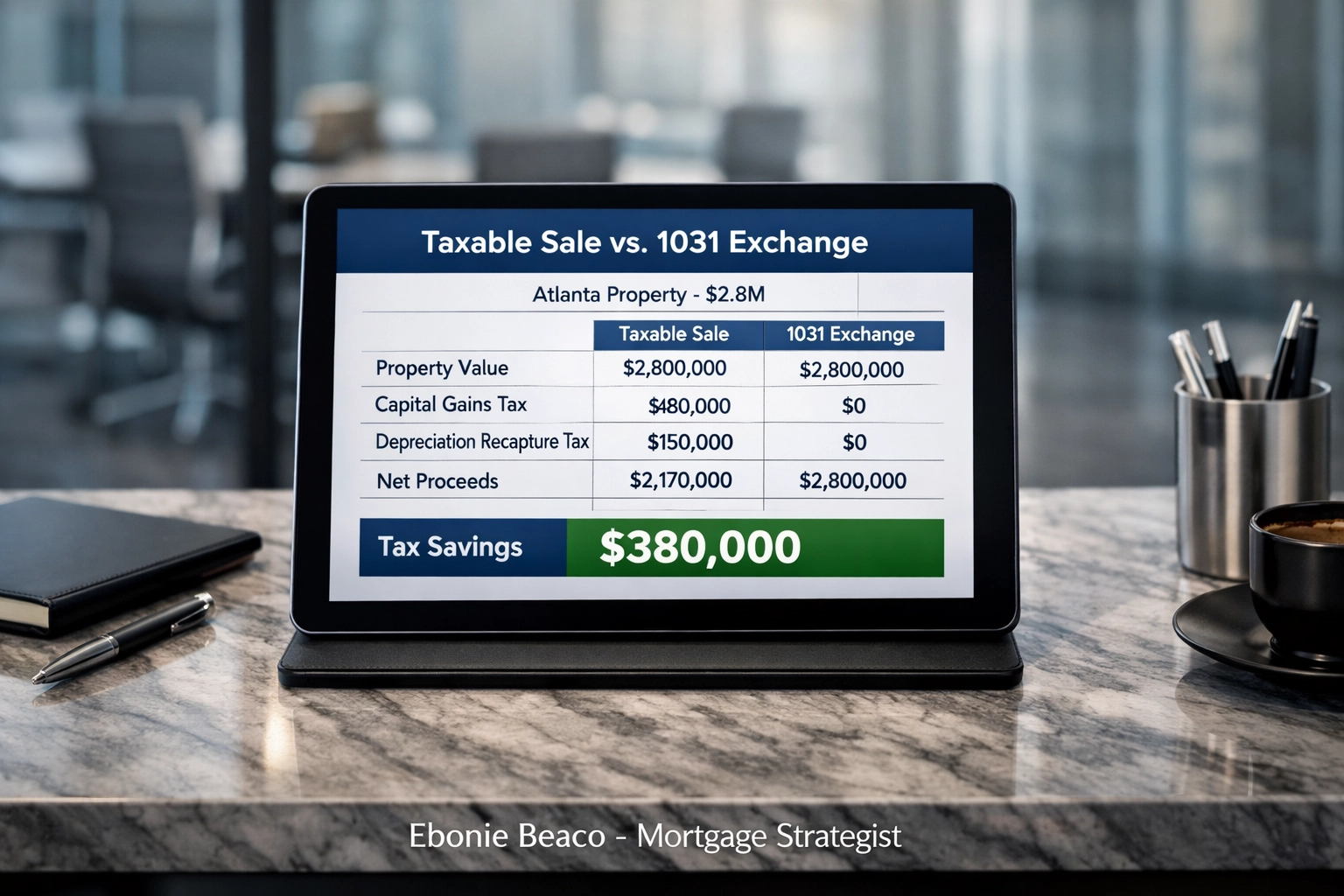 Calculation Image: Table comparing a Taxable Sale vs. 1031 Exchange for a $2.8M Atlanta Property. Shows $380,000 in tax savings. Ebonie Beaco - Mortgage Strategist
The 45-Day Cliffhanger
The biggest challenge with a 1031 Exchange is the timeline. The IRS is not generous with their deadlines. Once you close the sale of your 12-unit building (the relinquished property), a clock starts ticking.
- The 45-Day Identification Period: You have exactly 45 days to identify up to three potential replacement properties. If you miss this window by even one hour, the exchange fails, and the tax bill becomes due immediately.
- The 180-Day Closing Period: You must close on your new property within 180 days of the sale of the first one.
This is why having a mortgage strategist on your side is critical. We do not just wait for you to find a property; we help you get your financing lined up in advance so you can close with confidence. Whether you are looking at DSCR Investor Loans or traditional commercial financing, speed is your best friend in a 1031.
Why Atlanta Multi-Family is Perfect for This Move
The Atlanta market is unique. We have high demand for housing but aging inventory in certain sectors. A 1031 Exchange allows you to trade up from a management intensive 12-unit building into a more modern 36-unit or 48-unit complex where you can afford professional property management.
This is the key to scaling. You stop being a landlord and start being a portfolio owner. You move your equity from an asset that has reached its peak appreciation into one that has room for value-add improvements.
Rules You Cannot Break
To keep the IRS happy and keep your cash in your portfolio, you must follow these rules:
- Equal or Greater Value: The new property must be worth as much or more than the one you sold.
- Equal or Greater Debt: You must replace the debt you had on the old property. If you had an $800,000 loan, your new loan should be at least $800,000.
- Qualified Intermediary: You cannot touch the money. A third-party "Qualified Intermediary" must hold the funds from the sale until they are wired to the closing table for the new property.
- Investment Intent: Both properties must be held for investment or use in a business.
Financing Your Next Move
Scaling from 12 units to a larger commercial residential mix or a 48-unit complex requires a different type of financing than a single-family home. Many of my clients utilize DSCR rental property loans because they focus on the income generated by the property rather than the investor's personal income.
If your new property needs a bit of work to reach its full potential, we might even look at Fix and Flip Loans or bridge financing to get the deal closed quickly before refinancing into a long-term Fixed Rate Mortgage.
Understanding the Loan Process is essential for any investor looking to make a big move. You need to know exactly how much leverage you can get before you start your 45-day identification clock.
 Visual Image: A realistic, high-quality landscape photo of a modern multi-family apartment building in Atlanta with a diverse group of professional investors walking in front. Title: Why Your Atlanta Multi-Family Empire is Leaking Cash: The 1031 Strategy. Ebonie Beaco - Mortgage Strategist
Stop the Leak Today
If you own a multi-family property in Atlanta, you are sitting on a powerful engine of wealth. But that engine is only as good as the fuel you put in it. If you are letting $300,000 or $400,000 leak out in taxes every time you want to grow, you will never reach the level of the major portfolio owners.
The 1031 Exchange is not just a tax loophole; it is a growth strategy. It is the tool that allows a small landlord to become a regional powerhouse.
Don't let your equity sit stagnant while the market moves around you. Let's look at your portfolio, run the numbers, and see if a 1031 Exchange is the right move for your next phase of growth. You can start by checking out our Mortgage Calculators to see how different loan amounts might affect your cash flow.
The Atlanta market is not waiting for anyone. The investors who win are the ones who understand how to use debt and tax strategy to their advantage.
Let's build your Atlanta legacy.
Scedule a 1 on 1 at https://calendly.com/homeloansnetwork
Ebonie Beaco Mortgage Strategist | Senior Loan Officer Home Loans Network powered by Loan Factory Inc. NMLS #2389954 HomeLoansNetwork.com 312-392-0664