Why Real Estate is the Best Tax Shelter: Depreciation and More

When you look at the wealth of the most successful investors in states like Florida, California, and Illinois, you’ll notice a common thread: they love real estate. It isn’t just because houses provide a roof over someone’s head or because rental checks arrive on the first of the month. A massive part of the appeal is the way the tax code is written. In the United States, real estate is widely considered the ultimate tax shelter.
If you are a homeowner in Chicago, a landlord in Virginia, or someone looking to flip their first house in Michigan, understanding the tax advantages of your property is just as vital as finding the right mortgage. At Home Loans Network, we believe transparency about the "hidden" benefits of property ownership helps you make better long-term financial decisions.
What Exactly is a Tax Shelter?
Before we dive into the weeds, let's define the term. A tax shelter is a legal strategy or financial arrangement used by individuals or corporations to minimize their taxable income and, therefore, their tax liability.
Real estate functions as a shelter because the IRS allows you to deduct various expenses and "paper losses" against the income the property generates. In many cases, these deductions can even offset income from other sources, like your W-2 job, depending on your investor status. Explore how these strategies apply to your specific portfolio by visiting our mortgage basics page.
The Power of Depreciation: Your Best "Paper" Friend
The most powerful tool in the real estate investor's shed is depreciation. This is a non-cash deduction that reflects the "wear and tear" of a building over time. Even if your property is actually increasing in value (appreciating) in a hot market like Atlanta or Miami, the IRS assumes the structure is slowly wearing out and allows you to write off a portion of its value every year.
How Depreciation Works for Residential Property
For residential rental properties, the IRS has set a "useful life" of 27.5 years. This means you can deduct roughly 3.636% of the building's value every single year. Note that you cannot depreciate the land: only the structure itself.
Let's look at a real-world example. Imagine you purchase a rental property in Indianapolis for $450,000. After an appraisal, it’s determined that the land is worth $50,000 and the house itself is worth $400,000.
The Calculation:
- Property Value: $450,000
- Land Value (Non-depreciable): $50,000
- Depreciable Basis (The House): $400,000
- Recovery Period: 27.5 Years
- Annual Depreciation Deduction: $400,000 / 27.5 = $14,545.45
 Image Description: A professional financial chart titled "Tax Benefits of Investing". It shows the calculation: $400,000 Basis divided by 27.5 Years equals $14,545.45 Annual Deduction. At the bottom, it reads: "Ebonie Beaco - Mortgage Loan Officer". The visual style is clean, using geometric shapes to represent the property and land portions without using any cash or money symbols.
Every year for nearly three decades, you get to tell the IRS that you "lost" over $14,500 in value, even if you collected $30,000 in rent and the house is now worth $500,000. This deduction can turn a cash-flow positive property into a "tax loss," effectively allowing you to keep your rental income without paying immediate income tax on it.
Mortgage Interest: The Primary Deduction for Homeowners and Landlords
Whether you are living in the home or renting it out, mortgage interest is a significant deduction. For homeowners, this is often one of the largest itemized deductions available. For investors, it is a business expense that reduces the taxable net income of the property.
In high-interest environments, this deduction carries a lot of weight. If you are considering a Cash-Out Refinance to pull equity from a property in California to buy another in Arkansas, the interest on that new debt is generally deductible as well. You can see how this impacts your monthly bottom line by using our mortgage calculators.
Deductible Operating Expenses
Operating a rental property comes with costs, and almost all of them are tax-deductible. This includes:
- Property Taxes: Local taxes paid to the city or county.
- Insurance: Premiums for landlord policies or homeowners' insurance.
- Repairs and Maintenance: Fixing a leaky roof in Detroit or painting a unit in Virginia Beach.
- Management Fees: If you hire a property manager to handle your tenants.
- Advertising: Costs to list your property on rental sites.
- Travel: In some cases, the cost of traveling to inspect your out-of-state investments in Kentucky or Missouri can be deducted.
By keeping meticulous records, landlords can significantly lower their "on-paper" profit, keeping more money in their pockets to reinvest in new acquisitions. If you are curious about how lenders view these expenses during the loan process, jump in and read about our loan process here.
The 1031 Exchange: Deferring Gains Forever
What happens when you want to sell a property that has appreciated significantly? Normally, you’d owe capital gains taxes. However, real estate offers a unique escape hatch called the 1031 Exchange.
Named after Section 1031 of the Internal Revenue Code, this allows an investor to sell a property and reinvest the proceeds into a "like-kind" property while deferring all capital gains taxes. Many investors use this strategy to "trade up" from a single-family home to a small multi-family building, or from a duplex to a larger apartment complex.
As long as you follow the strict timelines (45 days to identify a new property and 180 days to close), you can keep rolling your gains into larger and larger assets without giving a cut to the IRS. This is a primary strategy for those scaling portfolios in growing markets like Georgia or Alabama.
Capital Gains Exclusion for Homeowners
If you aren't an investor but a homeowner, you still have access to one of the best tax breaks in the tax code: the Section 121 exclusion.
If you have lived in your home as your primary residence for at least two of the last five years, you can exclude up to $250,000 (if single) or $500,000 (if married filing jointly) of the gain from the sale of your home from your taxable income. For homeowners in expensive markets like Los Angeles or Northern Virginia, this can represent hundreds of thousands of dollars in tax-free wealth.
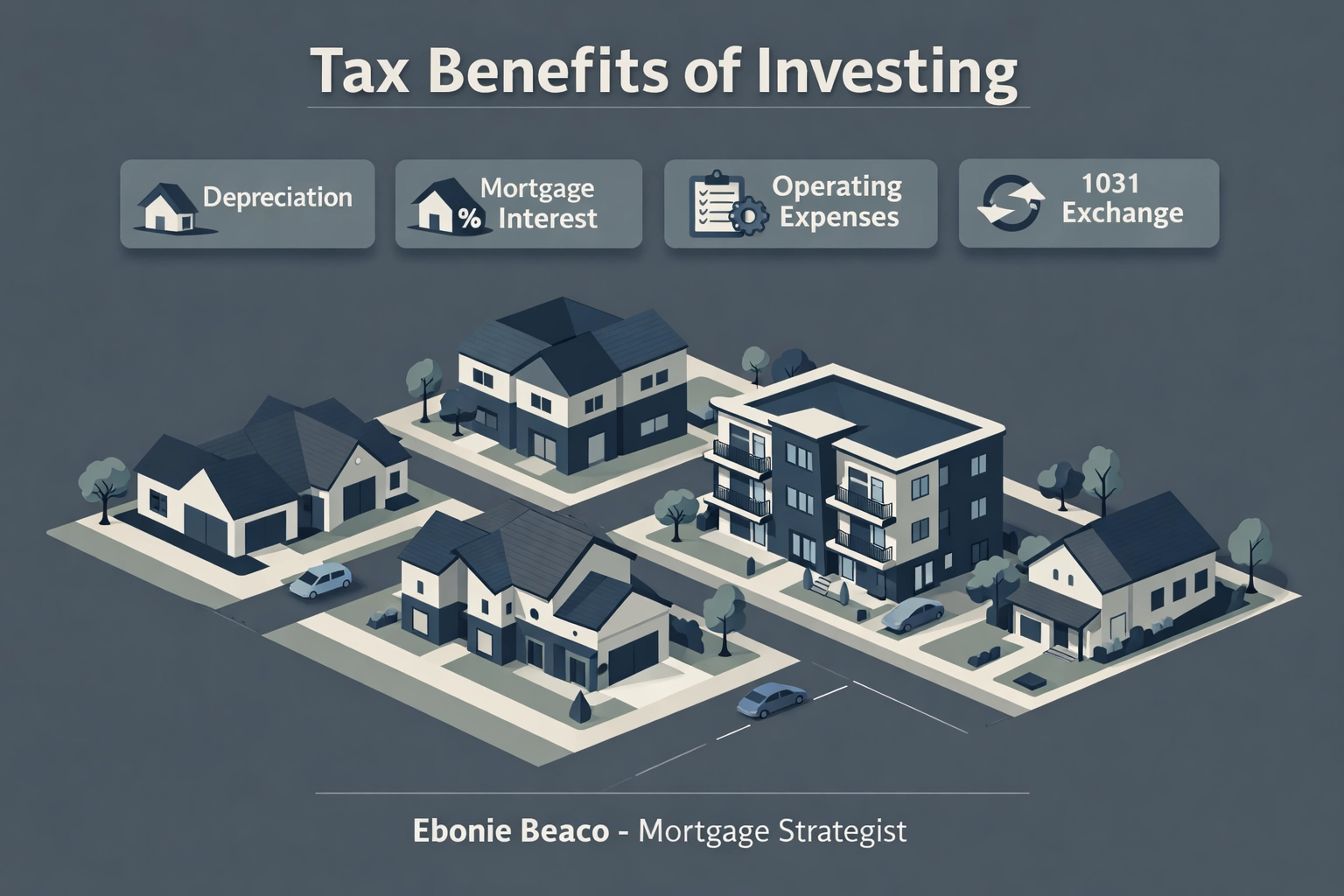 Image Description: A clean, hierarchical infographic titled "Tax Benefits of Investing". It lists: 1. Depreciation (27.5 Year Rule), 2. Mortgage Interest Deduction, 3. Operating Expense Write-offs, and 4. 1031 Exchange Deferrals. At the bottom, it reads: "Ebonie Beaco - Mortgage Loan Officer". No currency symbols are used.
Passive Losses and the "Real Estate Professional" Status
For most people, rental income is considered "passive," and losses from rental real estate can only offset income from other passive activities. However, if you or your spouse qualify as a Real Estate Professional (based on the number of hours spent on real estate activities), you may be able to use your real estate "losses" (largely generated by depreciation) to offset your active W-2 income.
This is a game-changer for high-income earners. It is one of the reasons why doctors, lawyers, and tech professionals often transition into full-time real estate investing or ensure their spouse qualifies for this status. It allows them to use a property in Florida to lower the tax bill on their salary earned in Chicago.
Financing Your Tax-Efficient Portfolio
Understanding the tax code is one half of the battle; having the right financing is the other. At Home Loans Network, we specialize in helping investors find the right tools to build their portfolios.
For example, many of our clients utilize DSCR (Debt Service Coverage Ratio) Loans. These loans focus on the income generated by the property rather than your personal income. When you combine a DSCR loan with a smart depreciation strategy, you are building a wealth-generating machine that is highly protected from tax erosion. Access more information about these specialized programs on our FAQ page.
Whether you are looking for Landlord Loans in Michigan, Short-Term Rental Financing in the Florida Panhandle, or a HELOC to access equity in your Virginia home, the goal is always the same: maximize your return and minimize your liability.
Strategic Thinking for Long-Term Wealth
The beauty of real estate is that it allows you to build equity in an asset while the government essentially incentivizes you to do so. By the time you account for depreciation, interest deductions, and operating costs, many investors find that their "taxable" income is near zero, even though their bank account is growing every month.
It is important to consult with a qualified tax professional to ensure you are maximizing these benefits based on your specific situation. Every state, from Indiana to California, has its own nuances, but the federal benefits of depreciation remain a constant pillar of real estate wealth.
If you are ready to take the next step in your investing journey or want to see how much equity you can unlock from your current home to start your portfolio, we are here to guide you clearly and confidently.
Maximize your real estate returns. Contact Ebonie Beaco for mortgage financing that aligns with your goals.
Schedule a 1 on 1 at https://calendly.com/homeloansnetwork
Ebonie Beaco Mortgage Strategist | Senior Loan Officer Home Loans Network powered by Loan Factory Inc. NMLS #2389954 HomeLoansNetwork.com 312-392-0664