Why Everyone from Florida to Michigan is Obsessed with HELOCs Right Now (And Why You Might Be Too Late)

The landscape of American homeownership has shifted dramatically over the last few years.
If you live in Florida, Michigan, Virginia, or Georgia, you have likely noticed your home value climbing to heights that seemed impossible a decade ago.
This surge in value has created a massive reservoir of "sleeping" wealth.
Homeowners across the country are currently sitting on trillions of dollars in tappable equity, and the Home Equity Line of Credit (HELOC) has become the primary tool to unlock it.
Whether you are a seasoned landlord in Chicago or a first-time homeowner in Richmond, understanding how to leverage this equity is the difference between stagnant wealth and a scaling portfolio.
Explore why this financial tool is dominating the market and why the window to secure one at favorable terms might be closing faster than you think.
The Secret Surge: Why Your Neighbors are Tapping Equity
For a long time, the standard move for accessing cash was a cash-out refinance.
However, since most homeowners locked in historically low primary mortgage rates between 2020 and 2022, nobody wants to touch their first mortgage.
Enter the HELOC.
HELOC (Home Equity Line of Credit): A revolving credit line secured by the equity in your home that allows you to borrow, repay, and borrow again.
Practical Application: It functions like a credit card with a much lower interest rate, allowing you to access cash without losing the 3% interest rate on your primary mortgage.
From the coastal markets of Florida to the industrial hubs of Michigan, the HELOC is being used as a strategic "second layer" of financing.
Homeowners are using these funds for everything from high-end kitchen renovations to funding the down payment on a second investment property.
The Florida Appreciation Trap: Is Your Equity Safe?
Florida has seen some of the most aggressive home price appreciation in the nation.
Investors and homeowners in cities like Miami, Tampa, and Orlando are sitting on six-figure equity gains.
But there is a catch.
As property values rise, so does the risk of a market correction.
Lenders are starting to look at high-appreciation markets with a more critical eye.
If you wait until the market "cools off," your appraisal might come in lower than expected, shrinking your available credit line.
Tapping into your equity now ensures you "lock in" those gains while the market is still at its peak.
Many Florida investors are currently using HELOCs to transition into DSCR (Debt Service Coverage Ratio) loans for rental acquisitions, effectively using their primary residence to build a real estate empire.
Jump in to learn more about our loan programs and how they pair with equity strategies.

Why a Michigan HELOC Lender is Seeing a Rush
The story in Michigan is slightly different but equally compelling.
While Florida is driven by massive migration, Michigan homeowners are seeing steady, reliable growth in equity.
As a Michigan HELOC lender, we are seeing a trend where homeowners in Detroit, Grand Rapids, and Ann Arbor are using equity to modernize older homes.
By using a HELOC to renovate a "fixer-upper" primary residence, these homeowners are essentially forcing even more appreciation.
CLTV (Combined Loan-to-Value): The total of all loans on a property divided by the property’s appraised value.
Practical Application: Lenders typically allow a CLTV of 80% to 90%, determining how much "room" you have to borrow against your home.
If your home is worth $350,000 and you owe $200,000, an 85% CLTV limit means you could potentially access a line of credit for nearly $97,500.
The Virginia Strategy: Scaling Portfolios in the DMV
In Virginia, particularly near the D.C. metro area, the cost of entry for real estate is high.
New investors often struggle to find the 20% to 25% down payment required for an investment property.
As a Virginia HELOC lender, we frequently guide clients on how to use their primary home’s equity to fund that initial down payment.
This is the "bridge" that many people use to move from being a homeowner to being a landlord.
By using a HELOC for the down payment and a DSCR loan for the purchase, you can acquire property with very little of your "liquid" cash out of pocket.
Access our mortgage basics guide to see how these different loan types interact.
The Invisible Threat: Why "Wait and See" is a Dangerous Game
Why might you be too late?
Lending standards are not static.
They fluctuate based on the economy, housing data, and regional risks.
In states like Illinois, Indiana, and Kentucky, we are seeing lenders become more conservative with their debt-to-income (DTI) requirements.
DTI (Debt-to-Income Ratio): Your total monthly debt payments divided by your gross monthly income.
Practical Application: HELOC lenders look at this to ensure you can handle the potential variable payment if you draw the full line of credit.
If the economy shifts or if unemployment ticks up in specific regions like Alabama or Missouri, lenders often pull back on HELOC products first.
They view "second liens" as higher risk than primary mortgages.
If you wait for the "perfect" time, you might find that the equity is there, but the lender's appetite for risk is gone.
How the BRRRR Method is Fueling the HELOC Craze
Real estate investors in Georgia and Arkansas are obsessed with the HELOC for one specific reason: the BRRRR method.
BRRRR: Buy, Rehab, Rent, Refinance, Repeat.
Practical Application: Investors use a HELOC to buy a distressed property for cash, renovate it, and then refinance it into a long-term loan to pay back the HELOC and start over.
This strategy allows investors to scale much faster than those saving up cash from a 9-to-5 job.
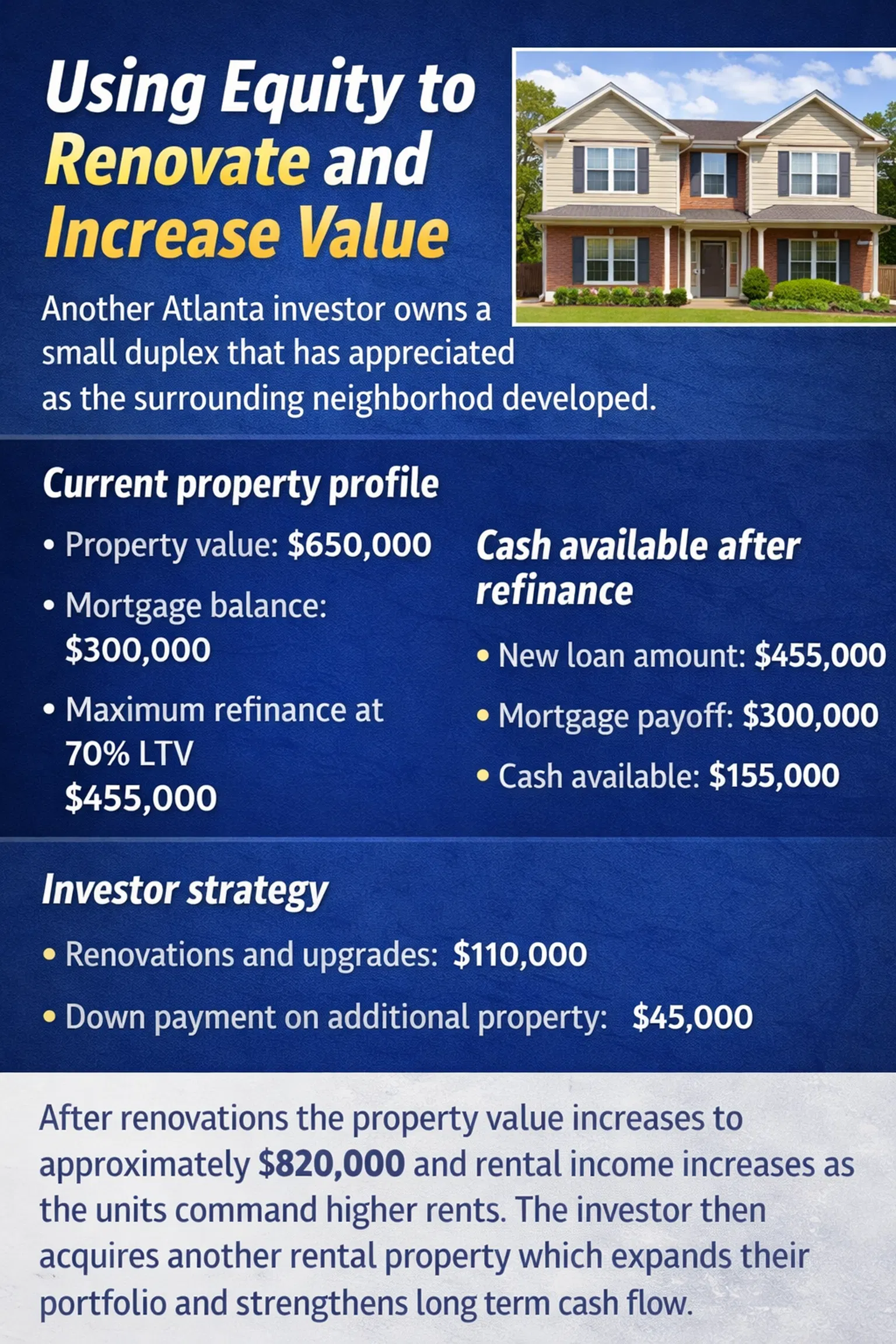
Using a HELOC from a primary residence in Atlanta to fund a fix-and-flip in Savannah is a classic wealth-building move we see daily.
Understanding the "Draw" vs. "Repayment" Period
One reason people hesitate is a lack of understanding regarding how the payments work.
A HELOC is typically split into two distinct phases.
Draw Period: The initial timeframe (usually 10 years) where you can take money out and often only pay interest on what you use.
Practical Application: This keeps your monthly costs low while you are performing renovations or waiting for an investment property to be ready.
Repayment Period: The phase after the draw period ends where you can no longer take out money and must pay back the principal and interest.
Practical Application: It is vital to have an exit strategy, such as selling the property or refinancing, before this period begins.
Compare these phases to a traditional home refinance to see which fits your timeline better.
The Math Behind the Magic: A Real-World Example
Let’s look at a scenario for a homeowner in California or Virginia.
- Current Home Value: $600,000
- Existing Mortgage Balance: $350,000
- Max CLTV (90%): $540,000
- Available HELOC: $190,000 ($540,000 minus $350,000)
With that $190,000 line of credit, the homeowner could:
- Add an ADU (Accessory Dwelling Unit) to their property, creating rental income.
- Use $100,000 as a down payment for a $400,000 rental property in Missouri or Kentucky.
- Keep the remaining $90,000 as an emergency fund for their real estate portfolio.

The Risk of Variable Rates: Don't Get Caught Off Guard
Transparently, HELOCs have a variable interest rate.
This means if the Prime Rate goes up, your payment goes up.
In a volatile economy, this scares some people.
However, savvy investors in California and Illinois use the HELOC as a short-term tool, not a 30-year debt solution.
The goal is to use the money to create a higher return than the interest rate you are paying.
If your HELOC interest is 9%, but the investment property you bought with it is returning 15% in cash flow and appreciation, you are winning.
Is It Too Late for You?
The "obsession" with HELOCs from Florida to Michigan is driven by the realization that home equity is a tool, not just a number on a statement.
Lenders are starting to tighten the screws.
Appraisals are becoming more conservative.
Debt-to-income requirements are getting stricter.
If you have been sitting on the sidelines watching your home value climb, the time to act is while the market is still favorable to borrowers.
Don't let your equity sit idle while the window of opportunity closes.
Whether you are looking to renovate your forever home in Alabama or start your investment journey in Indiana, we can help you navigate the process clearly and confidently.
Explore your options and see if you pre-qualify for a strategy that fits your goals.
Ready to see what your equity can do for you?
Schedule a 1 on 1 at https://calendly.com/homeloansnetwork
Ebonie Beaco
Mortgage Strategist | Senior Loan Officer
Home Loans Network powered by Loan Factory Inc.
NMLS #2389954
HomeLoansNetwork.com
312-392-0664