Wholesaling Real Estate: A Low-Cost Entry into Investing
Wholesaling real estate often serves as the first chapter for many successful investors. If you want to enter the property market but lack the capital for a massive down payment or the credit score required for traditional mortgage basics, wholesaling offers a unique pathway.
In its simplest form, wholesaling is the process of finding a property, usually one that is distressed or undervalued, and placing it under contract. Instead of buying the home yourself, you sell the rights to that contract to another buyer, typically a fix-and-flip investor or a long-term landlord.
This strategy allows you to generate income without ever taking title to the property. It is about speed, negotiation, and building a network.
How the Wholesaling Process Functions
The mechanics of a wholesale deal are relatively straightforward, though they require significant effort and market knowledge.
Identify a Distressed Property You look for homes that are off-market or owners who are highly motivated to sell. These might be houses facing foreclosure in Chicago, properties in probate in Florida, or tired rentals in Virginia.
Secure a Purchase Agreement You negotiate a price with the seller and sign a purchase contract. A critical component of this contract is the assignment clause, which allows you to transfer your interest in the property to someone else.
Find an End Buyer You market the deal to your buyers list. This list usually consists of real estate investors who have the funds or hard money loans ready to close quickly.
Assign the Contract Once you find a buyer, you sign an Assignment of Contract. This document officially transfers your right to purchase the property to the new investor in exchange for an assignment fee.
Close the Transaction The end buyer provides the funds to the title company or attorney. The original seller receives their agreed-upon price, and you receive your assignment fee as the middleman.
Why Wholesaling Appeals to New Investors
Wholesaling is frequently called the "low-cost entry" into real estate because it minimizes the financial barriers that typically stop people from investing.
Minimal Capital Required Unlike a traditional home purchase, you are not putting down 20 percent. Your primary costs involve marketing to find sellers (like direct mail or digital ads) and perhaps a small earnest money deposit to secure the contract.
No Credit Requirements Because you are not the one actually borrowing the money to buy the house, your debt-to-income ratio (DTI) and credit score do not play a role in the initial wholesale transaction.
Educational Foundation Wholesaling teaches you how to analyze deals, talk to sellers, and understand property values in specific markets like Michigan or Georgia. This experience is vital if you eventually want to move into DSCR investor loans for your own rental portfolio.
Calculating the Assignment Fee
To be a successful wholesaler, you must understand the math. If you overestimate the value or underestimate repair costs, you will not find a buyer. The assignment fee is the gap between what you promised the seller and what the end investor is willing to pay.
Most investors use the 70 percent rule as a baseline. This suggests that an investor should pay no more than 70 percent of the After Repair Value (ARV), minus the cost of repairs.
The Assignment Fee Calculation Example
Imagine you find a distressed property in Gary, Indiana.
Property Details:
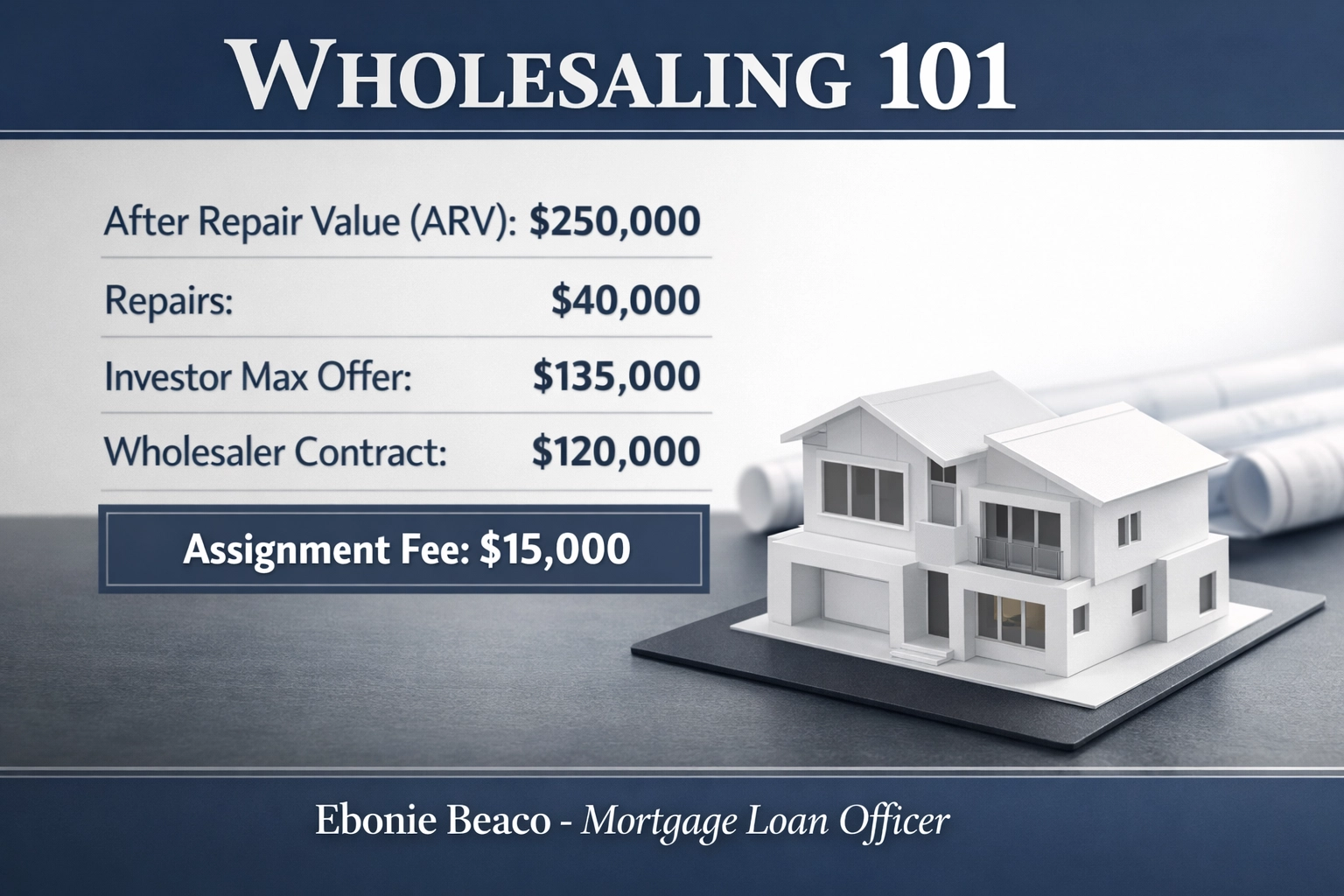
- After Repair Value (ARV): $250,000
- Estimated Repairs: $40,000
- Investor Max Offer (70% of ARV - Repairs): $135,000
If you negotiate with the seller to put the house under contract for $120,000, and you find a fix-and-flip investor willing to pay $135,000, your profit is the difference.
Assignment Fee Breakdown:
- Investor Purchase Price: $135,000
- Wholesaler Contract Price: $120,000
- Assignment Fee: $15,000
In this scenario, you have earned $15,000 for your work in sourcing the deal and connecting the parties. You can use mortgage calculators to help end buyers understand what their potential payments might look like if they eventually transition the property into a long-term rental.
The Role of the Buyers List
Your success depends on who you know. A wholesaler without a buyers list is just someone with a contract they cannot fulfill.
In active markets like Florida or California, you want to build relationships with various types of investors:
- Fix-and-Flip Investors: They want properties with high margins and significant repair needs.
- Buy-and-Hold Landlords: They look for properties in stable neighborhoods that will provide long-term cash flow.
- Turnkey Providers: They buy, renovate, and sell to passive investors.
Building this list requires networking at local real estate investment associations (REIAs) and staying active in professional communities. When you have a solid deal, you should be able to send one email or text and have multiple offers within hours.
Legal and Ethical Considerations
It is important to navigate the legal landscape of wholesaling carefully. Some states have specific regulations regarding how you market these deals.
In certain jurisdictions, if you are not a licensed real estate agent, you must be very clear that you are selling your "equitable interest" in a contract, not the property itself. Always consult with a local real estate attorney in states like Alabama or Arkansas to ensure your contracts are compliant with local laws.
Transparency is a core value here. Being honest with the seller about your intentions is not just ethical; it builds a better reputation for your business long-term. Many sellers are happy to work with wholesalers because they provide a quick, hassle-free exit from a property they no longer want to manage.
Scaling from Wholesaling to Ownership
While wholesaling is a great way to build capital, many investors use it as a stepping stone. The goal for many is to eventually keep the properties they find.
Once you have generated enough assignment fees to serve as a down payment, you can start exploring landlord loans or DSCR rental property loans. Wholesaling gives you the "boots on the ground" experience to recognize a deal that is too good to give away.
For current homeowners who want to start wholesaling or investing, you might even consider a cash-out refinance on your primary residence to create a marketing budget or a fund for your first "wholetail" deal (where you buy the property, do minor cleaning, and list it on the MLS).
Real-World Applications Across the States
The strategy remains the same, but the local market dynamics change:
- In Chicago, Illinois: You might focus on two-unit to four-unit buildings where investors are looking for "house hacking" opportunities or small multifamily additions to their portfolios.
- In Florida and Georgia: The focus might be on aging single-family homes in rapidly growing suburban areas.
- In California: Higher property values mean higher assignment fees, but the competition for deals is significantly steeper.
Wholesaling requires you to be a student of the market. You need to know which zip codes are seeing a "revival" and where the local landlords are currently buying.
Moving Toward Your First Deal
Wholesaling real estate is not a "get rich quick" scheme. It requires consistent marketing, constant communication, and a thick skin for when sellers say no. However, for those willing to put in the effort, it remains one of the most accessible ways to build a career in real estate finance and investment.
By mastering the art of the deal and the math of the assignment fee, you position yourself as a valuable asset to other investors. You become the person who finds the gold that everyone else is looking for.
Whether you are in Kentucky, Missouri, or Indiana, the opportunity to bridge the gap between motivated sellers and hungry investors is always present.
Looking to scale your wholesaling business with mortgage financing? Contact Ebonie Beaco for mentoring and loans.
Scedule a 1 on 1 at https://calendly.com/homeloansnetwork
Ebonie Beaco Mortgage Strategist | Senior Loan Officer Home Loans Network powered by Loan Factory Inc. NMLS #2389954 HomeLoansNetwork.com 312-392-0664