Wholesaling in Indiana: 2026 Rules for Successful Investing

Friday, March 27, 2026
Wholesaling real estate in Indiana has evolved significantly as we move through 2026. The landscape for investors in cities like Indianapolis, Fort Wayne, and Evansville now requires a higher level of transparency and a deeper understanding of consumer protection laws.
If you want to build a sustainable business finding off-market deals and assigning them to cash buyers, you need to know the current playbook. The days of operating in the shadows are over. Today, success is built on clear communication and strict adherence to the Indiana Real Estate Commission guidelines.
Understanding the 2026 Regulatory Environment
Indiana has shifted its focus heavily toward protecting homeowners, particularly those in distressed situations. The 2026 regulations emphasize that a wholesaler is not a broker unless they hold a license. This distinction is the foundation of your entire operation.
You are acting as a principal in a transaction, not an agent for someone else. This means you are marketing your equitable interest in a contract, not the physical bricks and mortar of the property itself.
Explore the mortgage basics to understand how these contracts eventually transition into funded deals for your end buyers.
Key Definitions for Indiana Wholesalers
Equitable Interest: The financial interest a buyer gains in a property once a purchase agreement is signed but before the deed is transferred. Practical Application: This is what you actually own and are legally allowed to sell to another investor without a real estate license.
Assignment of Contract: A legal document that transfers the rights and obligations of a purchase agreement from the original buyer to a new buyer. Practical Application: This allows you to collect a fee for finding the deal and stepping aside so the cash buyer can close.
Double Closing: A transaction where the wholesaler buys the property and immediately sells it to an end buyer in two separate, back-to-back closings. Practical Application: This strategy provides the highest level of privacy regarding your profit margins and is often preferred for high-spread deals.
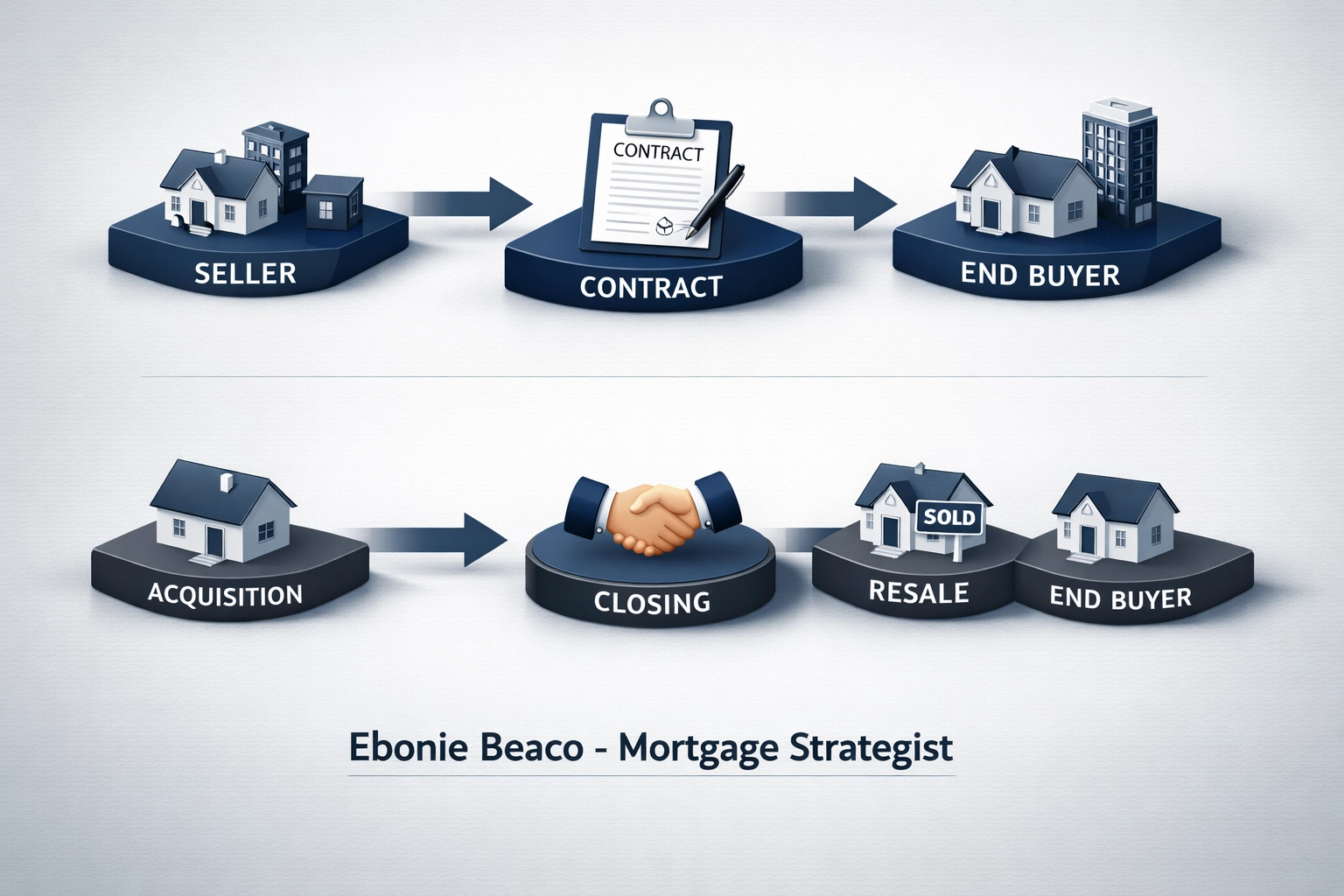 Visual: A diagram showing the flow of an Assignment vs. a Double Closing in an Indiana real estate transaction. Text overlay: "Ebonie Beaco - Mortgage Strategist"
The Golden Rule: Marketing the Right to Purchase
The most common mistake wholesalers make in 2026 is advertising a house they don't own. In Indiana, only the owner of record or a licensed real estate agent can market a property for sale.
As a wholesaler, your marketing must state clearly that you are selling a contract interest. Your flyers, emails, and social media posts should focus on the "assignment of contract" rather than the "house for sale."
Jump in and review our loan process to see how professional investors prep their financing before they ever see your marketing materials.
Transparency in Fee Structures
Indiana’s 2026 consumer protection focus requires absolute clarity regarding how you are getting paid. While you don't always have to disclose your exact fee to the seller in an assignment (depending on the contract language), being transparent builds a better long-term reputation.
Many successful Indiana investors now use a "Transparent Fee Disclosure" form. This document explicitly tells the seller that you intend to make a profit by assigning the contract to an end buyer.
This transparency reduces the risk of legal disputes at the closing table. When everyone knows the plan, the transaction moves faster. If you ever have questions about how these fees impact the buyer's side, you can contact us for a breakdown of investor closing costs.
The Three Primary Wholesaling Strategies
1. Contract Assignment
This remains the most popular method for beginners. You find a motivated seller, sign a purchase agreement with an "and/or assigns" clause, and then find a cash buyer. You charge an assignment fee, and the buyer takes over your position.
2. The Double Close
With a double close, you actually take title to the property for a few minutes. You use a bridge loan or transactional funding to buy the property from the seller (A-B transaction). Then, you immediately sell it to your end buyer (B-C transaction).
3. Buying and Reselling (Wholetailing)
This involves purchasing the property, doing minimal clean-up, and listing it back on the market. This often requires more traditional financing, such as hard money loans or fix and flip financing.
 Visual: A photo of a suburban Indiana home in a neighborhood like Fishers or Carmel. Text overlay: "Ebonie Beaco - Mortgage Strategist"
Calculating Your Maximum Allowable Offer (MAO)
To stay profitable and ensure your cash buyers actually want your deals, you must master the numbers. The MAO formula is the standard tool for Indiana investors.
MAO = (ARV x 70%) - Repairs - Your Fee
- ARV (After Repair Value): What the home is worth fully renovated.
- 70% Rule: A standard buffer used by investors to account for closing costs, holding costs, and profit.
- Repairs: The estimated cost to bring the home to its best condition.
- Your Fee: The amount you want to earn for finding the deal.
Example Scenario:
- ARV: $300,000
- Estimated Repairs: $50,000
- Your Desired Fee: $10,000
- Calculation: ($300,000 x 0.70) = $210,000.
- MAO: $210,000 - $50,000 - $10,000 = $150,000.
In this scenario, your offer to the seller should not exceed $150,000 to remain a viable deal for a fix-and-flip investor.
 Visual: A deal breakdown chart showing the MAO calculation: $300k ARV, $50k Repairs, $10k Fee, $150k Max Offer. Text overlay: "Ebonie Beaco - Mortgage Strategist"
Building a Compliant Cash Buyers List
Your success in wholesaling depends on your ability to move contracts quickly. In 2026, cash buyers are looking for wholesalers who understand the financing side of the business.
Many of these buyers will eventually move their properties into long-term rentals using DSCR investor loans. If you understand how a DSCR rental property loan works, you can better explain the value of your deal to a potential landlord.
Compare different loan programs so you can speak the same language as your sophisticated buyers.
Common Compliance Pitfalls to Avoid
- Marketing without a contract: Never advertise a property unless you have a signed purchase agreement that gives you equitable interest.
- Representing the seller: Do not give the seller legal or financial advice. Refer them to an attorney or a licensed professional.
- Vague contract terms: Ensure your "right to assign" is clearly stated in the contract to avoid breach of contract claims.
- Handling Earnest Money: Always use a neutral third party, like a title company, to hold earnest money deposits.
Access our FAQ for more insights on how real estate transactions are structured to stay within state guidelines.
Scaling Your Wholesaling Business
Once you have mastered the basics of assignment, you might find yourself wanting to take down deals yourself. This is where moving from a wholesaler to a "fix and flipper" or a "buy and hold" investor happens.
Transitioning requires a shift in financing strategy. You might look into cash out refinance options to use equity from your personal home or other investments to fund your next purchase.
Access the mortgage calculators to see how much equity you could potentially leverage for your next Indiana investment.
Final Thoughts for Indiana Investors
Wholesaling in Indiana in 2026 is a professional pursuit. It requires a commitment to transparency and a deep understanding of contract law. By focusing on consumer protection and clear fee structures, you position yourself as a leader in the local market.
Whether you are working in the busy streets of Indianapolis or the growing suburbs of Northwest Indiana, the principles remain the same: market the contract, disclose your role, and know your numbers.
 Visual: A professional investor reviewing a contract on a tablet in a modern Indiana office setting. Text overlay: "Ebonie Beaco - Mortgage Strategist"
If you are ready to take the next step in your real estate journey, whether that means financing your first rental or securing a bridge loan for a double close, I am here to help.
Scedule a 1 on 1 at https://calendly.com/homeloansnetwork
Ebonie Beaco
Mortgage Strategist | Senior Loan Officer
Home Loans Network powered by Loan Factory Inc.
NMLS #2389954
HomeLoansNetwork.com
312-392-0664
Ebonie Beaco - Mortgage Strategist