Wholesale Closing Secrets Revealed: What Experts Don't Want You to Know About Assignment Fees

Real estate wholesaling is often described as the "fast track" to wealth, but the actual logistics of getting paid remain shrouded in mystery.
Many gurus suggest that you simply find a property and collect a check, yet they rarely explain the mechanics of the assignment of contract or how to navigate the closing table without losing your profit.
If you are operating in high-velocity markets like Atlanta, Los Angeles, or Miami, understanding these "hidden" layers is the difference between a $2,000 fee and a $20,000 payday.
Explore the inner workings of wholesale closings and discover how savvy investors protect their interests across California, Florida, and Georgia.
Decoding the Wholesale Real Estate Contract
At its core, a wholesale transaction relies on the legal transfer of rights from one party to another.
Real Estate Wholesale Contract: A legally binding agreement where a wholesaler secures a property under contract and subsequently sells the rights of that contract to an end buyer.
This document serves as the foundation for your legal claim to an equitable interest in the property.
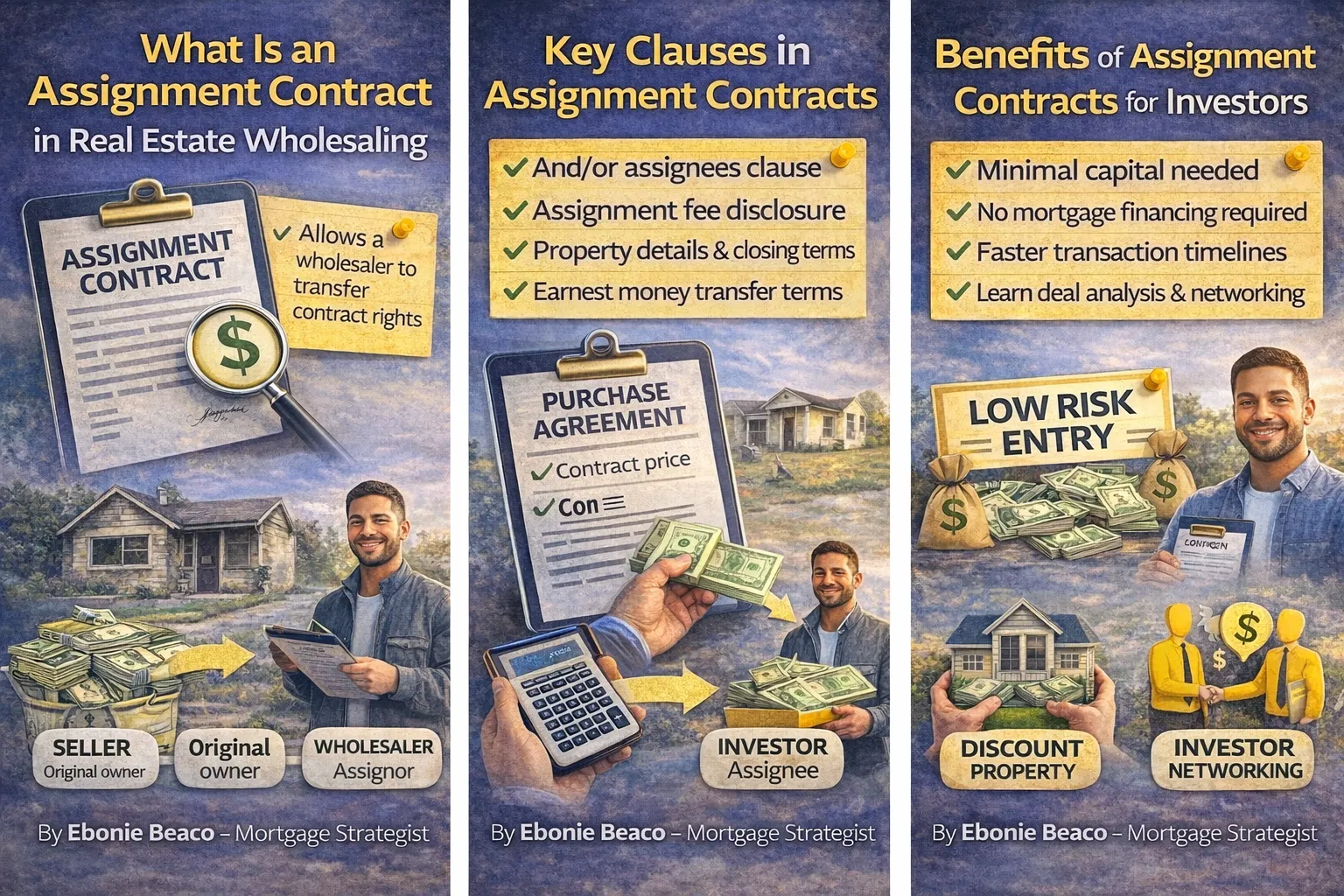
Assignment of Contract: A legal clause or separate document that transfers the wholesaler's rights and obligations to a third-party investor.
Using this mechanism allows you to exit the deal before the actual deed transfer occurs.
When you structure these deals, you must ensure your original purchase agreement includes the phrase "and/or assigns."
Without this specific language, you may find yourself legally obligated to purchase a property you cannot afford.
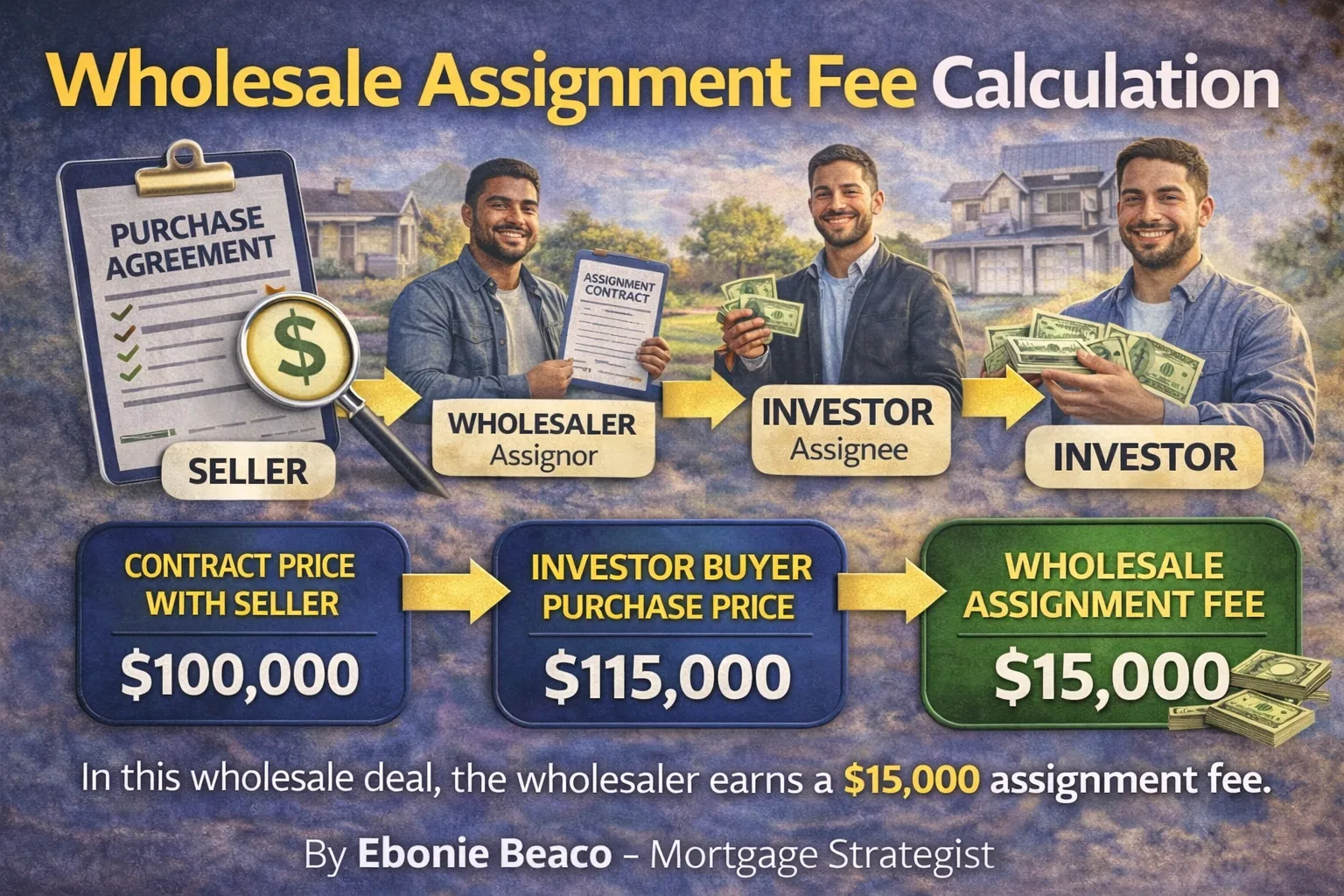
The Truth About Assignment Fees
The assignment fee is the lifeblood of the wholesaler, yet it is also the most scrutinized part of the transaction.
Assignment Fee: The profit a wholesaler earns for finding a deal and connecting the seller with a cash buyer.
You calculate this by taking the difference between the price you negotiated with the seller and the price the end buyer agrees to pay.
Equitable Interest: The legal right to obtain full ownership of a property based on a signed contract.
This interest is what you are actually selling, rather than the physical bricks and mortar.
How Experts Hide the Numbers
One "secret" that many veteran wholesalers use is the double closing strategy.
In a standard assignment, the end buyer sees exactly how much you are making on the HUD-1 settlement statement.
If your fee is $30,000 on a $100,000 house, a cash buyer might feel you are overcharging and try to negotiate your fee down at the last minute.
To prevent this, wholesalers in states like Illinois or Virginia often use a double closing.
Double Closing: Two separate real estate transactions occurring back-to-back where the wholesaler briefly takes ownership of the property.
This method keeps your profit confidential because the original seller and the end buyer never see each other's settlement statements.
Navigating Logistics in California, Florida, and Atlanta
Each market has its own set of cultural and legal expectations when it comes to wholesaling.
Atlanta, Georgia: The High-Volume Hub
Atlanta remains one of the most active wholesaling markets in the country.
Investors here often focus on DSCR investor loans for their end buyers to ensure the deal closes quickly.
Explore DSCR options here.
Florida: The Transparency State
In Florida, title companies are very familiar with wholesale transactions, but disclosure is key.
Many wholesalers in Miami or Tampa prefer to use "Assignment Fee Advances" to get paid faster.
California: The High-Stakes Market
With property values in California being significantly higher, a 5% assignment fee can result in a massive payday.
However, higher prices mean higher Earnest Money Deposits (EMD) are often required to be taken seriously by sellers.

Understanding the Financial Calculations
To be a successful wholesaler, you must master the numbers better than the end buyer.
Let's look at a typical deal breakdown for a property in Richmond, Virginia:
- Contract Price with Seller: $200,000
- Estimated Repairs (REHAB): $50,000
- After Repair Value (ARV): $350,000
- Investor's Max Allowable Offer (MAO): $230,000 (Calculated as 70% of ARV minus repairs)
- Your Assignment Fee: $30,000 ($230,000 - $200,000)

In this scenario, the investor uses a Fix and Flip Loan to fund the $230,000 purchase and the $50,000 renovation.
You can compare mortgage calculators to help your buyers understand their potential ROI.
The Secret "Go for No" Strategy
Experts often use a psychological tactic called "Go for No" during fee negotiations.
Most wholesalers are afraid to ask for a $25,000 fee because they fear rejection.
By aiming for a "no," you push the boundaries of what the buyer is willing to pay.
If you ask for $40,000 and they say "no," you have started the negotiation at a much higher floor than if you asked for $10,000 initially.
Jump in and test your market's ceiling; you might find that investors in Chicago or San Diego are more concerned with the deal's equity than your specific profit margin.
Why Some Wholesalers Fail at the Finish Line
The closing process is where most deals fall apart due to poor logistics.
Earnest Money Deposit (EMD): A sum of money provided by the buyer to demonstrate their "good faith" in completing the transaction.
If your end buyer does not put down a non-refundable EMD, they can walk away, leaving you stuck with the original contract.
Title Search: An examination of public records to confirm the legal ownership of a property and identify any liens or encumbrances.
Access a reliable title company early in the process to ensure there are no surprises that could delay your assignment of contract.
Scaling Your Wholesaling Business
Once you understand the mechanics of assignment fees, your goal should shift to velocity.
Instead of trying to hit a "home run" on every deal, focus on closing 3 to 5 deals per month.
Successful wholesalers in Michigan and Arkansas often transition into becoming "Wholetailers."
Wholetailing: Purchasing a property, doing minimal "trash out" or cleanup, and then immediately listing it on the MLS for a higher price.
This strategy often requires a Bridge Loan or a Hard Money Loan to cover the brief holding period.
Learn more about bridge financing.
Protecting Your Reputation
In the world of real estate, your reputation is your most valuable asset.
Transparent wholesalers often find that they build a "Buyer's List" that will close on any deal they present.
If you are working with investors who use BRRRR (Buy, Rehab, Rent, Refinance, Repeat) strategies, they need to know that your numbers are accurate.
Providing a detailed deal analysis can help build this trust.
Check out our real estate deal analyzer tools to provide professional-grade data to your buyers.
Final Logistics Check
Before you head to your next closing in Virginia or Kentucky, ensure you have:
- A fully executed Real estate wholesale contract.
- A signed Assignment of contract with your end buyer.
- Confirmation that the end buyer's EMD is held by the title company.
- A clear understanding of whether you are doing a standard assignment or a double closing.
If you need guidance on how your buyers can secure funding to close your deals faster, we can help.
Access our FAQ page for more insights on investor financing.

Wholesaling is a powerful way to enter the real estate market without significant capital.
By mastering the logistics of assignment fees and the nuances of the closing table, you position yourself as a professional strategist rather than just a middleman.
Schedule a 1 on 1 to discuss financing strategies for your next deal:
https://calendly.com/homeloansnetwork
Ebonie Beaco
Mortgage Strategist | Senior Loan Officer
Home Loans Network powered by Loan Factory Inc.
NMLS #2389954
HomeLoansNetwork.com
312-392-0664