What is a Hard Money Loan? Speedy Financing Tips

Real estate moves at a lightning pace.
If you are eyeing a distressed property in Chicago or a quick fix-and-flip in Atlanta, you know that waiting 45 days for a traditional bank approval usually means losing the deal.
That is where hard money enters the picture.
Think of hard money as a specialized tool in your investment toolbox.
It is not a permanent solution, but for the right project, it is the bridge that gets you from a "For Sale" sign to a profitable exit.
Defining the Hard Money Loan
A hard money loan is a short-term, asset-based loan secured by real estate.
Unlike a traditional mortgage where a lender spends weeks digging into your tax returns and debt-to-income (DTI) ratios, hard money lenders look primarily at the value of the property itself.
We call this "asset-based lending."
The "hard" in hard money refers to the hard asset: the property: backing the loan.
These loans typically come from private investors or specialized lending companies rather than big-box banks.
Why Investors Choose Hard Money Over Banks
You might wonder why someone would choose a loan with higher interest rates than a standard 30-year fixed mortgage.
The answer is simple: Speed and flexibility.
Traditional lenders have strict guidelines set by government-sponsored entities.
If a house is missing a kitchen or has a hole in the roof, a traditional bank will not touch it.
Hard money lenders, however, specialize in these types of "distressed" properties.
They understand that the property is a diamond in the rough.
Explore more about the mortgage basics to see how these differ from standard products.
The Core Characteristics of Hard Money
Before you jump in, you need to understand the mechanics of these loans.
They do not function like the mortgage on your primary residence.
1. Interest Rates and Costs
Expect to see interest rates ranging from 8% to 12%, and sometimes higher depending on the risk.
Lenders also charge "points" (origination fees) upfront, often between 1% and 3% of the loan amount.
2. Loan-to-Value (LTV) and ARV
Lenders focus on the Loan-to-Value (LTV) or, more commonly for investors, the After Repair Value (ARV).
They might lend you 70% to 75% of what the home will be worth once it is fully renovated.
3. Short Repayment Terms
These are not 30-year loans.
Most hard money terms last between 6 and 24 months.
They are designed to be paid off quickly, either by selling the property or refinancing into a long-term landlord loan.
4. Interest-Only Payments
Most of these loans are structured as interest-only.
This keeps your monthly carrying costs lower while you focus your capital on the renovation.
How the Process Works
The application process is significantly streamlined.
You find a property, submit a basic application, and provide a "scope of work" detailing the planned renovations.
The lender orders an appraisal or a Broker Price Opinion (BPO) to verify the current and future value.
Because the focus is on the asset, closing can happen in as little as 5 to 10 days.
This speed allows you to compete with all-cash buyers in competitive markets like Florida or California.
Real-World Example: The Fix-and-Flip Calculation
Let’s look at how the numbers actually break down in a typical investment scenario.
Imagine you find a property in Virginia for $200,000 that needs $50,000 in work.
After the repairs, the home will be worth $350,000.
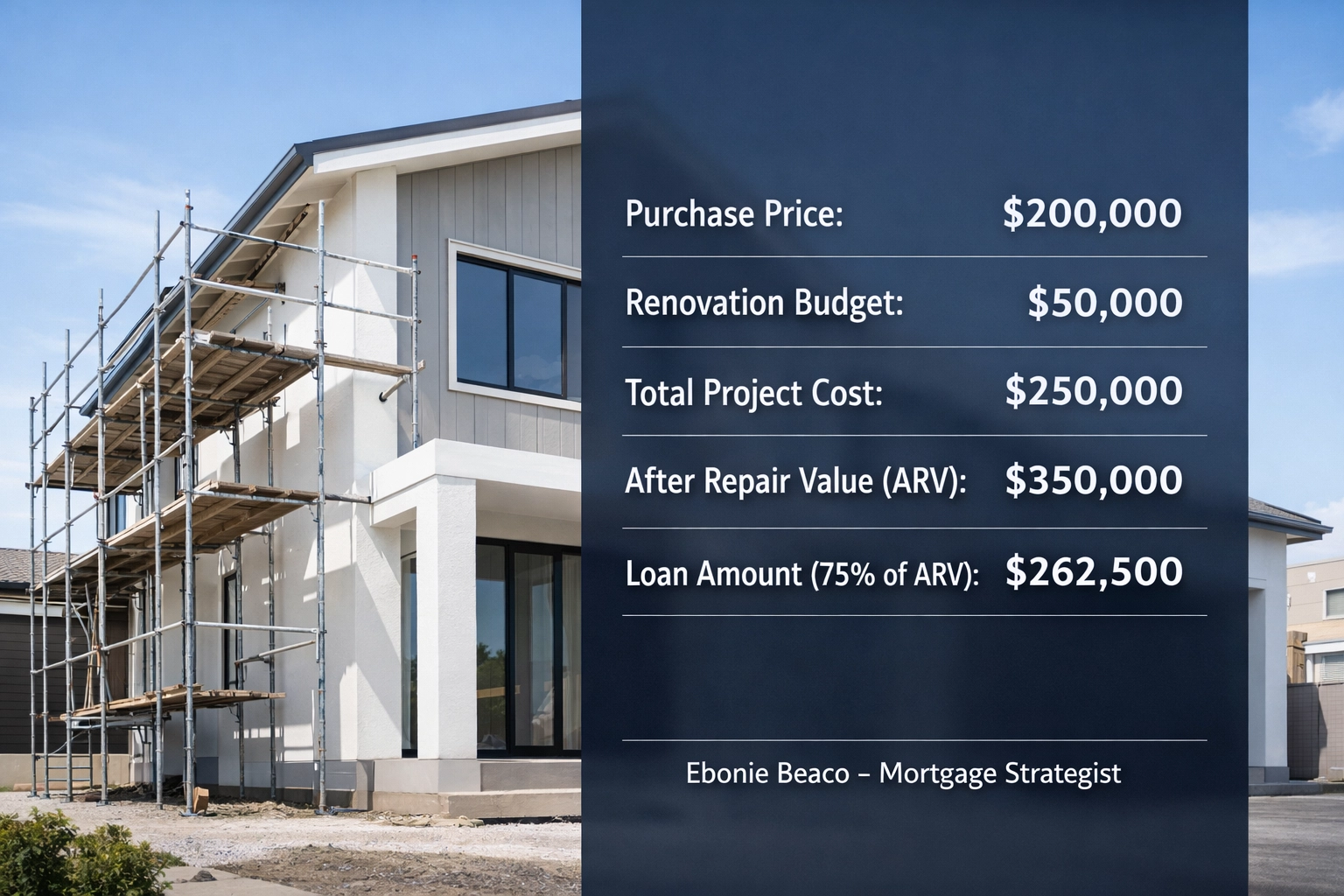 Title: What is a Hard Money Loan? Breakdown
Calculation:
Purchase Price: $200,000
Renovation Budget: $50,000
Total Project Cost: $250,000
After Repair Value (ARV): $350,000
Loan Amount (75% of ARV): $262,500
Ebonie Beaco - Mortgage Loan Officer
Title: What is a Hard Money Loan? Breakdown
Calculation:
Purchase Price: $200,000
Renovation Budget: $50,000
Total Project Cost: $250,000
After Repair Value (ARV): $350,000
Loan Amount (75% of ARV): $262,500
Ebonie Beaco - Mortgage Loan Officer
In this scenario, the hard money loan covers the entire purchase and the renovation budget.
You would only need to bring the closing costs and the interest payments to the table.
Access our mortgage calculators to run your own scenarios.
When Should You Use Hard Money?
Hard money is not for every situation.
It is a high-cost capital source that requires a clear "exit strategy."
Fix-and-Flip Projects
This is the most common use. You buy, renovate, and sell within a year.
The BRRRR Strategy
Buy, Rehab, Rent, Refinance, Repeat.
Investors use hard money to buy and fix the property, then refinance into a DSCR loan once a tenant is in place.
Bridge Financing
If you are moving from one investment to another and your capital is tied up, a hard money "bridge" loan can fill the gap.
Distressed Property Purchases
If a property is in foreclosure or needs major structural repairs, hard money is often the only way to secure the deal.
Hard Money in Specific Markets
Different regions have different vibes for real estate investing.
In Alabama and Arkansas, where entry prices are lower, hard money can help you scale a portfolio of rental homes quickly.
In Michigan and Indiana, investors often use these loans to revitalize older neighborhoods.
In higher-priced markets like Florida, Georgia, and Illinois, the speed of hard money is the competitive advantage you need to secure a contract over someone using traditional financing.
Regardless of where you are, the goal is to use the loan to create value.
Check out our about us page to learn how we help investors across these states.
The Risks to Consider
Because these loans are expensive, you must move fast.
If your renovation takes twice as long as expected, the interest payments can eat into your profit margins.
Always have a backup plan.
If the market shifts and you cannot sell the property, can you refinance it into a long-term rental loan?
You should also review our privacy policy and terms before starting any financial application.
Qualifying for Hard Money
Even though the property is the star of the show, lenders still want to know who they are doing business with.
They will check your experience level.
If this is your first flip, they might require a larger down payment.
If you have a track record of five successful exits, you will likely get better rates and higher leverage.
They will also look at your liquidity to ensure you can handle the monthly payments and any unexpected repair costs.
Jump in and look at our FAQ for more common questions about qualification.
Comparing Hard Money to DSCR Loans
Many investors get hard money and DSCR (Debt Service Coverage Ratio) loans confused.
Hard money is for the renovation phase.
DSCR loans are for the stabilized phase.
Once your property in Missouri or Kentucky is renovated and rented out, you "take out" the hard money loan by refinancing into a DSCR loan.
This moves you from a high interest rate to a lower, long-term rate based on the rental income.
Take the Next Step in Your Investing Journey
Hard money is a powerful engine for growth when used correctly.
Whether you are a seasoned landlord or a first-time investor, understanding your funding options is the first step toward a successful deal.
We focus on helping you navigate these complex choices with transparency and expert guidance.
If you have a deal on the table or just want to learn how to structure your next purchase, let's talk.
Reach out to Ebonie Beaco for hard money options or mentoring at www.homeloansnetwork.com.
Scedule a 1 on 1 at https://calendly.com/homeloansnetwork
Ebonie Beaco Mortgage Strategist | Senior Loan Officer Home Loans Network powered by Loan Factory Inc. NMLS #2389954 HomeLoansNetwork.com 312-392-0664