What is a Blanket Mortgage? Financing Multiple Properties

Managing a growing real estate portfolio often leads to a mountain of paperwork. If you own five, ten, or twenty rental properties, keeping track of individual monthly payments, varying interest rates, and separate tax escrows becomes a full-time job.
Explore the concept of a blanket mortgage.
A blanket mortgage is a single loan that finances two or more pieces of real estate under one agreement.
This financial tool allows you to consolidate multiple properties into one monthly payment while using all the properties as collateral.
Real estate investors in markets like Florida, California, and Chicago frequently use this strategy to streamline their operations and scale their businesses quickly.
How a Blanket Mortgage Functions
The mechanics of a blanket loan differ significantly from a standard residential mortgage.
Instead of a one-to-one relationship between the house and the loan, a blanket mortgage creates a "blanket" of debt across an entire portfolio.
The Release Clause
Release Clause: A provision in a blanket mortgage that allows a specific property to be unburdened from the lien once a predetermined portion of the loan is paid. Practical Application: This allows a developer or house flipper to sell off one home from a group of ten without having to pay off the entire $2 million loan balance.
Without this clause, you would be stuck. You would have to refinance the entire portfolio every time you wanted to sell a single asset.
With a release clause, you simply pay the lender the agreed-upon "release price" for that specific unit, and the lien is lifted, leaving the remaining properties under the original loan.
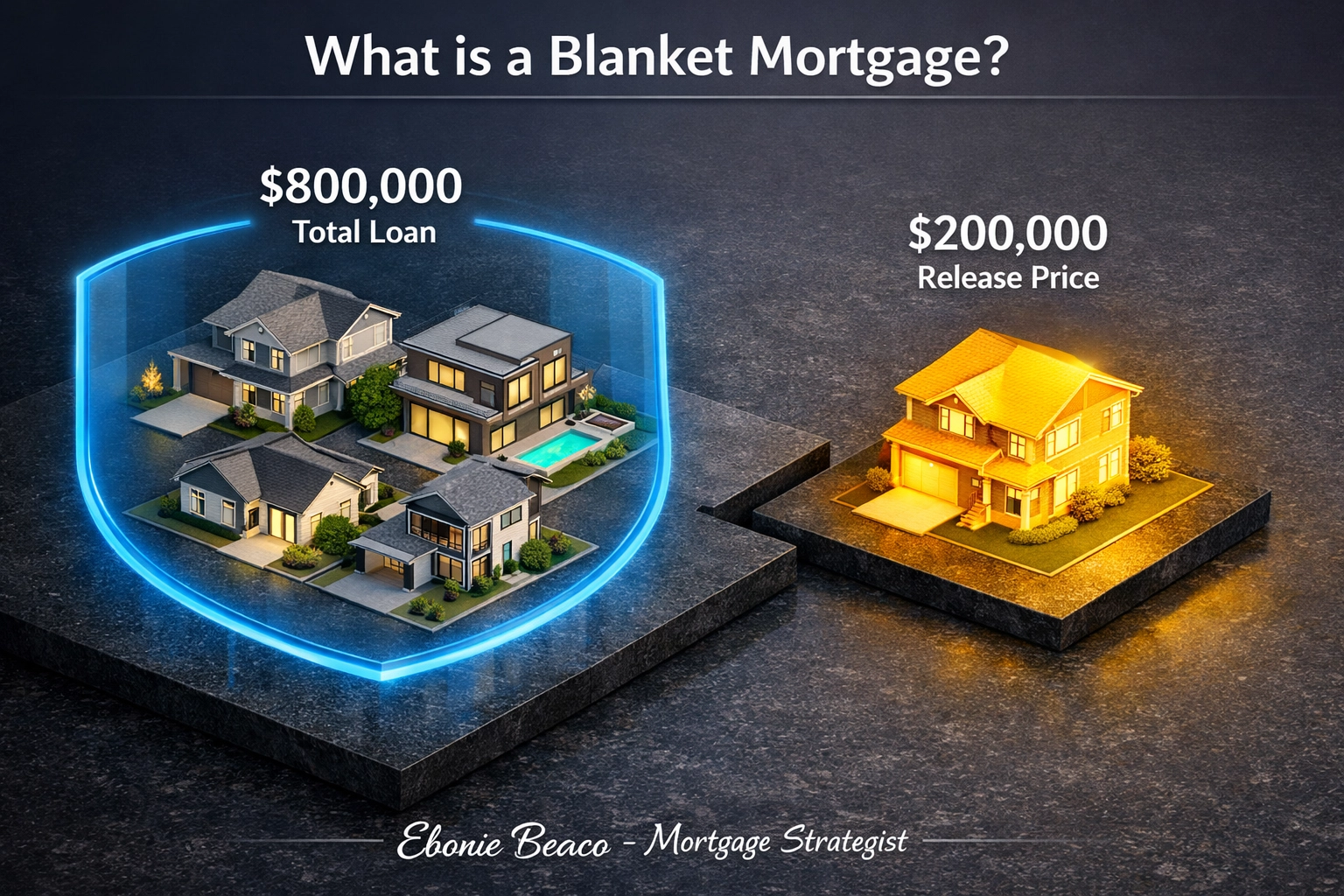 Visual Breakdown: A portfolio of 4 properties under one $800,000 loan, showing a $200,000 release for one property sale.
Who Uses Blanket Mortgages?
Blanket loans are not designed for the average homebuyer looking for a primary residence.
They are specialized tools for the professional side of the industry.
Investors and Landlords If you are building a BRRRR (Buy, Rehab, Rent, Refinance, Repeat) portfolio in Virginia or Michigan, you might find yourself with several small loans. Consolidating them into one blanket mortgage can simplify your life and potentially improve your debt-to-income ratio for future acquisitions.
Developers and Builders A developer in Georgia or Alabama might buy a large tract of land to build a subdivision. A blanket mortgage covers the land purchase and the construction of all units, allowing the builder to sell individual homes to buyers as they are completed.
House Flippers Investors who manage multiple fix-and-flip projects simultaneously in Missouri or Arkansas use blanket loans to maintain liquidity. Instead of applying for five separate hard money loans, they use one blanket facility to cover all active projects.
Commercial Entities Businesses purchasing several storefronts or office spaces in Kentucky or Indiana often prefer the consolidated nature of these loans.
The Financial Benefits of Consolidating
Scaling a real estate business requires efficiency.
Access these specific advantages when you move away from individual property loans.
Streamlined Administration
You deal with one lender, one monthly statement, and one due date. This reduces the administrative overhead of managing a large portfolio and lowers the risk of missing a payment on a single property.
Reduced Closing Costs
Closing Costs: The fees paid at the end of a real estate transaction, including appraisal fees, title insurance, and loan origination fees. Practical Application: By closing one large loan instead of five small ones, you save thousands of dollars by only paying for one set of processing and underwriting fees.
Negotiation Leverage
Because blanket mortgages involve larger loan amounts: often in the millions: you have more room to negotiate terms. Lenders are often willing to provide better interest rates or flexible repayment structures for high-value commercial deals.
Potential Risks and Drawbacks
While the benefits are significant, you must understand the risks involved with cross-collateralization.
Cross-Collateralization: Using the equity of multiple properties to secure a single loan. Practical Application: If you default on the loan, the lender has the legal right to foreclose on every property included in the blanket, even those that are performing well.
Higher Down Payment Requirements
Most lenders offering blanket mortgages in Illinois or California look for a larger "skin in the game." You should expect down payments ranging from 25% to 50% depending on the asset type and your experience level.
Geographic Limitations
Some lenders require all properties within the blanket mortgage to be located within the same state or even the same county. If you own a rental in Florida and another in Virginia, finding a lender to "blanket" them together might be more challenging.
Complexity of Terms
These are non-conforming loans. They do not follow the standard rules set by Fannie Mae or Freddie Mac. You will need to review the fine print regarding "release prices," which are often set at 115% to 125% of the property’s pro-rata share of the loan to protect the lender’s equity position.
Real-World Example: The Florida Portfolio
Let's look at a practical scenario for a landlord in Florida.
Imagine you own four rental properties, each valued at $250,000.
- Total Portfolio Value: $1,000,000
- Total Existing Debt: $600,000 (across four separate loans)
- Monthly Payments: $5,200 total
By opting for a blanket mortgage with a 75% Loan-to-Value (LTV) ratio, you could potentially do a cash-out refinance for $750,000.
- Pay off existing debt: $600,000
- Closing costs: $15,000
- Cash-out for new investments: $135,000
You now have $135,000 in liquid capital to buy your fifth property, and you only have one mortgage payment to track. You can check your potential numbers using mortgage calculators to see how equity extraction might work for your specific portfolio.
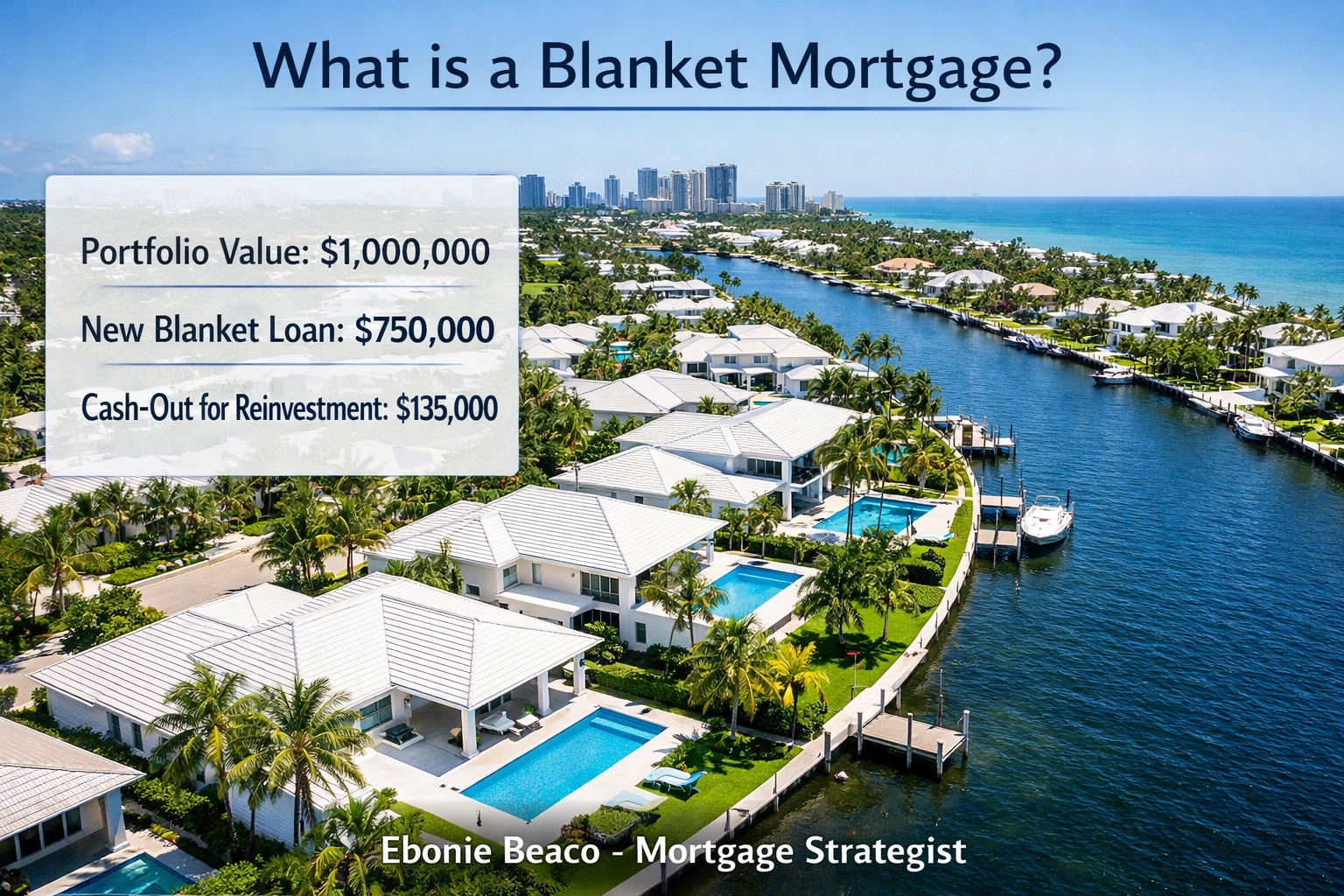 Financial Chart: Portfolio Refinance Breakdown. Value: $1M. New Loan: $750k. Cash to Investor: $135k.
How to Qualify for a Blanket Loan
Qualifying for a blanket mortgage is different than qualifying for a standard 30-year fixed loan.
Lenders focus more on the property’s income-producing potential than your personal income.
DSCR (Debt Service Coverage Ratio): A calculation used by lenders to determine if a property’s rental income can cover the mortgage debt. Practical Application: A DSCR of 1.25 means the property generates 25% more income than the cost of the mortgage, making it a "safe" bet for the lender.
To qualify, you will typically need:
- A strong credit score (usually 680+).
- A proven track record in real estate investing.
- Detailed operating statements for all properties involved.
- A clear exit strategy (selling the properties or long-term refinancing).
You can learn more about the general loan process to prepare your documentation.
Blanket Mortgages vs. Individual Loans
Why choose one over the other?
Individual loans are great for beginners. If you only own one or two rentals in Chicago, the complexity of a blanket mortgage might not be necessary.
However, as you scale, you hit "lender limits." Many traditional lenders limit the number of individual mortgages one person can hold (often capped at 10). A blanket mortgage counts as a single loan, even if it covers 50 houses. This is a common strategy for investors looking to bypass traditional financing hurdles.
If you are just starting out, reviewing the mortgage basics can help you decide which path is right for your current stage.
Exploring Your Options
Every real estate portfolio is unique. Whether you are looking to consolidate debt on a group of rentals in Georgia or you need a construction facility for a new project in California, the right financing structure is the key to your success.
Jump in and evaluate your equity. If you have significant equity spread across several properties, a blanket mortgage might be the tool that unlocks your next phase of growth.
If you are unsure where to start or which properties should be included in a blanket arrangement, it is helpful to consult with a strategist who understands the nuances of investor-focused lending.
Access professional guidance to navigate the complexities of release clauses, cross-collateralization, and DSCR requirements.
Schedule a 1 on 1 at https://calendly.com/homeloansnetwork
Ebonie Beaco
Mortgage Strategist | Senior Loan Officer
Home Loans Network powered by Loan Factory Inc.
NMLS #2389954
HomeLoansNetwork.com
312-392-0664