What are Non-QM Loans? Expanding Your Options

If you have ever been turned down by a big bank because your tax returns do not show enough income, or because you are a real estate investor with ten properties, you have likely run into the "QM" wall. QM stands for Qualified Mortgage. These are the standard loans backed by Fannie Mae or Freddie Mac that fit into a very specific, tight box.
But what happens when you do not fit in that box? That is where Non-QM loans come into play.
A Non-QM loan is a mortgage that does not conform to the strict federal lending guidelines set by the Consumer Financial Protection Bureau (CFPB) for standard loans. Instead of focusing solely on tax returns and debt-to-income ratios, these loans allow lenders to use alternative methods to verify your ability to repay.
Explore how these options can help you scale your portfolio or buy your next home, even if your financial situation is unique.
The Key Differences: QM vs. Non-QM
The primary distinction between these two worlds is flexibility. While traditional loans require deep dives into your W-2s and tax transcripts, Non-QM lenders look at the bigger picture.
Qualified Mortgage (QM): A loan that meets specific criteria regarding a borrower's ability to repay, typically requiring standard income documentation and capping debt-to-income (DTI) ratios at 43%.
Non-Qualified Mortgage (Non-QM): A loan designed for borrowers who are creditworthy but do not meet the rigid standards of a QM loan, often utilizing bank statements or asset verification instead of tax returns.
Jump in and look at why these are popular in markets like Chicago, Florida, and California, where high property values and entrepreneurial spirits often clash with traditional banking rules. You can learn more about the foundations of lending at the Mortgage Basics page.
Who Specifically Benefits from Non-QM?
Non-QM is not a "subprime" loan. It is a solution for sophisticated borrowers with complex finances. Access these programs if you fall into one of these categories:
- Self-Employed Borrowers: Business owners often take legal tax deductions that lower their "taxable income," making them look less qualified on paper than they actually are.
- Real Estate Investors: If you are buying a rental property in Georgia or Virginia, you might want to qualify based on the property’s income rather than your own.
- Foreign Nationals: Investors from outside the U.S. who want to purchase property in Miami or Los Angeles but lack a U.S. credit score or Social Security Number.
- ITIN Borrowers: Individuals with an Individual Taxpayer Identification Number instead of a Social Security Number.
- High Net Worth Individuals: People with significant assets but little "monthly income" on a paystub.
Bank Statement Loans: The Self-Employed Secret
If you are a freelancer in Illinois or a contractor in Michigan, your tax returns might not tell the whole story. Bank statement loans allow you to qualify using your actual cash flow.
Bank Statement Loan: A mortgage product where the lender calculates qualifying income based on the average monthly deposits into a borrower’s personal or business bank accounts over 12 to 24 months.
Instead of looking at the "bottom line" of your tax return after all your expenses, we look at the gross deposits. This often results in a much higher qualifying income, allowing you to secure the financing you need for a home purchase.
DSCR Loans: The Investor’s Power Tool
For landlords and real estate investors, the DSCR (Debt Service Coverage Ratio) loan is a game changer. This is a Non-QM product that focuses entirely on the property, not your personal income.
DSCR Loan: A loan for investment properties where qualification is based on the property's ability to generate enough rental income to cover the monthly mortgage payment.
If you are looking at a multi-unit building in Chicago or a beach rental in Florida, the lender will look at the expected rent. If the rent covers the mortgage, you are often good to go.
DSCR Calculation Example
Let’s look at how an investor might qualify for a property in Virginia using this method.
Example Scenario:
- Purchase Price: $400,000
- Annual Property Taxes: $4,800 ($400/mo)
- Annual Insurance: $1,200 ($100/mo)
- Monthly Principal & Interest: $1,900
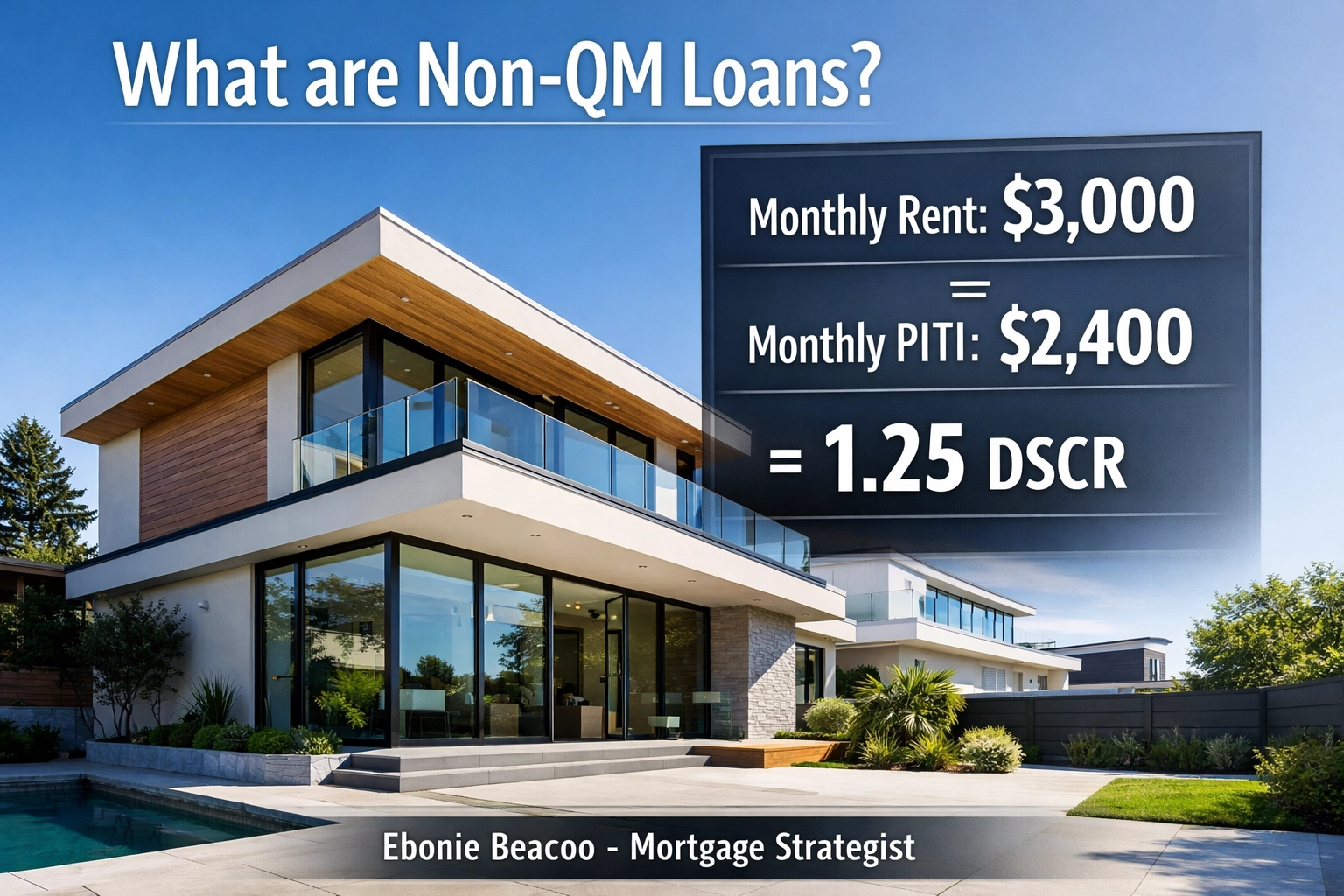
- Total Monthly Payment (PITI): $2,400
- Estimated Monthly Rent: $3,000
The Calculation: $3,000 (Rent) / $2,400 (PITI) = 1.25 DSCR
Lenders typically look for a DSCR of 1.0 or higher. Since this property has a 1.25 ratio, it "covers" the debt and qualifies easily without the investor needing to show a single paystub.
Asset Depletion: Letting Your Wealth Work
Sometimes, you have the money, but you do not have the "job" in the traditional sense. This is common for retirees or people who have recently sold a business in California or Indiana.
Asset Depletion: A qualifying method where the lender divides the borrower's total liquid assets by a set number of months (usually 360) to create a "monthly income" figure for loan qualification.
If you have $1,000,000 in liquid assets, the lender might "deplete" that over 360 months, giving you an extra $2,777 in monthly qualifying income. This can be the difference between a denial and an approval. Use our mortgage calculators to see how different income levels affect your buying power.
Why Location Influences Your Non-QM Strategy
Real estate is local, and so is financing. In high-cost areas like Virginia or California, jumbo loan limits are high, but sometimes even those have too many "hoops" to jump through. Non-QM jumbo loans offer a path forward with fewer restrictions on reserve requirements or credit seasoning.
In states like Alabama, Arkansas, and Kentucky, investors often use Non-QM for landlord loans to build portfolios of single-family homes. Because Non-QM does not limit the number of properties you can own (unlike Fannie Mae, which caps you at 10), it is the primary way to scale a large rental empire.
The Transparency Check: Rates and Terms
It is important to be transparent: Non-QM loans typically come with slightly higher interest rates than standard QM loans. Why? Because the lender is taking on more perceived risk by not following the federal "box."
However, for most investors and self-employed individuals, the slightly higher rate is a small price to pay for the ability to actually close the deal. Compare the cost of a slightly higher rate against the cost of not being able to buy the property at all. Usually, the investment return or the personal necessity of the home outweighs the rate difference.
Explore our FAQ for more details on how these rates are structured.
Is a Non-QM Loan Right for You?
You should consider a Non-QM path if:
- You are self-employed with significant write-offs.
- You are an investor wanting to buy in your LLC's name.
- You have had a "life event" (like a bankruptcy or foreclosure) that is more recent than the 4-7 years standard loans require.
- You have high assets but low traditional income.
If you are unsure where you stand, we can guide you through the loan process and help you compare your options.
Moving Toward Your Real Estate Goals
Navigating the world of Non-QM can feel overwhelming because there are so many different "flavors" of these loans. Whether you are looking for Airbnb and short-term rental financing in Florida or a fix and flip loan in Missouri, the goal is always the same: finding the capital that fits your specific financial DNA.
At Home Loans Network, we specialize in looking past the standard tax return and finding the story behind the numbers. We believe that your ability to build wealth should not be limited by a rigid government form.
If you are ready to stop hearing "no" from traditional banks and want to see what a "yes" looks like, let's talk. Whether you need the financing itself or you want mentoring on how to structure your next three deals, we are here to provide the strategy.
Scedule a 1 on 1 at https://calendly.com/homeloansnetwork
Ebonie Beaco Mortgage Strategist | Senior Loan Officer Home Loans Network powered by Loan Factory Inc. NMLS #2389954 HomeLoansNetwork.com 312-392-0664