Using Home Equity to Buy Your First Rental

Many homeowners across the country sit on a goldmine without even realizing it. Whether you reside in a high-growth area like Atlanta, Georgia, or own property in the steady markets of Michigan or Indiana, your home has likely gained significant value over the last few years. This value, known as home equity, acts as a powerful financial tool that can launch your career as a real estate investor.
Instead of letting that equity sit idle, you can tap into it to fund the down payment on your first rental property. This strategy allows you to leverage an asset you already own to acquire another one that produces monthly cash flow. In this guide, we explore how to transition from being a homeowner to becoming a landlord by using the equity you have already built.
Defining Home Equity
Home equity is the difference between the current market value of your property and the amount you owe on your mortgage. If your home in Chicago is worth $450,000 and your mortgage balance is $250,000, you have $200,000 in equity.
Lenders typically allow you to access a portion of this equity while leaving a safety cushion of about 15% to 20% in the home. Accessing this capital provides the liquidity needed for a down payment on an investment property without needing to save for years from your primary income.
Exploring Your Financing Options
There are two primary ways to extract equity from your primary residence to purchase real estate: a Cash-Out Refinance and a Home Equity Line of Credit (HELOC).
Cash-Out Refinance
A cash-out refinance replaces your existing mortgage with a new, larger loan. You receive the difference between the two loans in a lump sum at closing. This is a popular choice when current mortgage rates are lower than or similar to your existing rate.
Explore home refinance options to see how this might restructure your monthly obligations while providing the capital for your first rental.
Home Equity Line of Credit (HELOC)
A HELOC functions more like a credit card secured by your home. You are approved for a specific limit and can draw funds as needed. You only pay interest on the amount you actually use. This is often the preferred route for investors who want to keep their original low-interest first mortgage intact while having a flexible source of funds for down payments or property renovations.
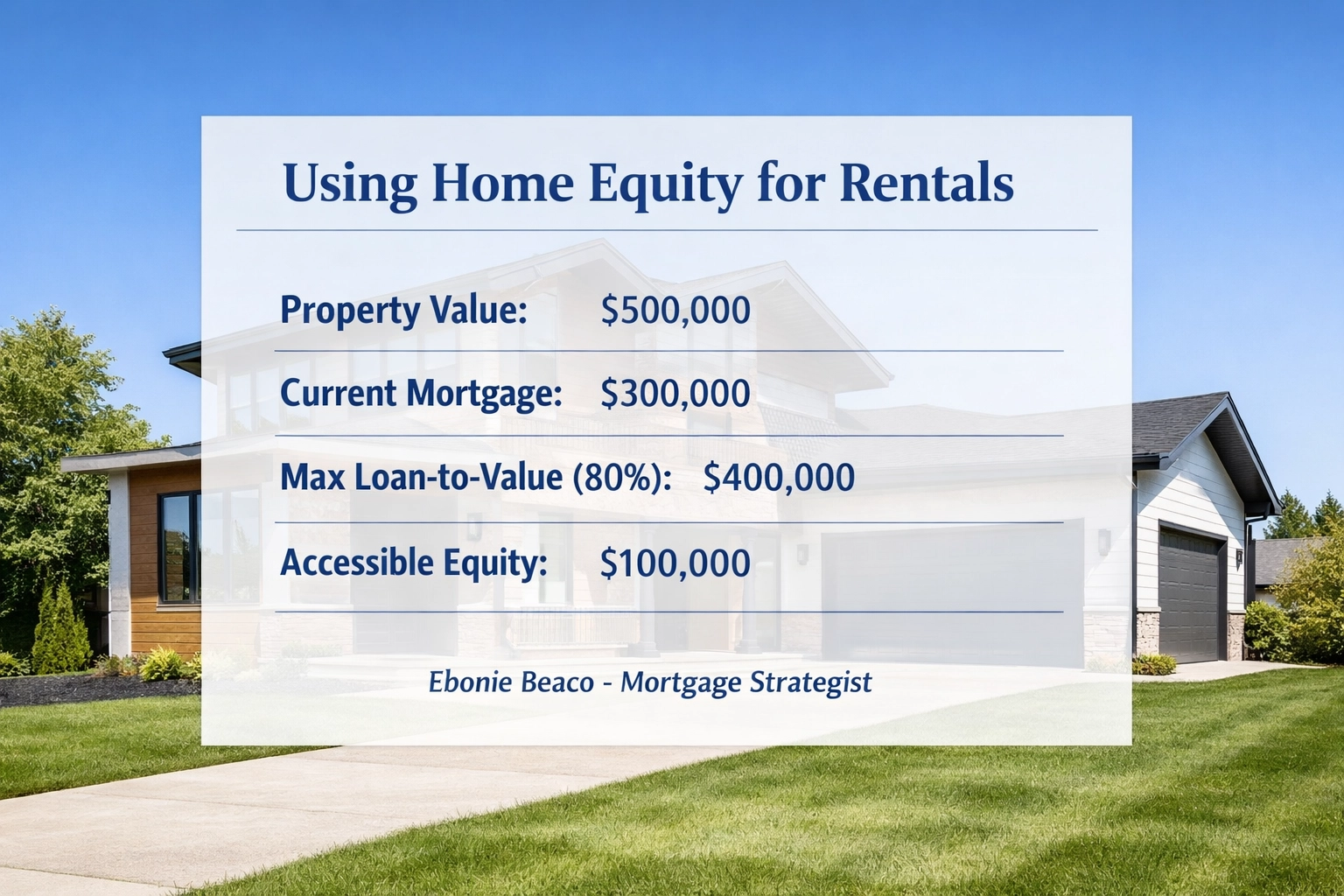 Image Instructions: Title 'Using Home Equity for Rentals' prominently. Display the following calculation: Property Value: $500,000 | Current Mortgage: $300,000 | Max Loan-to-Value (80%): $400,000 | Accessible Equity: $100,000. No money or cash icons. Include 'Ebonie Beaco - Mortgage Loan Officer' at the bottom.
The Math Behind the Strategy
To understand how this works in a real-world scenario, let's look at an example. Imagine you own a home in Virginia or Florida valued at $500,000.
- Current Value: $500,000
- Current Mortgage Balance: $300,000
- Maximum Loan-to-Value (LTV): Most lenders allow an 80% LTV for equity extraction.
- Calculated Limit: $500,000 x 0.80 = $400,000.
- Available Cash: $400,000 - $300,000 = $100,000.
With $100,000 available, you could easily cover a 20% down payment and closing costs on a $400,000 rental property in markets like Little Rock, Arkansas, or Birmingham, Alabama. You can use the mortgage calculators to run these numbers for your specific situation.
Qualification Standards for Equity Extraction
Lenders view investment-related financing with a higher degree of scrutiny. To successfully use your equity for a rental purchase, you usually need to meet specific criteria.
Credit Score Requirements: While some primary residence loans allow for lower scores, extracting equity for investment purposes usually requires a score of 700 or higher to get the best terms.
Debt-to-Income (DTI) Ratio: Lenders look at your total monthly debt payments compared to your gross monthly income. Most prefer a DTI below 43%, though some flexible programs allow up to 50% if you have strong cash reserves.
Loan-to-Value (LTV) Limits: As mentioned, you generally cannot strip all the equity out of your home. Keeping 20% equity in the primary residence is a standard requirement for most traditional and non-QM mortgage loans.
Selecting the Right Rental Property
Once you have secured the funding from your equity, the next step is choosing the right investment. Many first-time investors look for single-family homes or small multifamily units (duplexes or fourplexes).
In states like California or parts of Florida, you might focus on short-term rentals or Airbnb properties to maximize yield. In the Midwest, such as Illinois or Michigan, long-term residential leases often provide the most stability.
Jump in by researching the home purchase process to understand how the acquisition phase differs when you are buying as an investor rather than an owner-occupant.
Leveraging DSCR Loans for Your Rental
After you use your home equity for the down payment, you still need a mortgage for the remaining balance of the rental property purchase. Many savvy investors choose a DSCR (Debt Service Coverage Ratio) loan.
DSCR Loan: A mortgage program where qualification is based on the rental income of the property rather than the personal income of the borrower.
If the monthly rent covers the mortgage payment (including taxes, insurance, and HOA fees), the loan can be approved regardless of your personal DTI. This is a game-changer for investors who want to scale their portfolios quickly without being limited by their personal salary.
The Benefits of Using Equity
Tax-Free Capital: When you borrow against your home equity, the cash you receive is not considered taxable income. It is a loan, which means you get to use the full amount for your investment.
Speed of Acquisition: Having a HELOC or cash-in-hand allows you to act quickly when a deal hits the market. In competitive areas like Northern Virginia or Southern California, being able to make an offer with a large down payment or as a cash-buyer (using your equity) gives you a massive advantage.
Building a Legacy: By using one asset to buy another, you are effectively doubling your exposure to real estate appreciation. Over time, both properties grow in value while the tenants in the rental property pay down that mortgage for you.
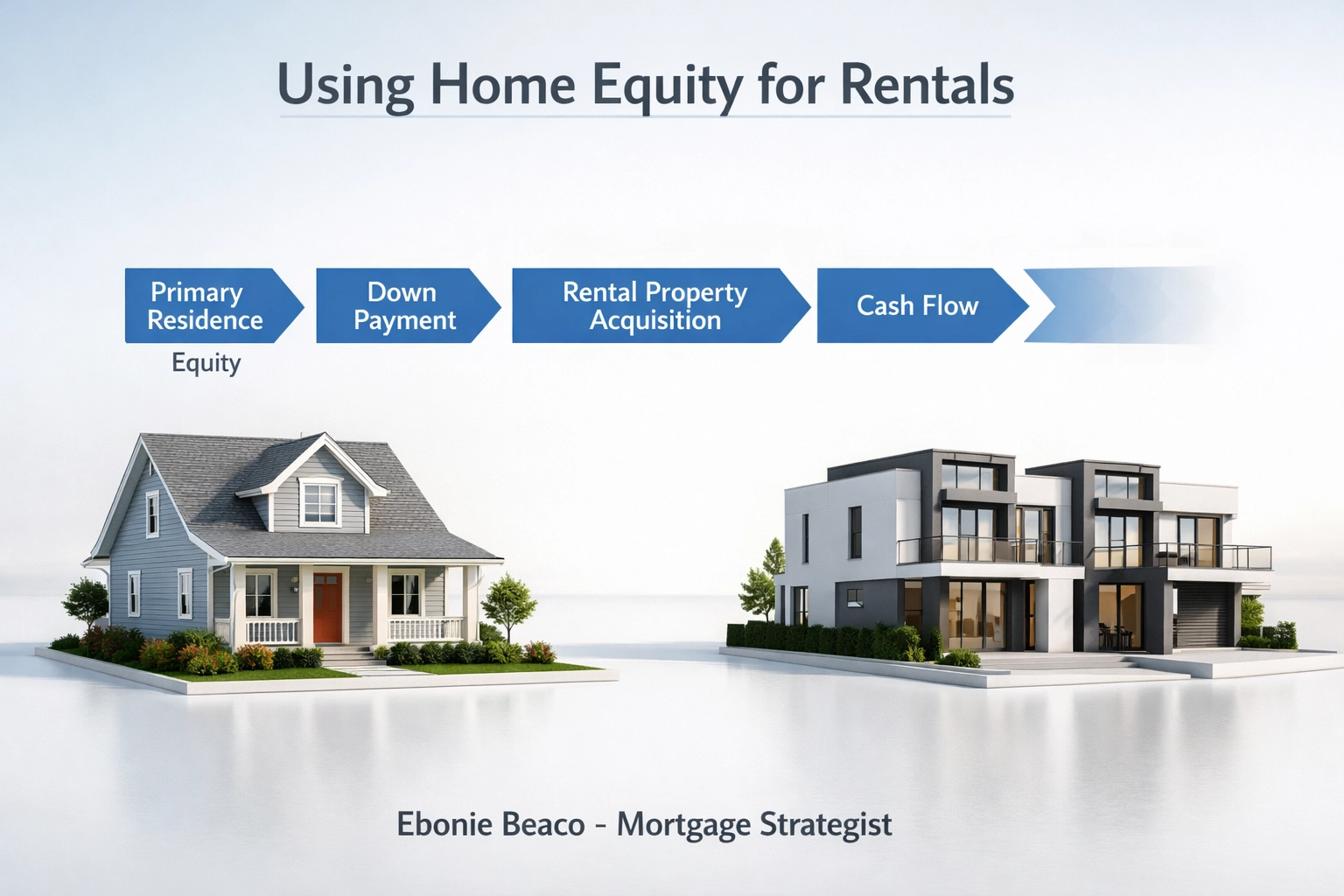 Image Instructions: Title 'Using Home Equity for Rentals'. Visual flowchart: Primary Residence Equity -> Down Payment -> Rental Property Acquisition -> Cash Flow. No money or cash images. Professional and clean layout. Include 'Ebonie Beaco - Mortgage Loan Officer' at the bottom.
Regional Market Considerations
Real estate is local, and the strategy you use should reflect the market you are entering.
- Florida and California: High demand for short-term rentals. Equity can be used to furnish and launch an Airbnb.
- Georgia and Alabama: Strong markets for single-family rentals with affordable entry points.
- Illinois and Michigan: Excellent opportunities for "Buy, Rehab, Rent, Refinance, Repeat" (BRRRR) strategies using equity for the initial buy and fix.
Review our loan process to see how we guide investors through these specific regional nuances.
Risks to Manage
Leveraging equity is a powerful strategy, but it requires careful planning. You are putting your primary residence at risk if you cannot make the payments. It is vital to ensure that the rental income from the new property is sufficient to cover its own expenses and, ideally, help offset the cost of the equity loan you took out.
Always maintain a "rainy day" fund or cash reserves. Lenders often require six to twelve months of mortgage payments in reserve for investment properties to ensure you can handle vacancies or unexpected repairs.
How to Get Started
The first step is a professional equity analysis. You need to know exactly how much your home is worth and how much a lender is willing to let you draw out. We provide detailed scenarios to help you compare the cost of a HELOC versus a cash-out refinance.
Accessing your equity is about more than just getting cash; it is about creating a structured plan to grow your wealth. Whether you are a seasoned landlord or a first-time investor, understanding the leverage available to you is the key to scaling.
Access the FAQ page for quick answers to common questions about equity and investor financing.
Take the Next Step
Using your home equity to buy a rental property is one of the most effective ways to build a real estate portfolio. By turning "dead equity" into an active, income-producing asset, you set yourself up for long-term financial freedom.
If you are ready to see what your equity can do for you, or if you need mentoring on how to find and finance your first deal, let's talk.
Schedule a 1 on 1 at https://calendly.com/homeloansnetwork
Ebonie Beaco Mortgage Strategist | Senior Loan Officer Home Loans Network powered by Loan Factory Inc. NMLS #2389954 HomeLoansNetwork.com 312-392-0664
Reach out to Ebonie Beaco to leverage your equity or for mentoring at www.homeloansnetwork.com.