Using Cash-Out Refinancing to Scale Your Real Estate Portfolio

Scaling a real estate portfolio often feels like a puzzle where the missing piece is always capital. You might have a property that has gained significant value over the last few years, yet that wealth is locked behind the front door. For many investors in markets like Chicago, Atlanta, or Tampa, the solution lies in a strategy called cash-out refinancing. This financial move allows you to tap into your home's equity to fund the acquisition of your next rental property, fix-and-flip project, or multi-unit building.
Understanding the Cash-Out Refinance
Cash-Out Refinance: A mortgage transition where an existing loan is replaced by a new one for a larger amount than the current balance. The homeowner receives the difference between the two loans in a lump sum at closing.
Accessing these funds allows you to use the equity you have already built as a down payment for a new investment. Instead of waiting years to save up enough for a 20% down payment on a second or third property, you use the appreciation of your current assets to move faster.
The Mechanics of Reinvestable Equity
When you look at your property, you see more than just a building; you see a reservoir of potential capital. However, lenders do not let you withdraw 100% of your home's value. In most investment scenarios, lenders prefer you to keep a "skin in the game" buffer, usually around 20% to 25%.
To understand how much you can actually use to grow your portfolio, you need to calculate your reinvestable equity. This figure represents the amount you can walk away with after paying off your old mortgage, assuming a standard 75% Loan-to-Value (LTV) limit for investment properties.
The Calculation for Reinvestable Equity
To find out what you can work with, use this simple formula: (Current Property Value * 75%) - Current Mortgage Balance = Reinvestable Equity
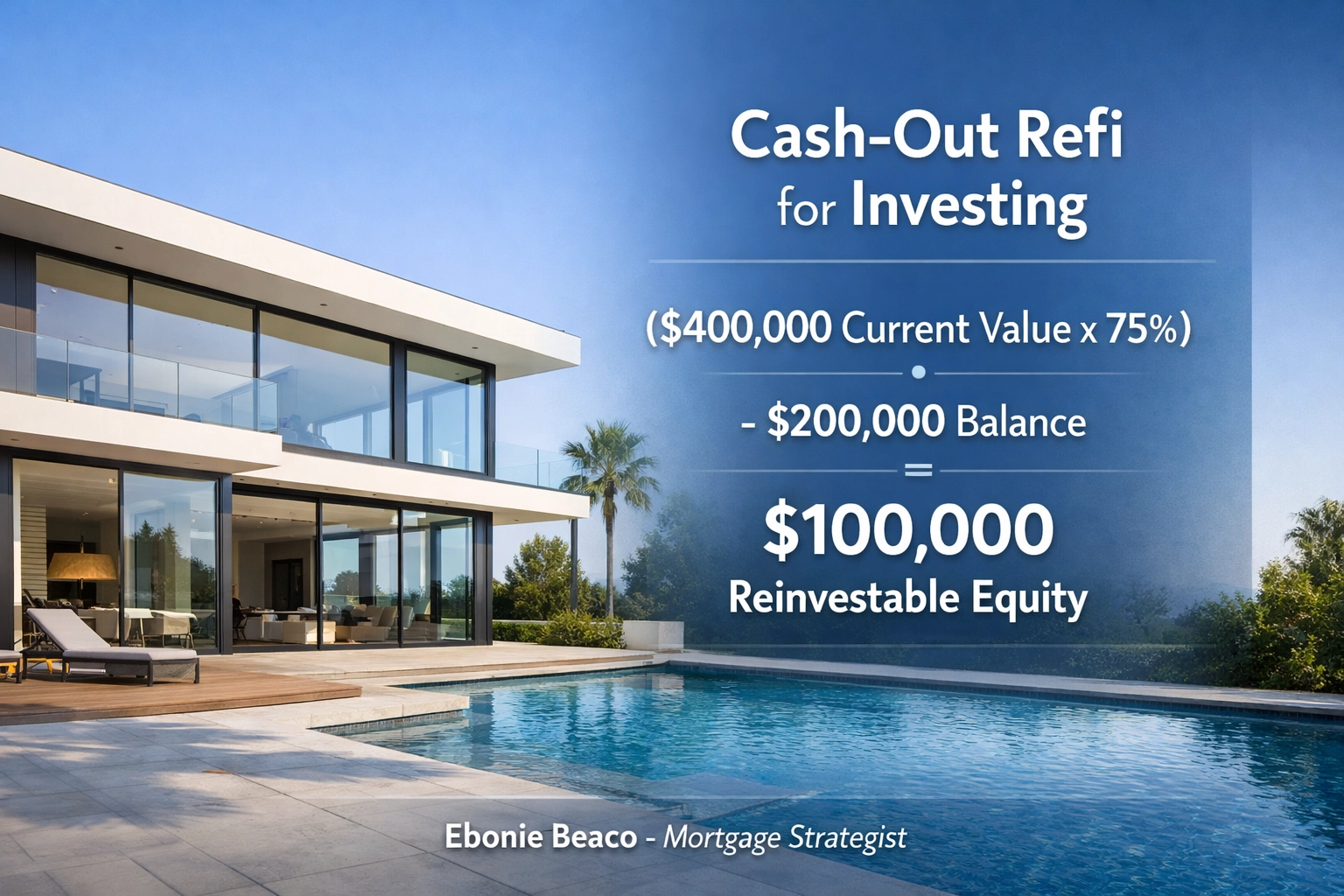 Image Description: A professional financial breakdown graphic titled "Cash-Out Refi for Investing". It shows a property valued at $400,000. It displays the math: ($400,000 * 75%) = $300,000. Then $300,000 - $200,000 (Current Balance) = $100,000 Reinvestable Equity. At the bottom, it reads "Ebonie Beaco - Mortgage Loan Officer".
If your property in a high-growth area like Virginia or Florida has jumped in value from $300,000 to $450,000, that $100,000+ in potential cash can be the catalyst for your next two or three deals. You can explore more about the home refinance process to see how these numbers apply to your specific situation.
Strategic Uses for Your Refinance Proceeds
Once you have the capital in hand, the goal is to deploy it into income-producing assets. Here are a few ways successful investors use cash-out proceeds:
1. Funding the BRRRR Method
The Buy, Rehab, Rent, Refinance, Repeat (BRRRR) strategy is a favorite among landlords in Michigan and Indiana. You use the cash-out funds to buy a distressed property, fix it up, and then refinance that property based on its new, higher value. This cycle allows you to recycle the same pool of capital over and over again.
2. Acquiring Short-Term Rentals
With the rise of travel in coastal Florida and California, many investors use equity to purchase Airbnb or VRBO properties. These short-term rental financing options often require higher down payments, making the cash-out refinance an ideal source of funding.
3. Transitioning to Multifamily
If you own a few single-family homes, you might want to scale up to a duplex or a four-unit building. Using the equity from one or two smaller properties can provide the substantial down payment needed for a commercial-style residential loan.
Comparing Cash-Out Refinance vs. HELOC
HELOC (Home Equity Line of Credit): A revolving line of credit that uses your home as collateral, allowing you to draw funds as needed, similar to a credit card.
Many homeowners ask whether they should get a HELOC or a cash-out refinance. A HELOC is often a second mortgage with a variable interest rate. A cash-out refinance replaces your first mortgage entirely, usually with a fixed rate. If you plan to use a large sum of money all at once for a new purchase, the cash-out refinance provides the stability of a fixed payment. If you only need small amounts of cash over a long period for minor repairs, a HELOC might be a better fit. You can compare these strategies using mortgage calculators to see which monthly payment fits your budget better.
Regional Market Highlights
Real estate is local. The strategy you use in Chicago might differ from what you do in rural Arkansas.
- Illinois and Chicago: High rental demand makes cash-out refinancing a powerful tool for building a multi-unit portfolio in neighborhoods showing steady appreciation.
- Florida and Georgia: These markets have seen rapid price increases. Homeowners who bought five years ago likely have massive amounts of untapped equity that can be redirected into new construction or fix-and-flip projects.
- Virginia and California: In high-cost markets, even a small percentage of appreciation equals a large dollar amount. A 10% gain on a million-dollar California home provides $100,000 in theoretical equity.
Qualification Standards for Investors
Lenders look at more than just the property value when you request a cash-out refinance. They want to ensure the new debt is sustainable.
DSCR (Debt Service Coverage Ratio): A metric used by lenders to measure a property's ability to cover its own mortgage debt through its rental income.
If you are refinancing an investment property, many lenders offer DSCR investor loans. These programs focus on the property’s cash flow rather than your personal income or debt-to-income (DTI) ratio. This is incredibly helpful for investors who may have complex tax returns or multiple existing mortgages.
Key Requirements to Keep in Mind:
- Credit Score: Most cash-out programs prefer a score of 680 or higher for the best rates.
- Equity Position: You typically must leave 20% to 25% equity in the property.
- Seasoning: Some lenders require you to own the property for at least six to twelve months before doing a cash-out refinance based on a new appraisal.
The Financial Benefits of Tax-Free Capital
One major advantage that seasoned investors discuss is that the cash received from a refinance is not considered income by the IRS. Because the money is technically a loan, you do not pay capital gains tax on it. This allows you to access the "profit" of your property's appreciation without selling the asset and losing the monthly rental income.
By keeping the original property and using a refinance, you benefit from:
- Continued Appreciation: You still own the asset as it grows in value.
- Tax Deductions: The interest on the mortgage used for business purposes is often tax-deductible.
- Tenant Debt Paydown: Your tenants continue to pay off the new, larger mortgage for you.
Taking the Next Step in Your Investment Journey
Scaling a portfolio requires a shift in mindset from "saving money" to "leveraging equity." If you have been sitting on a property that has grown in value, you have a tool at your disposal that can change your financial trajectory. Whether you are a landlord in Alabama looking for your next duplex or a homeowner in Michigan wanting to start your investment journey, the cash-out refinance is a primary vehicle for growth.
Understanding the loan process is the first step toward unlocking that potential. Every market and every financial profile is different, so a personalized strategy is essential for success.
Ready to see how much equity you can put to work?
Use your equity to buy more property. Contact Ebonie Beaco for a cash-out refinance strategy.
Scedule a 1 on 1 at https://calendly.com/homeloansnetwork
Ebonie Beaco Mortgage Strategist | Senior Loan Officer Home Loans Network powered by Loan Factory Inc. NMLS #2389954 HomeLoansNetwork.com 312-392-0664