Using a Self-Directed IRA for Real Estate Investing

Many investors feel trapped by the traditional stock and bond options found in standard retirement accounts.
If you are looking for a way to diversify your portfolio, using a Self-Directed IRA (SDIRA) to purchase real estate might be the strategy you need.
This approach allows you to use your retirement funds to buy rental properties, fix and flips, or even commercial buildings while maintaining the tax advantages of an IRA.
Whether you are eyeing a multi-family property in Chicago or a vacation rental in Florida, understanding how to navigate the SDIRA landscape is essential.
Explore the mechanics of this powerful investment tool and see how it can help you build long-term wealth.
Defining the Self-Directed IRA
Self-Directed IRA (SDIRA): A retirement account that offers the same tax benefits as a traditional or Roth IRA but allows the owner to invest in alternative assets.
Unlike accounts held at major brokerage firms that limit you to stocks and mutual funds, an SDIRA gives you the freedom to invest in real estate, land, and private notes.
The key distinction is the custodian.
You must work with a specialized custodian who is willing to hold and administer non-traditional assets.
Access more information on the fundamentals of borrowing and investing by visiting our mortgage basics page.
How the Investment Process Works
The process of buying real estate with an IRA is different from a standard home purchase.
You do not personally own the property; your IRA does.
This means all transactions must be conducted at arm's length to satisfy IRS regulations.
Jump in by following these general steps:
- Establish an SDIRA Account: You need to open an account with a custodian that permits real estate investments.
- Fund the Account: You can move funds into the SDIRA via a rollover from an existing 401(k) or a transfer from another IRA.
- Identify the Property: Whether it is a single-family home in Virginia or a commercial space in California, you find the deal.
- The IRA Purchases the Asset: Your custodian handles the paperwork and issues the funds for the purchase.
- Title the Property Correctly: The deed must be in the name of the IRA, not your personal name.
Compare different investment scenarios and loan processes to see which fits your timeline.
Navigating Prohibited Transactions and Disqualified Persons
Transparency is vital when dealing with the IRS and your retirement funds.
The IRS has strict rules regarding who can interact with the property held in your SDIRA.
Disqualified Persons: Individuals who are prohibited from engaging in any transactions with the IRA, including the account owner, their spouse, parents, and children.
Prohibited Transactions: Actions that result in the direct or indirect use of IRA funds or assets by a disqualified person.
You cannot live in the property, use it as an office, or even let your children stay there for a weekend.
Additionally, you cannot perform the maintenance yourself.
If the property in Michigan needs a new roof, you must hire a third-party contractor and pay them directly from the IRA funds.
Failing to follow these rules can lead to the disqualification of your entire account, resulting in massive tax hits and penalties.
The Flow of Income and Expenses
A major benefit of the SDIRA is the tax-deferred or tax-free growth of your investment.
However, this requires a strictly managed "closed loop" of funds.
Income Flow: All rental checks or sale proceeds must be made payable to the IRA and deposited directly into the IRA account.
Expense Flow: Every cost associated with the property, including taxes, insurance, and repairs, must be paid using IRA funds.
If you pay for a repair out of your personal pocket, it is considered an improper contribution and can trigger an audit.
Before you commit to a purchase, use our mortgage calculators to ensure the projected rental income covers the property's ongoing costs.
Financing with Non-Recourse Loans
Most investors assume they need to pay 100% cash for an IRA-owned property.
That is a common misconception.
You can actually use leverage to buy a larger asset, but you must use a Non-Recourse Loan.
Non-Recourse Loan: A loan where the lender’s only recourse in the event of default is the property itself; the lender cannot pursue the IRA holder or other assets in the IRA.
Because the IRS prohibits you from personally guaranteeing a debt for your IRA, standard mortgages are off the table.
Lenders offering non-recourse financing typically require a higher down payment, often 30% to 40%.
This strategy is frequently used by investors in high-growth markets like Atlanta, Georgia, or various cities throughout Florida to scale their portfolios faster.
Real-World Calculation: Leveraging the SDIRA
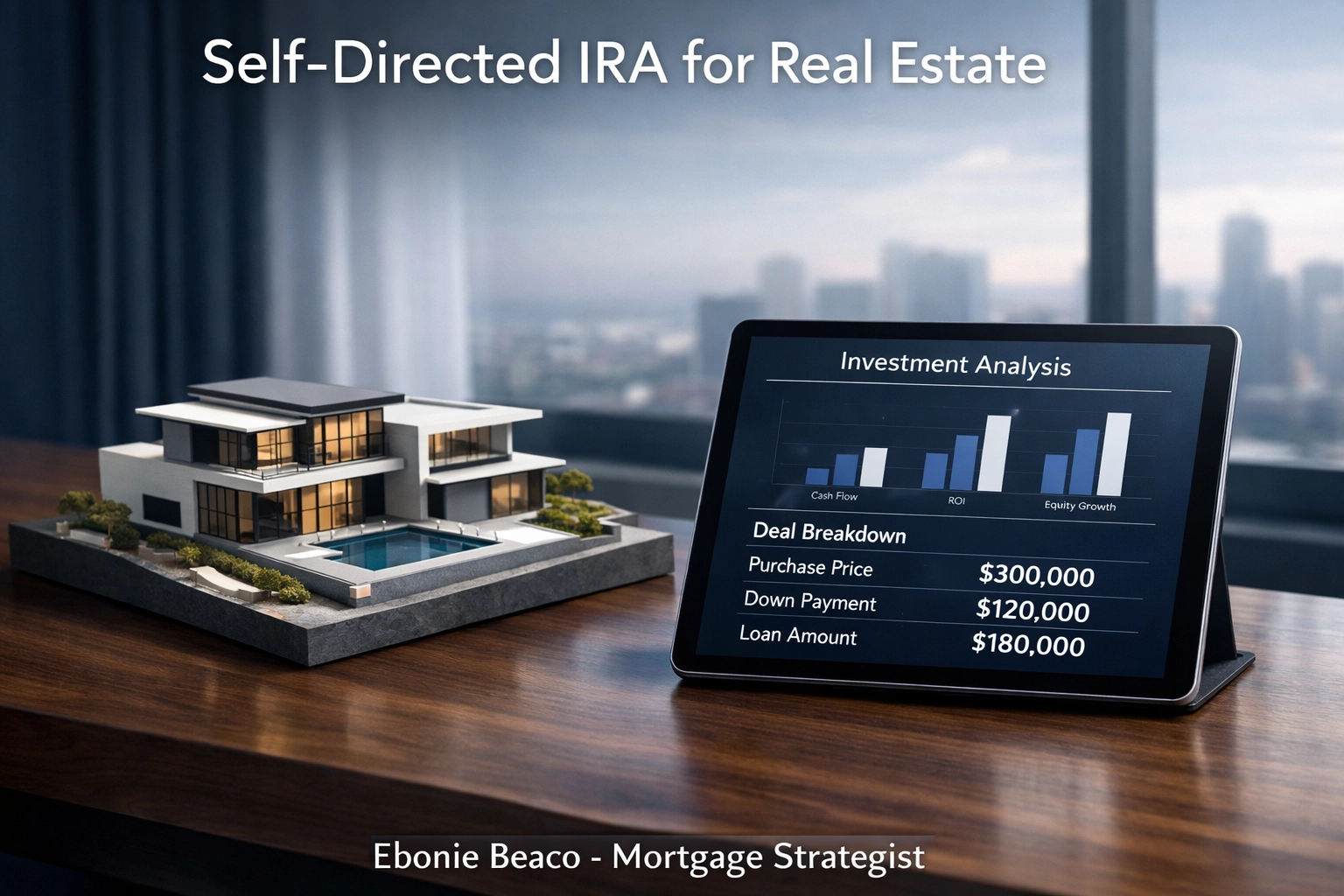
Imagine you have $150,000 in your SDIRA and you want to purchase a rental property in Kentucky valued at $300,000.
| Item | Calculation |
|---|---|
| Purchase Price | $300,000 |
| IRA Down Payment (40%) | $120,000 |
| Non-Recourse Loan Amount | $180,000 |
| Estimated Closing Costs (from IRA) | $8,000 |
| Remaining IRA Cash Reserve | $22,000 |
 Title: Self-Directed IRA for Real Estate. Ebonie Beaco - Mortgage Loan Officer.
In this scenario, your IRA owns a $300,000 asset while only using $128,000 of its liquid cash.
The rental income pays down the non-recourse mortgage, building equity inside your retirement account.
If you have questions about how these numbers apply to your specific situation, you can book an appointment to discuss the details.
Understanding UBIT and UDFI
When you use a loan to buy property inside an IRA, you introduce a specific tax consideration.
Unrelated Debt-Financed Income (UDFI): The portion of income generated by a property that is attributable to borrowed funds.
Unrelated Business Income Tax (UBIT): The tax paid on the UDFI.
Because the government does not want IRAs to have an unfair advantage over traditional investors when using leverage, the "leveraged" portion of the profit is taxed.
If your property is 60% financed, then 60% of the net income (after deductions) may be subject to UBIT.
While this sounds like a drawback, many investors find that the increased returns from leverage far outweigh the tax cost.
Always consult with a tax professional who understands SDIRA rules in states like Alabama, Arkansas, or Missouri to ensure you are filing correctly.
Investment Strategies for Your SDIRA
The flexibility of a self-directed account allows for various strategies depending on your goals.
- Buy and Hold: Purchase a single-family home or small multi-unit building in Indiana or Illinois and collect steady rental income.
- Fix and Flip: Use IRA funds to buy, renovate, and sell properties in hot markets like Virginia.
- Syndications: Pool your IRA funds with other investors to purchase large apartment complexes or commercial assets.
- Private Lending: Your IRA can act as the bank, lending money to other real estate investors in exchange for a set interest rate and a lien on the property.
These methods help you move away from the volatility of the stock market and into tangible assets you understand.
Check our FAQ page for answers to common questions regarding investment types.
Regional Opportunities and Market Insights
Real estate is local, and your SDIRA strategy should reflect the market where you are buying.
In Chicago, many investors use SDIRAs to acquire small multifamily properties (2-4 units) where the rental demand remains high.
Investors in Florida often look for short-term rental opportunities or new construction.
Meanwhile, in states like Michigan and Indiana, the lower entry price points allow SDIRA holders to purchase properties entirely with cash, avoiding the complexities of non-recourse loans and UBIT.
Regardless of where you invest, performing due diligence on the local economy and housing trends is a requirement for success.
Taking the Next Step
Using a Self-Directed IRA for real estate is a sophisticated strategy that requires precision and the right team.
It provides a path to diversification that traditional retirement accounts simply cannot match.
If you are curious about non-recourse financing or need a mentor to help you navigate the rules of the SDIRA, reach out for professional guidance.
Ebonie Beaco and the team at Home Loans Network specialize in helping investors find the right funding solutions for their retirement goals.
Whether you are looking to purchase your first rental or expand an existing portfolio, we are here to provide the transparency and expertise you need.
Explore your options for a home purchase or investment financing today.
Scedule a 1 on 1 at https://calendly.com/homeloansnetwork
Ebonie Beaco
Mortgage Strategist | Senior Loan Officer
Home Loans Network powered by Loan Factory Inc.
NMLS #2389954
HomeLoansNetwork.com
312-392-0664