Transitioning from W-2 to Full-Time Investor

Leaving the security of a steady paycheck to pursue real estate investing full-time is a significant milestone. Many people find themselves sitting at their desks in Chicago, Miami, or Los Angeles, dreaming of the day they can trade their office key for a set of master keys to a rental portfolio. The path from being an employee to being a full-time property owner is not just about finding the right house; it is about building a strategic financial bridge that supports your lifestyle without the safety net of a bi-weekly direct deposit.
At Home Loans Network, we see this transition frequently. The most successful investors do not just quit their jobs and hope for the best. They leverage their W-2 status while they still have it, using that documented stability to secure the best possible financing before making the leap.
Why Your W-2 is a Secret Weapon
Before you hand in your resignation, understand that your current job is your greatest asset in the eyes of traditional lenders. When you apply for a standard home purchase loan or a refinance, lenders look at your Debt-to-Income (DTI) ratio.
Debt-to-Income (DTI) Ratio: A percentage that represents the portion of your gross monthly income that goes toward paying debts. Application: Lenders use this to determine if you can afford a new mortgage payment alongside your existing obligations.
While you are employed, your income is predictable. Lenders love predictability. Once you become a full-time investor, especially in the first two years, your "income" on paper might look very different due to tax write-offs and depreciation. Use your W-2 to acquire as many properties as possible using conventional or FHA financing. This allows you to lock in lower interest rates and lower down payments before you lose the "employee" status that traditional banks prefer.
Leveraging House Hacking for Your First Move
One of the fastest ways to build equity while still working is house hacking. This involves purchasing a multi-unit property (up to four units), living in one unit, and renting out the others. In markets like Chicago or Indianapolis, this is a common entry point for aspiring full-time investors.
By using an FHA loan, you can put down as little as 3.5%. The rental income from the other units can often cover a large portion, if not all, of your mortgage. This reduces your personal living expenses, allowing you to save more of your W-2 salary for your next investment.
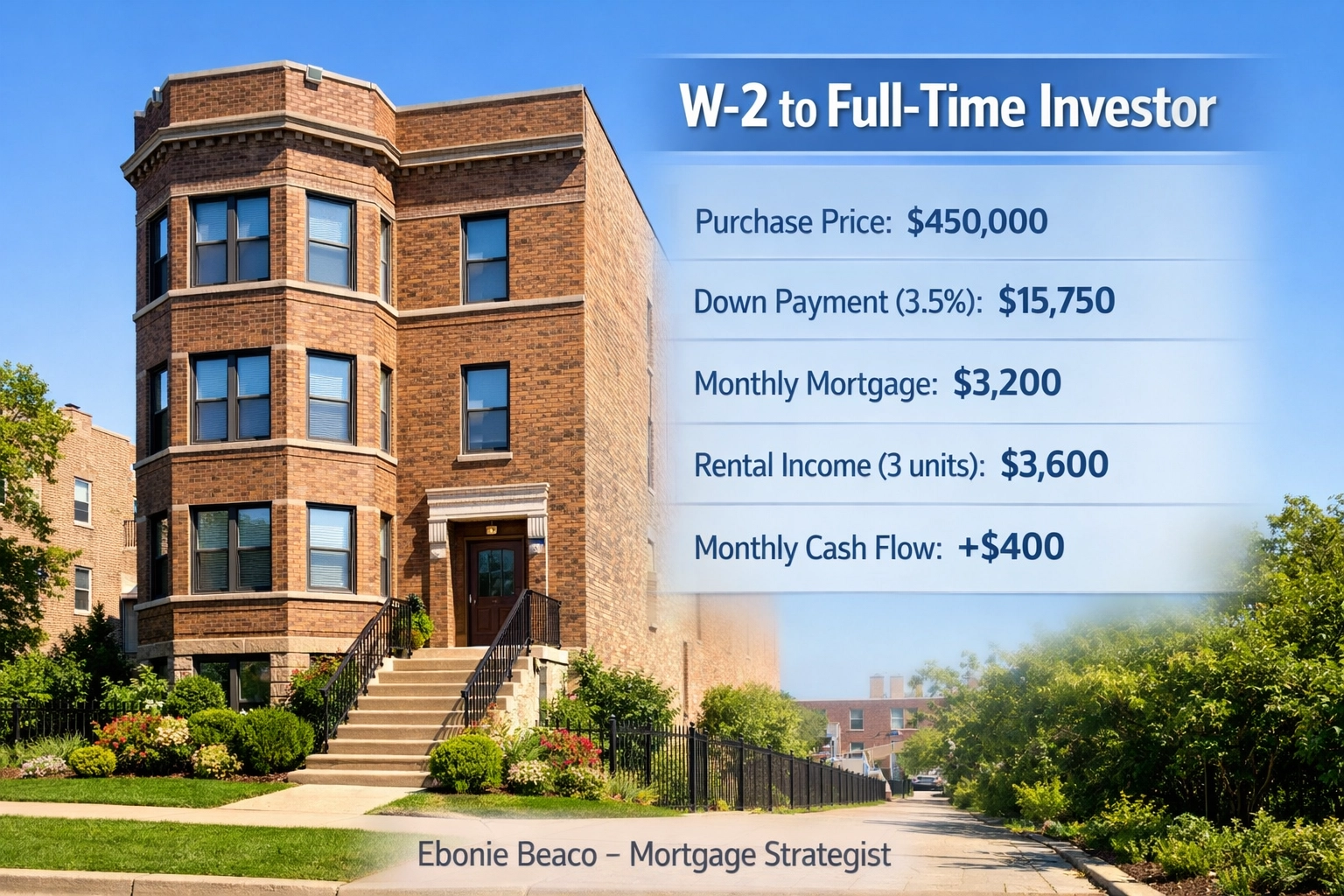 Image details: Title 'W-2 to Full-Time Investor' on the image. 'Ebonie Beaco - Mortgage Loan Officer' at the bottom. Calculation: Purchase Price: $450,000 (4-unit property). Down Payment (3.5%): $15,750. Monthly Mortgage: $3,200. Rental Income (3 units): $3,600. Monthly Cash Flow: +$400.
The Shift to DSCR Loans
As you move closer to full-time status, you may reach a point where your DTI ratio becomes too high for traditional loans, or you simply want to stop using your personal income to qualify. This is where DSCR investor loans become essential.
Debt Service Coverage Ratio (DSCR): A financial metric used by lenders to measure a property's ability to cover its own debt payments. Application: If the property generates enough rent to cover the mortgage, taxes, insurance, and HOA fees, the lender may approve the loan regardless of your personal employment status.
DSCR loans are perfect for the transition because they focus on the asset's performance rather than your paycheck. This means even after you leave your W-2 job, you can continue to scale your portfolio in states like Florida, Virginia, or Georgia, where the rental markets remain strong.
 Image details: Title 'W-2 to Full-Time Investor' on the image. 'Ebonie Beaco - Mortgage Loan Officer' at the bottom. Calculation: Gross Monthly Rent: $2,800. Monthly PITIA (Principal, Interest, Taxes, Insurance, HOA): $2,000. DSCR Calculation: $2,800 / $2,000 = 1.40.
Building the Financial Bridge
You should not leave your job until your passive income covers your "nut": your total monthly living expenses. However, even when the math works, you need a liquid safety net. We recommend having at least six to twelve months of living expenses and property reserves in a high-yield savings account.
Reserves: Liquid assets required by a lender to remain in your account after a loan closes. Application: These funds ensure you can handle unexpected repairs or vacancies without risking your personal lifestyle.
In volatile markets or when dealing with short-term rentals (Airbnb), having a larger cushion is vital. Investors in California or Florida often maintain higher reserves due to higher property values and potential seasonal fluctuations in occupancy.
Scaling with the BRRRR Method
If you are looking to accelerate your path to full-time status, the BRRRR method (Buy, Rehab, Rent, Refinance, Repeat) is a powerful strategy. It allows you to recycle your capital.
- Buy: Purchase a distressed property in a market like Michigan or Arkansas.
- Rehab: Renovate the property to increase its value.
- Rent: Place a reliable tenant to generate income.
- Refinance: Use a cash-out refinance to pull your initial investment back out.
- Repeat: Use that same capital to buy the next property.
A cash-out refinance is a strategic way to access equity without selling the asset. This keeps your portfolio growing while providing the liquidity needed to fund your transition away from a 9-to-5 job.
 Image details: Title 'W-2 to Full-Time Investor' on the image. 'Ebonie Beaco - Mortgage Loan Officer' at the bottom. Calculation: Purchase Price: $150,000. Rehab Costs: $50,000. New Appraised Value: $275,000. Cash-Out Refinance (75% LTV): $206,250. Total Investment: $200,000. Capital Recovered: $6,250 profit + original investment.
Exploring Non-QM and Bank Statement Loans
Once you are officially self-employed as a full-time investor, you might find that traditional tax returns don't tell the whole story of your wealth. Many full-time investors use Non-QM (Non-Qualified Mortgage) loans, specifically bank statement loans.
Bank Statement Loan: A mortgage product where income is verified using monthly bank deposits rather than tax returns. Application: This allows self-employed investors to qualify based on their actual cash flow rather than their taxable income after deductions.
This is particularly useful for investors in high-cost areas like California or Northern Virginia, where significant tax deductions might otherwise disqualify them from high-balance mortgage products. You can access more info on how these programs work for self-employed individuals through our FAQ.
Regional Market Insights
The strategy for transitioning depends heavily on where you are buying.
- Illinois (Chicago): Focus on small multifamily properties (2-4 units). The inventory is rich for house hacking, and the rental demand remains consistent.
- Florida & Georgia: These markets are excellent for the DSCR model. With the rise of short-term rentals and a steady influx of new residents, the rent-to-value ratios often support strong cash flow.
- California: Given the higher entry price, many investors use a HELOC on their primary residence to fund down payments for out-of-state investments in more affordable regions like Kentucky or Missouri.
Common Pitfalls to Avoid
The excitement of being your own boss can lead to premature exits. Avoid these common mistakes:
- Quitting Too Early: Ensure your portfolio has been stable for at least 6-12 months before resigning.
- Underestimating Expenses: Don't just calculate mortgage vs. rent. Account for property management, vacancy, and maintenance.
- Neglecting Credit: Your credit score remains a vital component of investor financing, even for DSCR loans. Keep your personal finances lean.
- Ignoring the Exit Strategy: Every property should have a Plan B. If the rental market dips, can you sell it? If interest rates rise, can you still cash flow?
Jump In with Strategy
The journey from a W-2 to a full-time real estate investor is a marathon, not a sprint. It requires a blend of disciplined saving, strategic borrowing, and a deep understanding of mortgage products. Whether you are looking to purchase your first rental in Arkansas or want to refinance a portfolio in Michigan, having a mortgage strategist who understands the investor mindset is a necessity.
We are here to help you compare options and guide you clearly through the complexities of the loan process. Transitioning to full-time investing is achievable when you have the right financing blueprint in place.
Are you ready to map out your exit strategy and scale your portfolio?
Scedule a 1 on 1 at https://calendly.com/homeloansnetwork
Ebonie Beaco Mortgage Strategist | Senior Loan Officer Home Loans Network powered by Loan Factory Inc. NMLS #2389954 HomeLoansNetwork.com 312-392-0664