The Ultimate Guide to Scaling Real Estate Wholesale: Everything You Need to Succeed

Scaling a real estate wholesaling business requires a shift from being a "solopreneur" to becoming a business owner.
Wholesaling involves finding deeply discounted properties, securing them under contract, and assigning that contract to an end buyer for a fee.
To grow, you must move beyond finding a single deal every few months and start building a repeatable system that generates consistent revenue.
This guide explores the specific strategies needed to scale, with a focus on high-activity markets like California, Florida, and Georgia.
Define Your Scaling Strategy
Scaling is the process of increasing your deal volume and revenue while maintaining or improving your profit margins.
It involves delegating tasks, automating marketing, and refining your lead generation.
Explore the different stages of growth to identify where your business currently stands.
Jump in by evaluating your current capacity and determining how many hours you spend on low-value tasks.
The Foundation of Market Research
Before you can expand into new territories, you need a deep understanding of your primary market.
Market Research: The systematic gathering and interpretation of information about individuals or organizations using statistical and analytical methods.
This helps you identify neighborhoods where investors are actively buying and where distressed properties are most common.
Compare different zip codes within major hubs like Atlanta, Miami, or Los Angeles to see where the highest volume of cash transactions occurs.
Accessing public records or using specialized data tools can reveal which areas have the highest concentrations of absentee owners.
Targeting Atlanta Investment Property
The Southeast remains one of the most attractive regions for real estate growth.
An Atlanta investment property is highly sought after by both local landlords and institutional buyers.
The city has a diverse economy and a steady influx of new residents, which keeps the rental market strong.
Wholesalers scaling in Georgia often focus on the "Inner Ring" suburbs where older homes provide ample opportunity for renovation.

Optimize Lead Generation Systems
You cannot scale a business if you rely on "driving for dollars" as your only source of leads.
Consistent deal flow requires a multi-channel marketing approach that works even when you are not actively looking.
Direct Mail and Digital Marketing
Direct Mail: A marketing strategy that involves sending physical letters or postcards to a targeted list of property owners.
It remains a staple for wholesalers because it allows you to reach owners who may not be active online.
Combine physical mail with digital strategies like PPC (Pay-Per-Click) advertising or SEO (Search Engine Optimization).
When you target specific keywords related to distressed properties, you capture motivated sellers at the exact moment they need help.
Leveraging Skip Tracing and Cold Calling
Skip Tracing: The process of locating a person's contact information, such as phone numbers or email addresses, using various databases.
Effective skip tracing allows your team to reach out to owners of vacant properties directly.
Outsourcing cold calling to a specialized virtual assistant (VA) can significantly increase your reach.
Your VA can filter through hundreds of leads, passing only the most motivated sellers to you or your acquisitions manager.
Building a High-Performance Team
You eventually reach a ceiling if you handle every part of the transaction yourself.
Scaling requires hiring people who are better at specific tasks than you are.
Acquisitions and Dispositions
Acquisitions Manager: A team member responsible for negotiating with sellers and getting properties under contract.
Hiring an acquisitions manager allows you to focus on high-level strategy and partnerships.
Dispositions Manager: A team member focused on marketing your contracts to a qualified buyer list and ensuring deals close.
They handle the "back end" of the business, building relationships with cash buyers and hedge funds.
Administrative Support and Transaction Coordination
Transaction Coordinator: A professional who manages the paperwork and communication between the buyer, seller, title company, and wholesaler.
They ensure that all legal documents are signed and that the closing stays on schedule.
Automate your administrative tasks by using a CRM (Customer Relationship Management) system to track every lead through the sales funnel.
Visit our FAQ page to see how structured processes help streamline real estate transactions.
Market Analysis: Scaling Across State Lines
Scaling often means moving into secondary markets where competition might be lower or margins might be higher.
California Real Estate Dynamics
California offers some of the highest wholesale fees in the country due to high property values.
However, the legal landscape is complex, and you must be diligent about disclosure requirements.
Focus on "infill" opportunities in cities like San Diego, Sacramento, or the Inland Empire.
Investors in California often use a Cash-Out Refinance to fund their next purchase, making them consistent repeat buyers for your deals.
Florida’s High-Volume Market
Florida is a prime state for virtual wholesaling because of the high volume of out-of-state owners.
Cities like Tampa, Orlando, and Jacksonville have consistent demand for fix-and-flip properties.
The market moves quickly, so your disposition team must have a robust list of vetted buyers ready to move on deals.

Financing Strategies for Your End Buyers
To scale your wholesale business, you need to understand how your buyers are funding their purchases.
A deal is only a deal if an investor can get the financing they need to close.
DSCR Loans for Landlords
DSCR Loan: A Debt Service Coverage Ratio loan qualifies a borrower based on the income generated by the property rather than their personal income.
Many of your cash buyers will eventually use these loans to pull their capital back out of a deal.
Understanding DSCR Investor Loans allows you to explain the exit strategy to potential buyers.
If a property generates enough rent to cover the mortgage and expenses, it is a prime candidate for a long-term hold investor.
Fix and Flip Financing
Hard Money Loan: A short-term, asset-based loan used by investors to purchase and renovate distressed properties.
Most fix-and-flip investors rely on these loans to acquire the properties you find.
When you present a deal to a buyer, including a breakdown of potential financing options makes the deal more attractive.
You can point your buyers toward Mortgage Basics to help them understand their leverage options.
Analyzing the Math of a Scaled Deal
Let's look at a practical example of how a wholesaler evaluates a deal for an investor using a Hard Money Loan.
Suppose you find a distressed property in Atlanta with an After Repair Value (ARV) of $400,000.
| Item | Calculation | Amount |
|---|---|---|
| After Repair Value (ARV) | Market Value | $400,000 |
| Rehab Costs | Estimated Repairs | $60,000 |
| Wholesaler's Purchase Price | Under Contract At | $220,000 |
| Wholesale Fee | Your Profit | $20,000 |
| Investor's Total Cost | Purchase + Fee | $240,000 |
| Investor's Equity | ARV - (Costs + Rehab) | $100,000 |
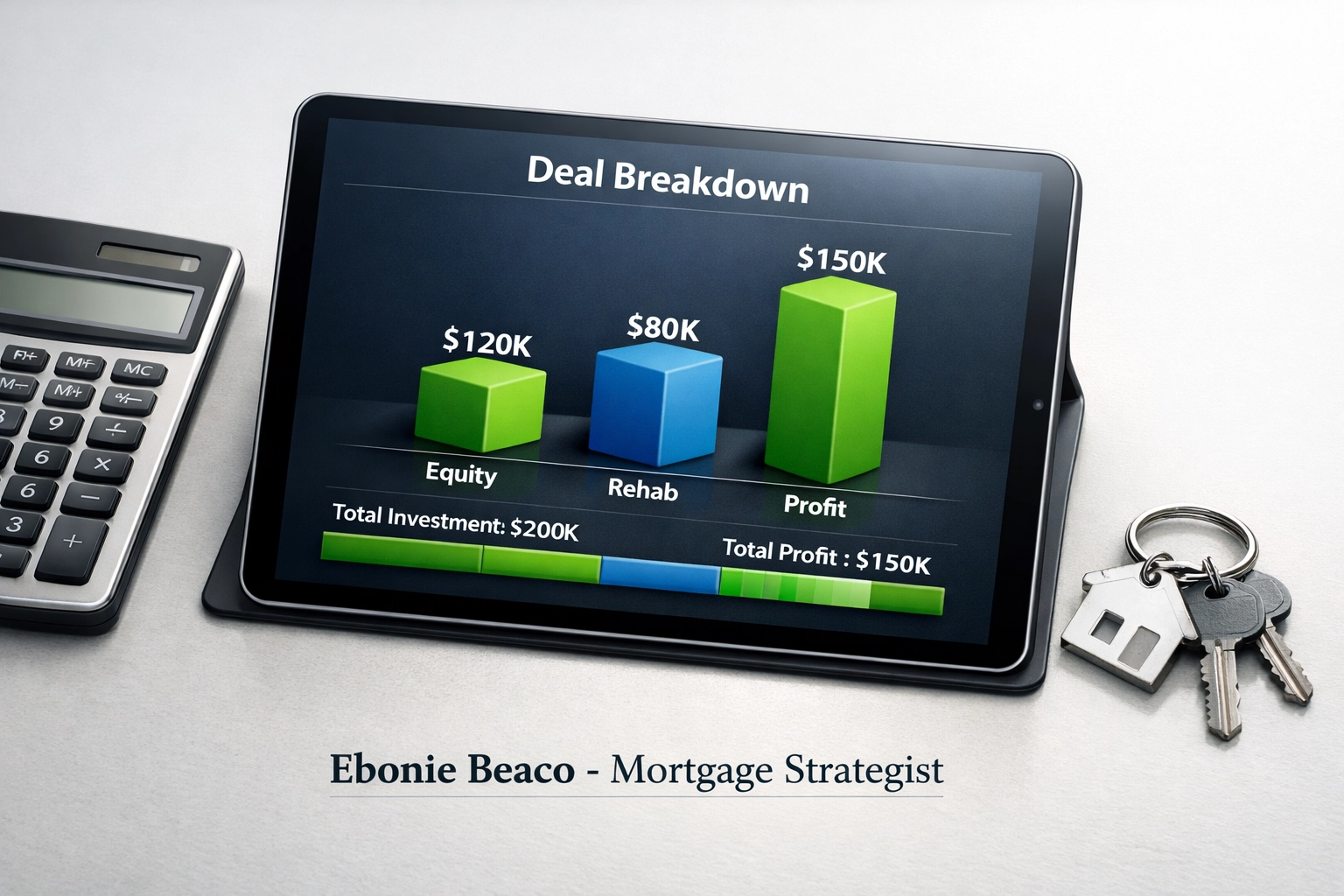
In this scenario, the investor has significant equity, making it an easy "yes" for most fix-and-flip lenders.
By providing this level of detail, you position yourself as a professional partner rather than just a middleman.
Legal Compliance and Best Practices
As you scale, the stakes become higher, and legal errors can be costly.
Contract Assignment vs. Double Closing
Assignment of Contract: A legal transaction where the original buyer (the wholesaler) transfers their rights and obligations to a new buyer.
This is the most common method for wholesaling.
Double Closing: Two separate real estate transactions that occur back-to-back, where the wholesaler briefly takes title to the property.
This is often used when the wholesale fee is very large and the wholesaler wants to keep the profit private.
Transparency and Disclosure
Maintain transparency with both your sellers and your buyers to build a long-term reputation.
Always disclose that you are an investor looking to make a profit and that you may assign the contract.
Review our Privacy Policy and Accessibility Statement for more on how we handle professional standards.
Tools for Scaling
To manage multiple deals in different states like Virginia, Illinois, or Michigan, you need the right tech stack.
- CRM: Use platforms like Podio or Salesforce to track leads and automated follow-ups.
- Data Software: Tools that provide lists of pre-foreclosures, tax liens, and probate leads.
- Communication: Systems that allow your VAs to call and text leads while recording data directly into your CRM.
- Electronic Signatures: Use secure platforms to get contracts signed quickly, which is vital in fast-moving markets like Chicago.

Final Thoughts on Scaling
Scaling real estate wholesale is about building a machine that operates independently of your daily involvement.
Focus on market selection, lead generation, and building a buyer list that trusts your numbers.
Whether you are looking for an Atlanta investment property or a high-margin deal in California, the principles of systems and delegation remain the same.
By understanding the financing needs of your buyers, including Jumbo Loans or Home Purchase options, you become a more valuable asset to their investment team.
If you are ready to explore how financing can help your buyers close more deals, we are here to guide you.
Schedule a 1 on 1 at https://calendly.com/homeloansnetwork
Ebonie Beaco
Mortgage Strategist | Senior Loan Officer
Home Loans Network powered by Loan Factory Inc.
NMLS #2389954
HomeLoansNetwork.com
312-392-0664