The Ultimate Guide to Mastering Your Real Estate Math: Why Every Investor and Wholesaler Needs This Cash Flow Calculator

Let’s be honest for a second. In the 2026 real estate market, "vibes" don't pay the mortgage. If you are a wholesaler in Birmingham, an investor in Chicago, or a landlord in the outskirts of Atlanta, you already know that the margin between a home run and a financial disaster is thinner than ever. Interest rates have been doing backflips, and property values in states like Florida and Virginia are shifting faster than a TikTok trend.
If you aren't running your numbers through a rigorous filter, you aren't investing; you’re gambling. And as your Mortgage Strategist, I’m here to tell you that the house always wins unless you bring a better calculator to the table.
I see a lot of deals come across my desk. Some are brilliant, and some are... well, let’s just say they are creative writing projects. The difference between the two usually comes down to one thing: a deep, unwavering commitment to the math. That is why you need to be using the REI Cash Flow Calculator. It is the same tool I recommend to my top-tier clients who are scaling their portfolios using DSCR Rental Property Loans and Fix and Flip Financing.
Why Your "Mental Math" is Costing You Money
Most people start their journey by looking at the rent, subtracting the mortgage, and pocketing the difference in their heads. That’s a fast track to a negative bank balance. Real estate has hidden "leakage": those pesky expenses like capital expenditures (CapEx), vacancy rates, and property management fees that eat your profit while you’re sleeping.
The REI Cash Flow Calculator removes the guesswork. It forces you to look at the cold, hard data. Whether you are doing a BRRRR (Buy, Rehab, Rent, Refinance, Repeat) in Michigan or looking for a Short-Term Rental in the Florida panhandle, this tool provides the transparency you need to walk into a closing with confidence.
Breaking Down the Features: How to Use the Strategy
The REI Cash Flow Calculator isn't just a spreadsheet on steroids. It’s a strategic roadmap. Here is how you should be navigating its primary sections to ensure your deal is actually a deal.
1. Property Details and Purchase Info
This is the foundation. You enter the purchase price, but more importantly, you account for the "as-is" value versus the "after-repair value" (ARV). For my wholesalers in Indiana and Missouri, getting the ARV right is the difference between a $20,000 assignment fee and a canceled contract.
2. Loan and Financing Assumptions
This is where I live. You’ll input your down payment, interest rate, and loan term. If you’re looking at Non-QM Mortgage Loans or Bank Statement Loans because you’re self-employed, these numbers will look different than a traditional conventional loan.
3. Income Projections
Don't just put in the current rent. Look at the market rent. If you are pivoting to an Airbnb or Short-Term Rental strategy in Georgia, your income might be higher, but your turnover costs will be too.
4. Expenses (The Reality Check)
This section is where dreams go to die: or where real wealth is built. You must account for:
- Property Taxes: (In Illinois, specifically Chicago, you better get this number right).
- Insurance: (Crucial for our Florida and Virginia coastal investors).
- Maintenance and CapEx: The roof will leak eventually. Set aside 5-10% now.
- Management Fees: Even if you manage it yourself, account for the cost. Your time has a price tag.

Visual: A detailed breakdown chart showing the comparison between Gross Income and Net Operating Income (NOI) for a standard rental property. "Know Your Numbers, Grow Your Wealth." Ebonie Beaco - Mortgage Strategist.
A Practical Example: The $250,000 Investment Property
Let’s run a real-world scenario. Say you find a solid single-family home in Little Rock, Arkansas, or maybe a duplex in Louisville, Kentucky.
- Purchase Price: $250,000
- Down Payment: 20% ($50,000)
- Loan Amount: $200,000
- Interest Rate (2026 Strategy): 7.5% (Estimated for an investment property)
- Monthly Rent: $2,200
If you just look at the $2,200 rent vs. a $1,398 principal and interest payment, you think you’re making $802 a month. You’re wrong.
When you plug this into the REI Cash Flow Calculator, you add in:
- Taxes & Insurance: $350/mo
- Vacancy (5%): $110/mo
- Maintenance/CapEx (10%): $220/mo
- Property Management (10%): $220/mo
Suddenly, your total expenses (including debt service) are $2,298. You are losing $98 a month.
Without this tool, you would have closed on that loan, signed the papers, and realized three months later that you’re subsidizing your tenant's lifestyle. That is why the math is the only thing that provides safety in this industry.
The Benefits: Why This Tool is Your Secret Weapon
1. Speed of Execution
In markets like Alabama and Michigan, the good deals are gone in hours. You don't have time to build a custom spreadsheet for every lead. You need to be able to run numbers on your phone while you're standing in the driveway of the property.
2. Professional Reporting for Lenders
When you come to me for a DSCR (Debt Service Coverage Ratio) Loan, I need to see that the property’s income covers the debt. If you bring me a report from this calculator showing a 1.25 DSCR or higher, your path to a "Yes" from the underwriting department becomes much smoother. It shows me you’re an expert, not a hobbyist.
3. Risk Mitigation
By adjusting the "Assumptions" section, you can "stress test" your deal. What if the vacancy rate hits 10%? What if property taxes jump? If the deal still makes sense in a worst-case scenario, it’s a winner.
Who Should Be Using This?
Wholesalers: You need to justify your asking price to your cash buyers. Handing a buyer a detailed cash flow analysis for a property in Gary, Indiana, makes you look like a pro and helps you move your contracts faster.
Real Estate Investors: Whether you are doing a Fix and Flip in Virginia or a long-term rental in Missouri, you need to know your Cash-on-Cash Return. This metric tells you how hard your money is working for you compared to other investments.
Homeowners looking to Refinance: If you’re considering a Cash-Out Refinance to buy your next investment property, use this tool to see if the new rental will support the debt you're taking on.
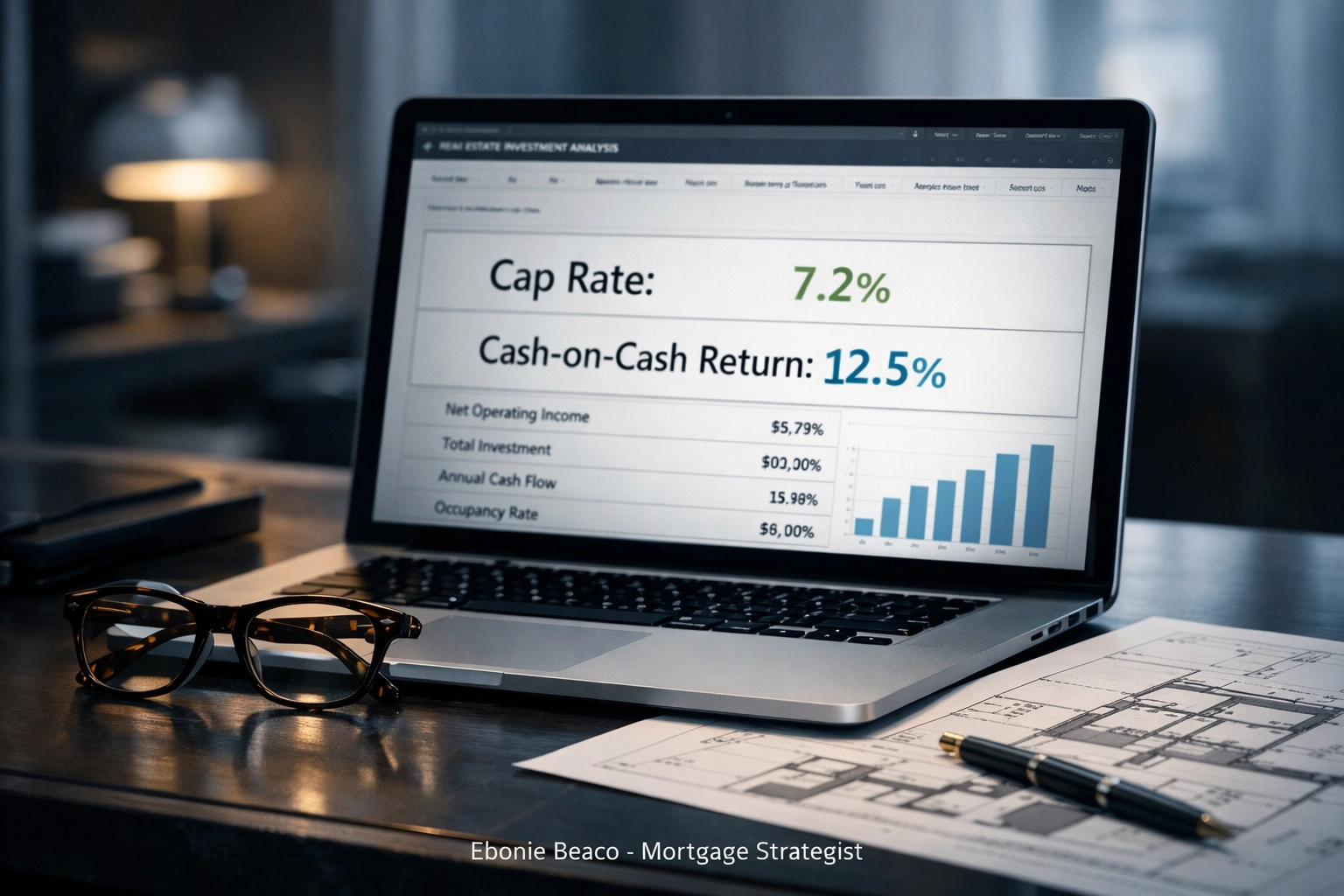
Visual: A tablet displaying a sleek financial dashboard with "Cash-on-Cash Return" and "Cap Rate" metrics highlighted. Overlay text: "Know Your Numbers, Grow Your Wealth." Ebonie Beaco - Mortgage Strategist.
Strategy Session: Financing Your Analyzed Deals
Once the REI Cash Flow Calculator tells you the deal is a "Go," that’s where my team at Home Loans Network steps in. We specialize in the financing strategies that traditional banks often shy away from.
- DSCR Investor Loans: We qualify the loan based on the property’s income, not your personal DTI.
- Fix and Flip / Bridge Loans: Perfect for short-term projects where speed and leverage are the goals.
- HELOC Loans: Access the equity in your current primary residence to fund the down payment on your next deal.
- Landlord Loans: Tailored for portfolios of all sizes across the Midwest and Southeast.
Investing in real estate is one of the most proven ways to build generational wealth, but it requires a disciplined approach. Don't let a "good feeling" lead you into a bad closing. Use the tool, verify the data, and then let’s structure the financing to maximize your leverage and your ROI.
If you have a deal on the table right now in Florida, Georgia, Illinois, or any of our active states, run it through the calculator and let’s talk about how to get it funded.
Ready to take the next step in your investment journey?
Don't leave your wealth to chance. Use the calculator to vet your deals, then reach out to me to discuss the best mortgage strategy for your specific goals. Whether it’s your first rental or your fiftieth, having an expert loan officer in your corner is the most valuable asset you can have.
Schedule a 1 on 1 at https://calendly.com/homeloansnetwork
Ebonie Beaco
Mortgage Strategist | Senior Loan Officer
Home Loans Network powered by Loan Factory Inc.
NMLS #2389954
HomeLoansNetwork.com
312-392-0664