The Ultimate Guide to Finding Off-Market Properties: Everything You Need to Succeed in California

Finding the right deal in today’s real estate market often feels like searching for a needle in a haystack, especially in high-demand regions like California, Florida, and Atlanta. If you are relying solely on the Multiple Listing Service (MLS), you are competing with thousands of other buyers, institutional investors, and hedge funds. To truly scale a real estate wholesaling business or build a rental portfolio, you have to go where the competition isn’t.
Off-market properties represent the "hidden" inventory of the real estate world. These are homes available for sale that never hit public sites like Zillow or Redfin. In some luxury pockets of California, like Marin County, nearly 20% of homes trade hands without ever seeing a "For Sale" sign on the lawn.
What is an Off-Market Property?
Off-Market Property: A real estate asset that is available for purchase but is not listed on the Multiple Listing Service (MLS).
Investors use these properties to avoid bidding wars and negotiate directly with sellers.
Pocket Listing: A property retained by a real estate broker who markets it privately to a select group of buyers rather than the general public.
This allows for privacy for the seller and exclusive access for the buyer.
Wholesaling: The process of a middleman (the wholesaler) contracting a property with a seller and then assigning that contract to an end buyer for a fee.
It is a high-speed strategy used to generate quick capital without taking long-term title to the property.
The Significance of Off-Market Deals in California and Beyond
California remains one of the most difficult markets to penetrate due to tight inventory and high entry costs. As of early 2026, California’s distressed property market includes over 15,000 properties in some stage of foreclosure and nearly 4,000 homes scheduled for auction. These numbers represent opportunity for those who know how to look.
Florida real estate investing follows a similar path. In cities like Miami, Tampa, and Orlando, the influx of out-of-state residents has squeezed supply. Investors in Florida often focus on "tired landlords" or absentee owners to find deals that aren't yet public.
Atlanta, Georgia, has become a powerhouse for wholesaling. The city's rapid expansion and diverse neighborhoods provide a steady stream of aging homes perfect for the fix-and-flip model.

Top Strategies for Finding Off-Market Deals
To succeed in wholesaling or investing, you need a multi-pronged lead generation strategy. You cannot rely on a single source of data.
1. Direct Mail Marketing
Direct mail involves sending postcards or "yellow letters" to targeted lists of homeowners. You might target individuals with high equity, those who have inherited property (probate), or those facing tax liens.
Explore this method if you have the budget for consistency; direct mail typically requires three to five "touches" before a seller calls you back.
2. Driving for Dollars
This is the most "boots on the ground" strategy available. You drive through neighborhoods in cities like Riverside, CA, or suburbs of Atlanta looking for physical signs of distress: boarded windows, overgrown lawns, or piles of mail.
Jump in by using apps that allow you to pin a property address and instantly find the owner’s contact information.
3. Public Records and Legal Notices
County courthouses are gold mines for information. You can find lists of pre-foreclosures, divorce filings, and tax delinquent properties.
Access these records to find sellers who are motivated by a timeline. If a house is going to auction in three weeks, the owner is often willing to negotiate a quick cash sale to save their credit.
4. Networking with Professionals
Build relationships with probate attorneys, divorce lawyers, and even mail carriers. These professionals are often the first to know when a property is about to become vacant or needs to be sold quickly.
Compare different referral structures to see how you can provide value back to these partners.
Real Estate Wholesaling: The Mechanics of the Deal
In real estate wholesaling, your goal is to find a property at a deep discount, lock it under contract, and "assign" that contract to a cash buyer. The difference between your contract price with the seller and the price the cash buyer pays is your assignment fee.
To be a successful wholesaler in California or Florida, you need to understand the MAO (Maximum Allowable Offer) formula.
ARV (After Repair Value): The estimated value of a property after it has been fully renovated.
Fixed Costs: The expenses associated with buying, holding, and selling the property (taxes, insurance, utilities, commissions).
The Formula:MAO = (ARV x 70%) - Repair Costs - Your Wholesale Fee
Financial Breakdown Example: A Florida Wholesale Deal
Let’s look at a real-world scenario for a distressed single-family home in Jacksonville, Florida.
- After Repair Value (ARV): $350,000
- Estimated Renovation Costs: $60,000
- Target Wholesale Fee: $15,000
Using the 70% rule (standard for many fix-and-flip buyers):
- $350,000 x 0.70 = $245,000
- $245,000 - $60,000 (Repairs) = $185,000
- $185,000 - $15,000 (Your Fee) = $170,000 (Your Maximum Offer to the Seller)
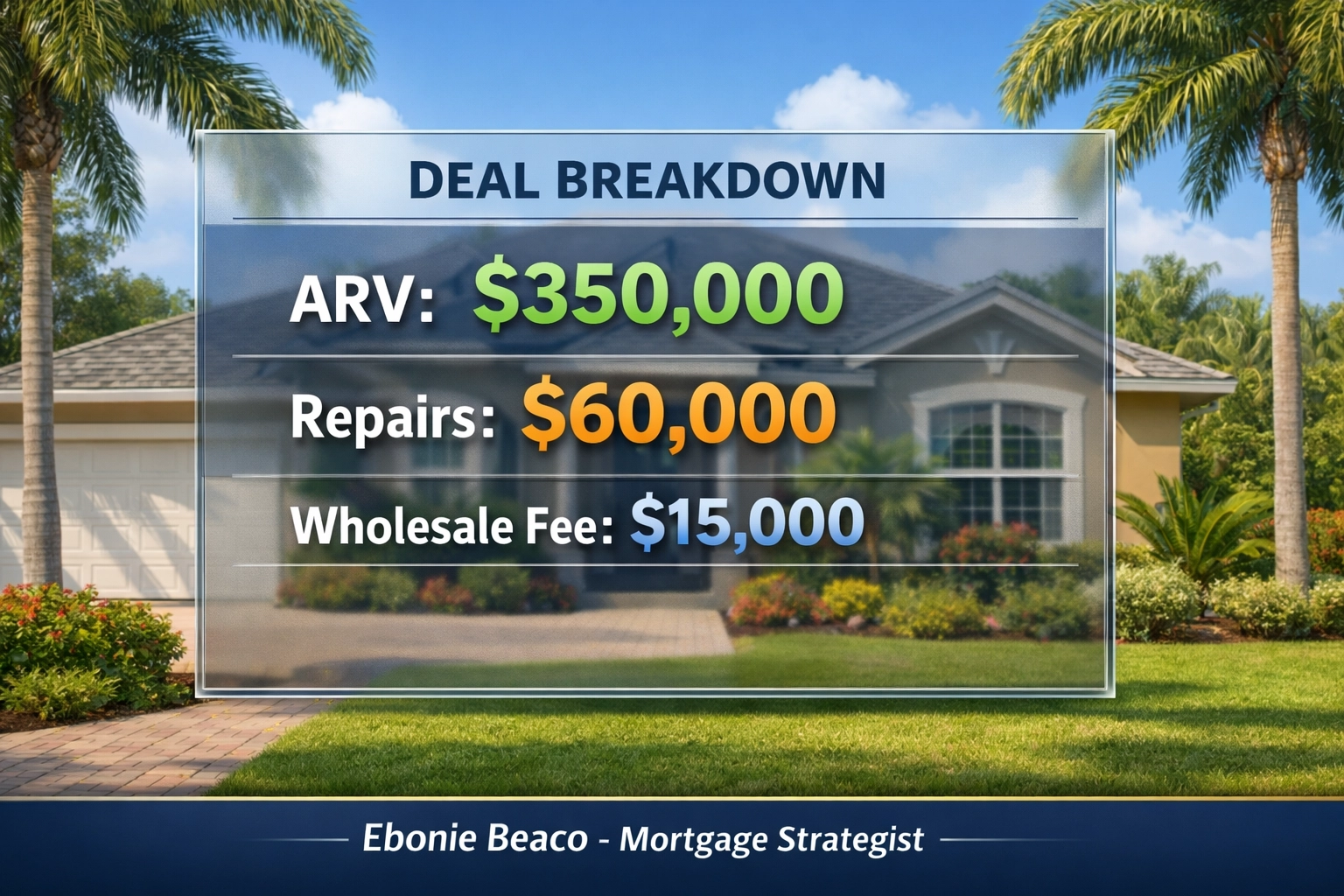
In this scenario, you would put the house under contract for $170,000 and sell the assignment to a flipper for $185,000. You walk away with $15,000 without ever swinging a hammer or taking out a long-term mortgage.
How Financing Fuels the Off-Market Engine
Even if you are wholesaling, you need to understand the financing your end-buyers will use. If your buyer can't get funding, your deal won't close.
DSCR Rental Property Loans
Many investors buying off-market deals in Atlanta or Florida are "buy-and-hold" landlords. They often use DSCR (Debt Service Coverage Ratio) loans.
DSCR: A loan where qualification is based on the property’s rental income rather than the borrower’s personal income.
If the rent covers the mortgage payment (and then some), the loan is a go. This is perfect for investors who have reached their limit on conventional loans.
Fix and Flip Financing
For the properties found through "driving for dollars" that need heavy work, your buyers will likely use Fix and Flip Loans (also known as hard money).
These are short-term, interest-only loans designed to cover the purchase and the renovation costs. Understanding these loan programs allows you to vet your buyers effectively.
Cash-Out Refinance Strategies
Experienced investors often use the BRRRR method (Buy, Rehab, Rent, Refinance, Repeat). They might buy an off-market property in California using a bridge loan, renovate it, and then use a cash-out refinance to pull their initial capital back out to buy the next one.
Navigating the Markets: CA, FL, and GA
California Strategy
In California, transparency is key. Because property values are so high, a small mistake in repair estimates can ruin a deal. Focus on "ADU potential." Many off-market buyers in Los Angeles or the Bay Area are looking for properties where they can add an Accessory Dwelling Unit to increase the property value and rental yield.
Florida Strategy
Florida is a "tax deed" and "tax lien" state. Investigating the county tax collector's list of delinquent properties is a prime way to find off-market leads. Florida real estate investing also relies heavily on the "absentee owner" list: people who own property in Florida but live in New York or Canada and are tired of managing a long-distance rental.
Atlanta Strategy
The Atlanta market is highly neighborhood-specific. Wholesalers here focus on areas seeing rapid gentrification or "path of progress" development. Direct mail campaigns targeting "long-term owners" (those who have owned for 20+ years) often yield the best results for finding homes that need modern updates.

Key Acronyms Every Wholesaler Should Know
- LTV (Loan to Value): The ratio of the loan amount to the value of the asset.
- REO (Real Estate Owned): Properties owned by a bank after an unsuccessful auction.
- ROI (Return on Investment): The percentage of profit made on a deal relative to the cost.
- POF (Proof of Funds): A document showing a buyer has the cash available to close; essential for off-market offers.
Building Your Buyers List
Finding the deal is only half the battle. You need a list of hungry investors ready to buy.
Access local real estate investment associations (REIAs) in your target cities.
Explore online platforms and social media groups dedicated to "Florida Real Estate Investing" or "California Fix and Flip."
The faster you can flip your contract, the faster you get paid and move on to the next lead.

Final Thoughts for the Modern Investor
Success in the off-market world requires a blend of data analysis and old-school networking. Whether you are looking for your first wholesale deal in Atlanta or trying to find a distressed property for a jumbo loan renovation in California, the principles remain the same: find the motivated seller, solve their problem, and understand the financing that makes the deal move.
At Home Loans Network, we specialize in helping investors navigate the complex world of real estate finance. From DSCR investor loans to fix and flip financing, we provide the tools you need to close more deals.
Ready to discuss your next investment scenario or need a proof of funds for an off-market offer?
Schedule a 1 on 1 at https://calendly.com/homeloansnetwork
Ebonie Beaco
Mortgage Strategist | Senior Loan Officer
Home Loans Network powered by Loan Factory Inc.
NMLS #2389954
HomeLoansNetwork.com
312-392-0664