The Ultimate Guide to California Fix and Flip Loans: Everything You Need to Succeed

SEO Title: California Fix and Flip Loans: The Complete Investor’s Guide for 2026
Meta Description: Master the California real estate market with our guide to fix and flip loans. Explore financing strategies, profit calculations, and tools to scale your portfolio.
URL Slug: california-fix-and-flip-loans-guide
Featured Image Recommendation: A professional landscape photograph of a California luxury home undergoing high-quality renovations with clear blue skies and palm trees.
SEO Alt Text: High-end California contemporary home under renovation representing a fix and flip investment project.
Social Media Excerpt: Ready to scale your real estate portfolio in California? Our ultimate guide breaks down fix and flip financing, deal analysis, and market trends for 2026. Learn how to secure the best loans and maximize your ROI.
SEO Tags: Fix and Flip Loans, California Real Estate, Real Estate Investing, Hard Money Loans, DSCR Loans, Rehab Loans, Investment Property Financing, REI Vault Pro, Bridge Loans, Home Equity.
California remains a primary destination for real estate investors seeking high-impact opportunities. The combination of strong buyer demand and a persistent shortage of updated housing inventory creates a fertile environment for fix and flip projects. However, the high entry costs in markets like Los Angeles, San Diego, and San Francisco require a sophisticated approach to financing.
Navigating the landscape of California fix and flip loans requires more than just capital; it demands a deep understanding of leverage, risk management, and the speed of execution. Whether you are a seasoned developer or an aspiring investor looking to enter the market, choosing the right loan program is the foundation of a successful project.
Technical Definitions for Fix and Flip Financing
To succeed in the California market, you must be fluent in the language of real estate finance. Understanding these core concepts allows you to communicate effectively with lenders and accurately project your returns.
Fix and Flip Loan
Definition: A short term, asset based loan specifically designed for the purchase and renovation of a property intended for resale.
Application: Use this to acquire distressed properties quickly without the lengthy documentation required by traditional banks.
After Repair Value (ARV)
Definition: The estimated market value of a property after all planned renovations and improvements are completed.
Application: Lenders use this figure to determine the maximum loan amount they are willing to provide, often capping at 70% to 75% of the ARV.
Loan to Cost (LTC)
Definition: A ratio used to express the percentage of the total project cost (purchase price plus rehab) that a lender is willing to finance.
Application: High-leverage programs may offer up to 90% LTC, meaning you only need to provide 10% of the total project capital.
Points
Definition: Upfront fees paid to a lender at closing, where one point equals 1% of the total loan amount.
Application: Compare points across different lenders to determine the total cost of capital for your 12 month hold.
Draw Schedule
Definition: A pre-negotiated timeline of fund releases from the lender to the borrower to cover completed renovation phases.
Application: Align your contractor’s milestones with the draw schedule to ensure consistent cash flow throughout the project.
Core Financing Options for California Investors
Financing a renovation project in California requires speed and flexibility. While traditional mortgage products are suitable for long term residents, they are rarely equipped to handle the pace or the property condition of a typical flip.
Hard Money and Bridge Loans
Hard money loans are the lifeblood of the fix and flip industry. These loans are primarily based on the value of the real estate rather than the borrower’s personal credit history. This makes them ideal for investors who need to close a deal in seven to ten days to beat out the competition.
In 2026, many institutional lenders have entered the hard money space, bringing more competitive rates and standardized terms. You can expect rates to range between 9% and 12%, depending on your experience and the specific location of the property. For those seeking even more scale, the REI Vault Pro AI Deal Analyzer can help you determine if the interest costs fit within your profit margins.
100% Financing and Partnering Models
For investors with a strong track record but limited liquid capital, some programs offer high-leverage solutions that cover nearly all acquisition and renovation costs. These "zero cash to close" models often involve a higher interest rate or a profit sharing agreement.
While these programs reduce your personal financial risk, they require extreme precision in your budget. Utilizing a tool like the AI Rehab Estimator ensures that your renovation costs are accurately accounted for before you sign a partnership agreement.
DSCR Loans as an Exit Strategy
Not every project ends in a sale. Sometimes, the most profitable path is to keep the renovated property as a long term rental. This is known as the BRRRR strategy (Buy, Rehab, Rent, Refinance, Repeat). Once the renovation is complete, you can refinance your short term bridge loan into a long term DSCR Investor Loan.
DSCR (Debt Service Coverage Ratio) loans qualify based on the property’s rental income rather than your personal income. If the property's rent covers the mortgage payment, you can often pull out your initial equity to fund your next project. You can analyze your potential rental income using the AI Rent Analyzer to confirm your exit strategy.
Analyzing a California Fix and Flip Deal
To illustrate how these loans function in a real scenario, let’s look at a typical mid-market project in a metropolitan area like Sacramento or Riverside.
Assume you identify a property with a purchase price of $650,000. Based on your research, the renovation required to bring it to modern standards will cost $110,000. After these improvements, the ARV is projected at $980,000.
Using a fix and flip loan with 90% LTC (Loan to Cost), the lender would provide $684,000. This covers a significant portion of the purchase and renovation. Your total out-of-pocket capital would be the remaining $76,000 plus closing costs and interest payments.

In this scenario, after accounting for six months of interest, selling costs, and holding fees, the projected net profit is approximately $185,000. This demonstrates the power of utilizing high-leverage financing to maximize the return on your invested capital. To run these numbers for your own potential deals, explore the AI Underwriting tools provided by REI Vault Pro.
Why Location within California Shapes Your Loan Terms
California is not a monolithic market. A fix and flip in the Silicon Valley area of San Francisco carries different risks and rewards than a project in the Central Valley or the Inland Empire. Lenders adjust their terms based on the liquidity and demand of the specific sub-market.
- Coastal Metros (LA, SF, SD): These areas often see the highest ARVs but also the highest competition. Lenders may offer more aggressive terms to experienced flippers in these high-demand zones.
- Inland Regions: In areas like Fresno or Bakersfield, entry prices are lower, making them accessible to newer investors. Lenders here might focus more on the borrower’s experience and the realism of the renovation budget.
- Short-Term Rental Markets: Investors flipping properties in destination areas like Joshua Tree or Lake Tahoe may find that lenders look favorably on properties that can transition into Airbnb rentals if the resale market shifts.
Regardless of where you invest, from the tech hubs of California to the emerging markets in Alabama, Florida, and Georgia, staying informed on local trends is essential. Access AI Market Analysis to stay ahead of shifting buyer preferences in your target zip codes.
Essential Tools for California Flippers
Managing a flip from three hundred miles away or even across the street requires a digital infrastructure. The "pen and paper" era of real estate investing has been replaced by sophisticated AI platforms that allow for rapid data processing and risk assessment.
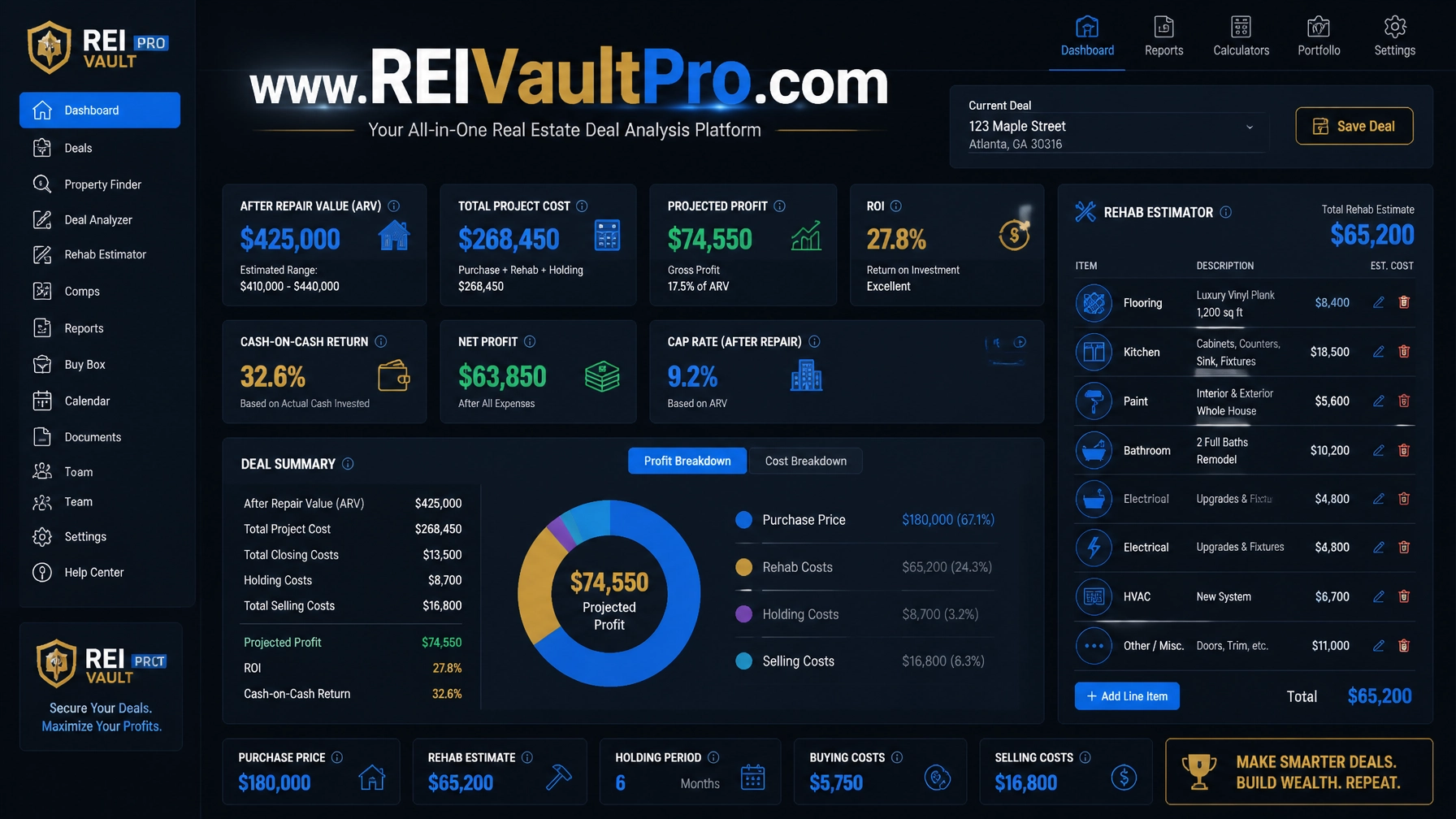
The REI Vault Pro platform offers a suite of tools designed to streamline every phase of the investment lifecycle. From the initial search for distressed inventory to the final underwriting of a multi-unit apartment building, these resources provide the clarity needed to make confident decisions.
Jump in and explore how these tools can reduce the time you spend on spreadsheets and increase the time you spend finding deals. Whether you are focused on single-family homes or scaling into commercial real estate, having an expert guide in your pocket is a competitive advantage.
Related REI Vault Pro Resources
- AI Deal Analyzer: This tool allows you to input property data and instantly receive a comprehensive breakdown of potential ROI, cash-on-cash returns, and profit margins. It is essential for verifying that a California flip is financially viable before committing to a loan.
- AI Rehab Estimator: Avoid the common mistake of underestimating renovation costs. This tool provides data-driven estimates for materials and labor based on the specific project scope, helping you present a professional budget to your lender.
- AI Rent Analyzer: If your exit strategy involves keeping the property as a rental, this resource provides accurate local market rent data. It helps you calculate your DSCR ratio and ensures your long term financing will be approved.
- AI Market Analysis: Stay updated on housing trends in California and beyond. This tool provides insights into absorption rates, median sales prices, and buyer demand, allowing you to choose the best markets for your next project.
The Path to Professional Real Estate Investing
Success in the California fix and flip market is a combination of local expertise and strategic financing. By leveraging the right loan products and utilizing advanced analytical tools, you can navigate the complexities of the 2026 housing market with confidence.
Investing in real estate is a journey of wealth building that requires constant education and the right partnerships. As you look to expand your portfolio across California or into states like Illinois, Indiana, and Virginia, remember that your financing is just as important as the property itself.
Access the resources you need to take your business to the next level. Compare different loan scenarios, explore new markets, and structure your deals for maximum impact.

Are you ready to transform your approach to real estate investment? We invite you to explore the full capabilities of our platform. Join the community of professional investors today at https://reivaultpro.com/join or Watch a Demo at https://reivaultpro.com/demo to see our AI tools in action. For those committed to long term success, consider our Lifetime Membership at https://reivaultpro.com/lifetime-membership for unlimited access to our elite investment suite.
Frequently Asked Questions
What is the average interest rate for a California fix and flip loan?
In the 2026 market, interest rates for fix and flip loans typically range from 9% to 12%. These rates are influenced by the borrower’s experience level, the property’s location, and the amount of leverage being requested. Experienced investors with multiple successful exits often qualify for the lower end of this range.
Do I need a high credit score to get a hard money loan in California?
While some lenders may check your credit history, hard money loans are primarily asset-based. The focus is on the property’s value and the potential profit of the deal. However, a higher credit score can lead to better terms and lower interest rates.
Can I use a fix and flip loan for a multi-unit property?
Yes, fix and flip loans can be used for various property types, including single-family homes, condos, and small multi-unit buildings (2-4 units). For larger apartment buildings or commercial properties, investors typically use bridge loans or specialized commercial construction financing.
How fast can I get funding for a deal?
One of the primary benefits of fix and flip loans is the speed of funding. Many lenders in our network can close a loan in as little as 7 to 10 days, provided the appraisal and title work are completed promptly. This allows you to compete with all-cash buyers.
What happens if the renovation takes longer than expected?
Most fix and flip loans have a term of 12 to 18 months. If your project runs behind schedule, many lenders offer extension options for an additional fee. It is important to communicate with your lender early if you anticipate needing more time to complete the project or sell the property.