The Ultimate Guide to Aging in Place: How Reverse Mortgages Keep You in the Home You Love

For most of us, "home" is more than just a roof and four walls. It is the place where you raised your kids, hosted countless holiday dinners, and built a lifetime of memories. As you look toward your retirement years, the idea of packing up and moving to an assisted living facility or a smaller condo might feel more like a chore than a choice.
This desire to stay put is called aging in place. It is a growing movement across the country, from the coastal suburbs of California to the historic neighborhoods of Atlanta, Georgia. However, staying in your home as you get older often requires home modifications, in home care, or simply a bit more cash flow to manage rising property taxes and insurance.
That is where a reverse mortgage enters the picture. It is a strategic financial tool that allows you to tap into your home equity without the burden of a monthly mortgage payment. Let’s dive into how this works and why it might be the key to staying in the home you love.
Why Aging in Place is the New Retirement Standard
Aging in Place is the ability to live in one’s own home and community safely, independently, and comfortably, regardless of age, income, or ability level.
Staying in your own environment provides a sense of continuity and comfort that a managed facility simply cannot replicate. But, let’s be real: homes require upkeep. Maybe you need to install a walk-in tub, widen some doorways, or hire a lawn service. These costs add up, especially on a fixed income.
Many homeowners in states like Florida and Michigan find that while their home value has skyrocketed, their monthly cash flow has stayed the same. This "house rich, cash poor" situation is exactly what reverse mortgages were designed to solve.
Decoding the Reverse Mortgage: What It Actually Is
A Reverse Mortgage is a loan for homeowners aged 62 or older that allows you to convert a portion of your home equity into cash.
Unlike a traditional mortgage where you make monthly payments to the lender, in a reverse mortgage, the lender essentially pays you. You still own the home, and you are still responsible for the property taxes and homeowners insurance. The loan is typically repaid when the last surviving borrower moves out of the home permanently or passes away.
Key Benefits of This Strategy:
- No Monthly Mortgage Payments: You are no longer required to make a monthly principal and interest payment.
- Tax-Free Cash: The money you receive from a reverse mortgage is generally considered a loan advance and is not taxed as income.
- Stay in Your Home: You retain the title and ownership of your property.
- Flexible Payouts: You can receive the money as a lump sum, a monthly payment, or a growing line of credit.
If you want to see how much equity you might have available, you can check out our mortgage calculators to get a head start on your planning.

HECM vs. Proprietary Loans: Finding Your Best Fit
Not all reverse mortgages are the same. Depending on your home value and your goals, you will likely choose between a government-insured HECM or a private Proprietary loan.
The HECM (Home Equity Conversion Mortgage)
The HECM is the most common type of reverse mortgage. It is insured by the Federal Housing Administration (FHA).
Because it is government-backed, it has strict rules and protections for the borrower. One of the biggest features is the "non-recourse" clause, which means you or your heirs will never owe more than the home is worth at the time of sale. For 2026, the maximum claim amount for a HECM is $1,149,825. If your home is worth more than that, you might be leaving money on the table with a HECM.
Proprietary (Jumbo) Reverse Mortgages
A Proprietary Reverse Mortgage is a private loan not insured by the FHA. These are often called "Jumbo Reverse Mortgages."
These loans are designed for high-value properties, often reaching up to $4 million or more in home value. If you own a luxury property in Southern California or a high-end estate in Virginia, a proprietary loan allows you to access much more cash than the HECM limit would permit.
The Math: How Loan-to-Value (LTV) Works for Seniors
When you apply for a reverse mortgage, the lender doesn't just look at your credit score. The most important factor is the Principal Limit, which is the total amount of money you can borrow. This is calculated based on:
- The age of the youngest borrower.
- The current interest rate.
- The appraised value of the home.
In the reverse mortgage world, we don't use a standard 80% LTV like you see in home refinance scenarios. Instead, we use a Principal Limit Factor (PLF).
Generally, the older you are, the higher the PLF, and the more money you can get. For example, a 62-year-old might qualify for roughly 35-45% of their home value, while an 85-year-old might qualify for 60-70%.
Case Study: Mr. Park’s Success in Irvine, California
Let’s look at a real-world example of how a Proprietary Reverse Mortgage can change a retirement trajectory.
The Client: Mr. Joon-Ho Park, a 74-year-old retired engineer living in Irvine, California.
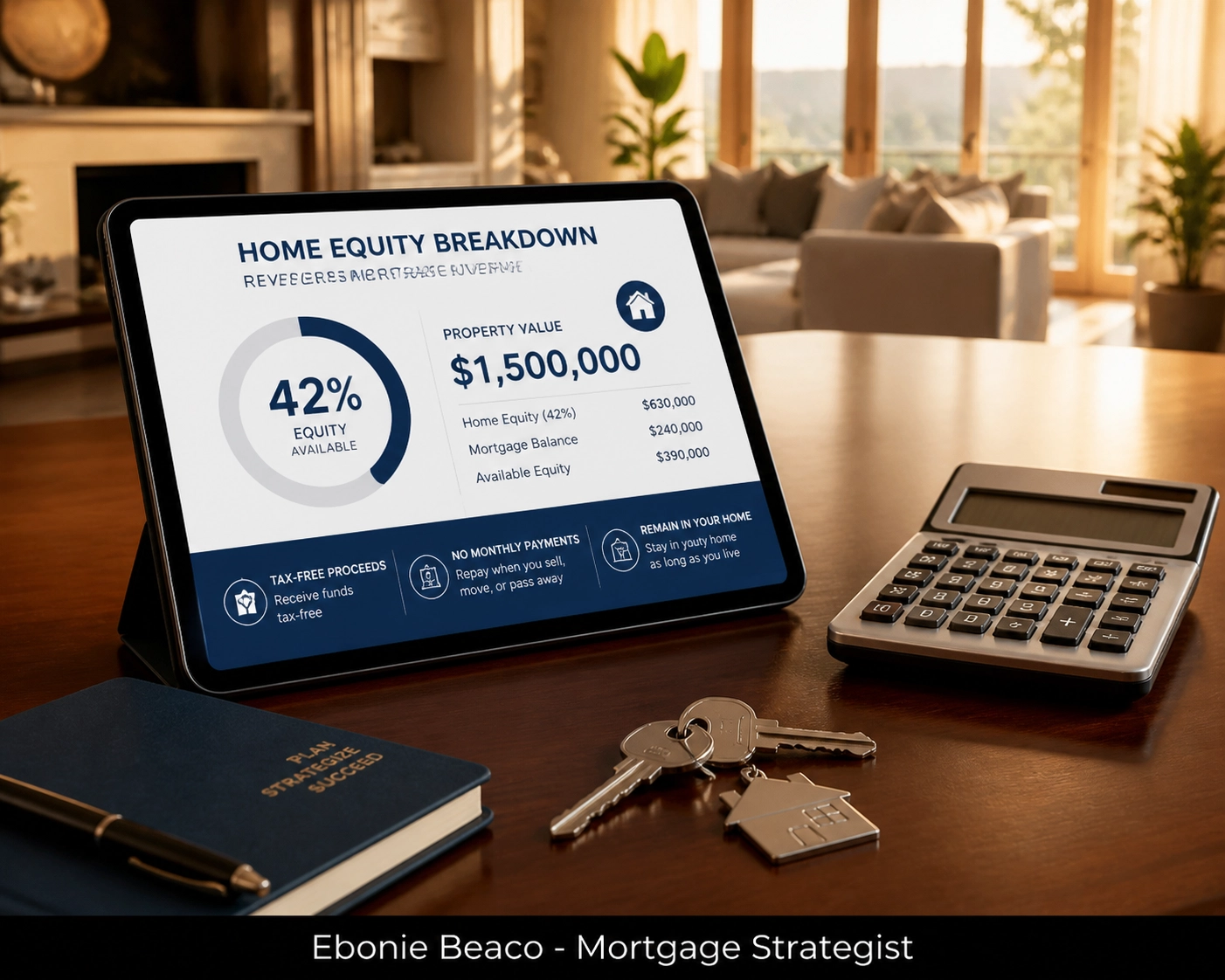
The Property: A beautiful single-family home valued at $1,500,000.
The Goal: Mr. Park wanted to renovate his first floor to be more accessible and hire a part-time caregiver so he wouldn't have to move in with his children.
The Calculation Breakdown:
Mr. Park’s home value exceeds the FHA HECM limit of $1,149,825. If he went with a HECM, his "value" for the calculation would be capped at that limit. By choosing a Proprietary Reverse Mortgage, he can use the full $1.5 million valuation.
- Home Value: $1,500,000
- Existing Mortgage: $0 (He owns it free and clear)
- Principal Limit Factor (PLF): Based on his age of 74 and current rates, his PLF is approximately 42%.
- Total Funds Available: $1,500,000 x 0.42 = $630,000.
Mr. Park chose to take $150,000 upfront for his home renovations and set up the remaining $480,000 as a line of credit. Now, he has the peace of mind knowing that he has a massive "emergency fund" for healthcare costs, and he doesn't have to worry about a monthly mortgage payment for the rest of his life.
This strategy allowed Mr. Park to maintain his independence and keep his wealth within his home until he no longer needs it. You can learn more about how ownership works in these scenarios by visiting our mortgage basics glossary.
Smart Ways to Use Your Reverse Mortgage Equity
Once you unlock your equity, how should you use it? Our clients in markets like Chicago, Illinois, and various cities in Florida often use their funds for:
- Eliminating an Existing Mortgage: This is the most common use. By paying off a traditional mortgage with a reverse mortgage, you immediately increase your monthly cash flow because the monthly payment goes away.
- Home Accessibility Upgrades: Installing ramps, widening hallways, or updating bathrooms to prevent falls.
- In-Home Care: Paying for professional caregivers allows you to stay safe at home rather than moving to a facility.
- Property Taxes and Insurance: Setting aside a "set-aside" account to ensure these bills are always paid on time.
- Silver Divorce: Using the equity to buy out a spouse's interest in the home so one person can stay put.
If you are curious about other ways to use your home equity, such as a HELOC loan, it's always worth comparing all your options.

Eligibility Checklist: Do You Qualify?
To qualify for a HECM or most proprietary reverse mortgages, you need to meet a few specific criteria:
- Age Requirement: At least one borrower must be 62 or older (some proprietary loans allow age 55+ in certain states).
- Primary Residence: The home must be your main place of living. You cannot do this on a rental property or a vacation home.
- Sufficient Equity: You typically need at least 50% equity in the home.
- Financial Assessment: Lenders will check your credit and income to ensure you can stay current on property taxes and insurance.
- Counseling: For HECM loans, you must complete a session with a HUD-approved counselor to ensure you understand all the details.
Common Misconceptions About Reverse Mortgages
There is a lot of bad info out there, so let’s clear up a few things:
- "The bank owns my home." – False. You keep the title. It is just like any other mortgage; the lender has a lien, but you are the owner.
- "I will leave my kids with a massive debt." – False. Reverse mortgages are non-recourse loans. If the home is sold for less than the loan balance, the insurance (or the lender in proprietary cases) covers the gap. Your heirs are not personally liable.
- "I can be kicked out at any time." – False. As long as you live in the home, pay your taxes/insurance, and keep the home in good repair, you can stay there forever.
If you are a real estate investor or a homeowner looking for more traditional options, you might also find our info on DSCR investor loans or cash-out refinance strategies helpful.
Final Thoughts: Taking the Next Step
Aging in place is about dignity, comfort, and staying connected to your community. A reverse mortgage isn't just a loan; it is a lifestyle preservation strategy. Whether you are in Alabama, Arkansas, Indiana, or Kentucky, your home equity can be the key to a stress-free retirement.
Navigating these options can feel overwhelming, but you don't have to do it alone. We are here to guide you through the math, the pros, and the cons to see if this fits your long-term goals.

Ready to see what your home equity can do for you?
Schedule a 1 on 1 at https://calendly.com/homeloansnetwork
Ebonie Beaco
Mortgage Strategist | Senior Loan Officer
Home Loans Network powered by Loan Factory Inc.
NMLS #2389954
HomeLoansNetwork.com
312-392-0664