The Stability of Single-Family Home Investing: Why It Works
If you are looking at the real estate market today, it is easy to feel overwhelmed by the options. Should you look at high-density apartment buildings in Chicago? Maybe a beachside Airbnb in Florida? While those options have their perks, there is a reason why the humble single-family home remains the backbone of many successful investment portfolios.
Single-family home investing offers a unique blend of stability, simplicity, and predictable growth. Whether you are a first-time landlord in Alabama or a seasoned investor scaling a portfolio in California, understanding the mechanics of these properties is the first step toward long-term wealth. At Home Loans Network, we believe in providing a clear view of how these deals actually work.
Why Single-Family Homes Attract Stable Tenants
One of the primary drivers of stability in this asset class is the demographic it attracts. Families and long-term renters often seek out single-family homes because they want a yard, more privacy, and access to specific school districts. Unlike apartment dwellers who might move every time a lease is up, single-family tenants tend to stay for years.
When a tenant views a house as a home rather than just a unit, they are more likely to take care of the property. This pride of ownership leads to lower maintenance costs over time. Many landlords find that their tenants are happy to handle minor tasks like lawn care or changing air filters, which keeps operational complexity low. This lower turnover rate is a huge win for your bottom line because vacancy is often the biggest "hidden" cost in real estate.
Market Resilience and Lower Volatility
Historical data suggests that single-family rentals (SFRs) are remarkably resilient. Between 1992 and 2017, SFRs generated returns that rivaled the stock market but with far less volatility. While stock prices can swing wildly based on global news, the value of a single-family home is tied to the local housing market and the actual utility of the property.
In 2022, while other housing sectors saw a dip, single-family rental construction starts actually hit record levels. This tells us that even when the economy gets a bit shaky, people still need a place to live, and they prefer the space and privacy of a standalone house. For investors in states like Virginia, Georgia, and Michigan, this translates to a reliable asset that holds its value over the long term.
 Title: Single-Family Investing
Ebonie Beaco - Mortgage Loan Officer
Title: Single-Family Investing
Ebonie Beaco - Mortgage Loan Officer
Financing Your Investment: The Landlord Strategy
Getting the right financing is just as important as finding the right property. Many new landlords start by using a home purchase loan to acquire their first rental, or they might leverage the equity in their current residence through a cash-out refinance.
For those looking to scale quickly without the hurdles of traditional debt-to-income (DTI) requirements, DSCR Investor Loans are a game-changer.
DSCR (Debt Service Coverage Ratio): A mortgage program where qualification is based on the property’s rental income rather than the borrower’s personal income. Application: If the monthly rent covers the mortgage payment (PITI), the loan is often a "go," allowing you to keep your personal finances separate from the investment’s performance.
This strategy is particularly effective in markets like Indianapolis or various cities in Florida where the rent-to-price ratio is favorable for cash flow. You can learn more about how these programs work by visiting our mortgage basics page.
The Math: Calculating Your Cash-on-Cash Return
Before you sign on the dotted line, you need to know if the deal actually makes sense. One of the most common metrics we use at Home Loans Network to evaluate a property is the Cash-on-Cash Return.
Cash-on-Cash Return: A rate of return that determines the cash income earned on the total cash invested in a property. Application: This tells you exactly how hard your liquid cash is working for you compared to putting that same money in a savings account or the stock market.
Let’s look at a real-world example of a single-family home purchase in a market like Little Rock, Arkansas or a suburb of Chicago, Illinois.
The Scenario:
- Purchase Price: $250,000
- Down Payment (20%): $50,000
- Closing Costs & Initial Repairs: $10,000
- Total Cash Invested: $60,000
- Monthly Rent: $2,400
- Monthly Mortgage (PITI): $1,800
- Monthly Cash Flow: $600
- Annual Cash Flow ($600 x 12): $7,200
The Calculation:
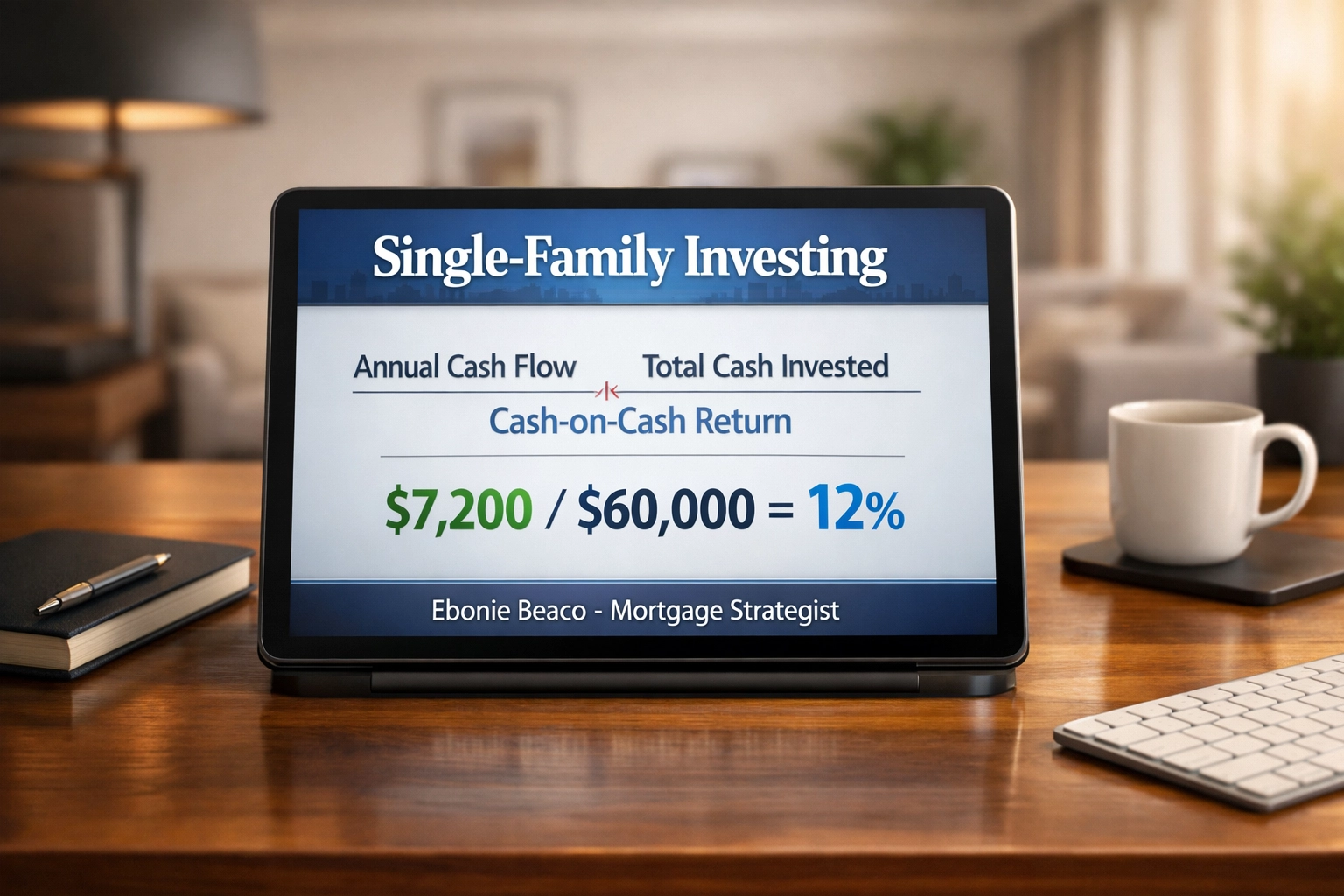
- $7,200 (Annual Cash Flow) / $60,000 (Total Cash Invested) = 12% Cash-on-Cash Return
A 12% return is a solid performance, especially when you consider that this doesn't even account for tax benefits or property appreciation over time.
 Title: Single-Family Investing
Calculation: Annual Cash Flow / Total Cash Invested = Cash-on-Cash Return
$7,200 / $60,000 = 12%
Ebonie Beaco - Mortgage Loan Officer
Title: Single-Family Investing
Calculation: Annual Cash Flow / Total Cash Invested = Cash-on-Cash Return
$7,200 / $60,000 = 12%
Ebonie Beaco - Mortgage Loan Officer
Scaling Your Portfolio with Equity
Once you have your first property and it has gained some equity, you don't have to wait years to buy your next one. Many investors use a cash-out refinance to pull equity out of their first rental to use as a down payment on a second or third property.
This "BRRRR" (Buy, Rehab, Rent, Refinance, Repeat) strategy is a favorite among those looking to build a large portfolio in places like Michigan or Georgia. By using a mortgage calculator, you can see how much equity you might be able to access to fund your next acquisition.
 Title: Single-Family Investing
Ebonie Beaco - Mortgage Loan Officer
Title: Single-Family Investing
Ebonie Beaco - Mortgage Loan Officer
Managing Your Rental with Ease
Management is often where new landlords get nervous. However, single-family homes are generally the easiest residential properties to manage. You aren't dealing with common areas, elevators, or dozens of tenants in one building. If something breaks, it’s usually a standard fix that any local handyman can handle.
For those who want to be completely hands-off, hiring a property management company is a common move. They typically charge 8% to 10% of the monthly rent, but the peace of mind they provide is often worth the cost, especially if you are an out-of-state investor buying in Florida while living in Virginia.
Why Single-Family Investing is a Win
The combination of lower vacancy rates, long-term tenants, and steady appreciation makes single-family homes a cornerstone of a healthy investment strategy. The barrier to entry is lower than multi-unit buildings, and the loan process is straightforward.
If you are just starting out, focusing on single-family homes allows you to learn the ropes of being a landlord without the high-stakes pressure of a commercial complex. You can focus on one property at a time, ensuring each one is profitable before moving to the next.
 Title: Single-Family Investing
Ebonie Beaco - Mortgage Loan Officer
Title: Single-Family Investing
Ebonie Beaco - Mortgage Loan Officer
Regional Insights: Where to Look
While you can find great deals anywhere, we are seeing significant activity in specific hubs.
- Chicago, IL: Strong rental demand in suburban areas where families are looking for more space.
- Florida: High appreciation rates and a massive influx of new residents.
- Alabama & Arkansas: Excellent entry price points for those looking for high cash-on-cash returns.
- Georgia & Virginia: Balanced markets with a mix of stability and growth.
No matter where you choose to invest, having a strategist in your corner is essential. We help you navigate the FAQ of investing and ensure you are getting the best program for your specific goals.
Buying a single-family rental? Contact Ebonie Beaco for financing and mentoring.
Schedule a 1 on 1 at https://calendly.com/homeloansnetwork
Ebonie Beaco Mortgage Strategist | Senior Loan Officer Home Loans Network powered by Loan Factory Inc. NMLS #2389954 HomeLoansNetwork.com 312-392-0664