The Saturation Myth: Is There Still Room for New Wholesalers in 2026?

Entering the arena of wholesale real estate in 2026 often brings up a common concern regarding whether the market has become too crowded for newcomers to find success. While the sheer number of participants has certainly increased over the last decade, recent global market data indicates that the wholesale sector is expanding from $60 trillion in 2025 to a projected $63.7 trillion by the end of this year. This significant 6% compound annual growth rate suggests that the industry is not shrinking but rather evolving into a more sophisticated and profitable distribution channel. You will find that the "saturation" many people complain about is actually a surplus of low-quality players who fail to adapt to modern property sourcing methods. High-quality wholesalers who focus on transparency and data-driven results continue to thrive in states like Alabama, Michigan, and Florida. Success in this landscape is about shifting your perspective from simple house flipping to becoming a strategic asset for real estate investors. Explore the underlying data, and you will see that opportunities for finding off-market deals remain abundant for those willing to put in the analytical work.

A sprawling city skyline featuring a dense variety of residential housing, representing the vast inventory available for strategic wholesaling in 2026. Ebonie Beaco - Mortgage Strategist
Wholesaling houses is a specific investment strategy where you identify distressed or undervalued properties, place them under contract, and then assign that contract to a final buyer for a fee. This process allows you to facilitate real estate transactions without necessarily taking title to the property or utilizing your own long-term capital. Many aspiring investors jump in without understanding that their primary value lies in their ability to solve problems for both the seller and the end-user. You must become an expert at identifying "off-market deals" which are properties not yet listed on the public MLS, providing a unique advantage to your network of cash buyers. By learning the mortgage basics and understanding how your buyers will eventually finance these properties, you position yourself as an educator rather than just a middleman. The resurgence of wholesale as a primary distribution channel for investment properties means that your role is more vital today than it was five years ago. Regardless of the volume of new entrants, the demand for high-yield inventory from seasoned landlords and fix-and-flip investors shows no signs of slowing down.
To distinguish yourself from the crowd, you must leverage advanced technology and high-quality data to predict where the next housing opportunities will arise. In 2026, data quality is the absolute key to unlocking potential in competitive markets like Chicago, Illinois, or Richmond, Virginia. New wholesalers who use AI-driven tools for inventory forecasting and sales predictions can establish a massive competitive advantage over those still using outdated manual methods. You should focus on specialization and service differentiation by providing your buyers with detailed property reports and clear exit strategies. When you provide a cash buyer with a deal that includes a comprehensive breakdown of the neighborhood's rental demand, you save them hours of research time. This professional approach builds trust and ensures that your buyers come back to you every time they are ready to scale their portfolios. Accessing real-time market insights allows you to navigate economic volatility and shifting inventory levels with confidence and precision.
Understanding the financing landscape for your end-buyers is another way to ensure your deals actually cross the finish line. Most of your successful buyers will use specialized programs like DSCR investor loans or fix and flip financing to acquire the properties you source. A Debt Service Coverage Ratio (DSCR) loan is a financing product that qualifies a borrower based on the rental income of the property rather than their personal debt-to-income ratio. By knowing which properties meet the criteria for these loans, you can tailor your marketing to the specific needs of landlords looking for income-producing assets. You might also work with investors who utilize hard money loans to cover rapid renovations before refinancing into long-term debt. Being able to explain these financing avenues to a potential buyer makes your contract assignment significantly more attractive. Your ability to bridge the gap between a distressed seller and a well-funded investor is what makes your business sustainable and profitable.
Real-World Deal Analysis: Chicago Two-Unit Building
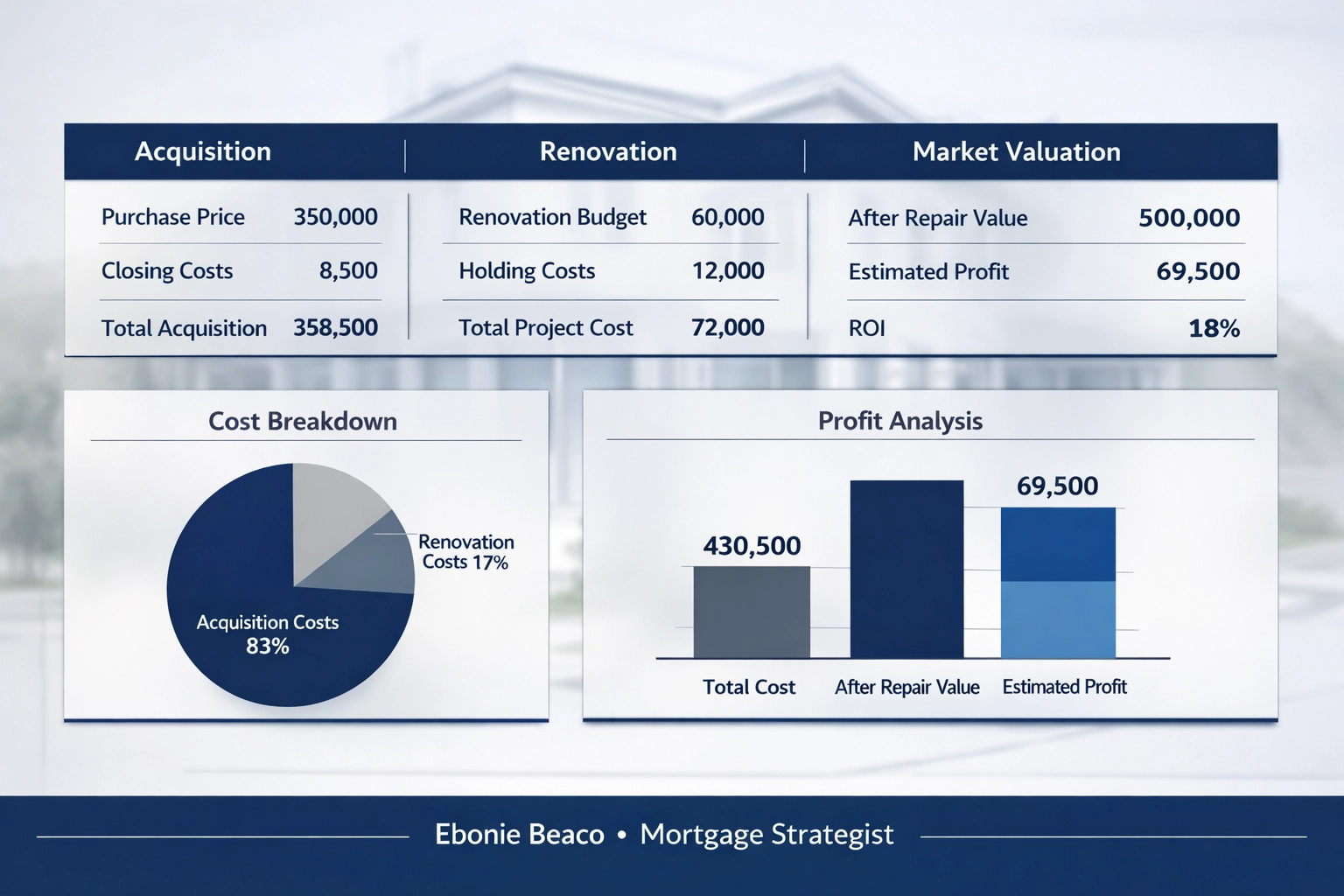
Consider a practical scenario involving a distressed two-unit building in a transitioning neighborhood in Chicago. You find a seller who needs to exit the property quickly due to a job relocation, and you negotiate a purchase price of $210,000 based on the current condition. After conducting a thorough analysis, you determine the After Repair Value (ARV) is $425,000, with an estimated renovation budget of $85,000 for modern updates. Following the standard 70% rule, you calculate that an investor’s Maximum Allowable Offer (MAO) would be around $212,500 after factoring in the repairs. You assign the contract to a fix-and-flip investor for a $15,000 wholesale fee, bringing their total entry price to $225,000. The investor uses a bridge loan at 80% of the purchase price, meaning they only need to bring $45,000 in cash to the closing table for the acquisition. This example demonstrates how a wholesaler provides a clear path to profit for an investor while earning a significant fee for their sourcing efforts.
A financial deal breakdown showing a $210,000 purchase price, $85,000 in repairs, and a $425,000 ARV, highlighting a $15,000 wholesale fee and investor profit potential. Ebonie Beaco - Mortgage Strategist
Targeting specific geographic regions such as the growing suburbs of Atlanta, Georgia, or the coastal markets of Florida can also help you avoid the noise of overcrowded urban centers. Many new wholesalers make the mistake of trying to cover too much territory, which dilutes their expertise and local connections. You should instead focus on becoming the "hyper-local" expert in a few specific zip codes where you can deeply understand the property values and zoning laws. In states like Indiana and Michigan, there is a steady supply of older homes that are perfect candidates for BRRRR investors who want to buy, rehab, rent, refinance, and repeat. By focusing on these specific investor strategies, you can curate your "off-market deals" to match the exact criteria of your most active buyers. Jump in by researching the local foreclosure lists or tax lien sales in your target county to find motivated sellers that others might be overlooking. Building a business in these niches allows you to ignore the broader saturation talk and focus on tangible results in your local community.
The global B2B ecommerce market is projected to hit $36 trillion this year, and real estate wholesaling is increasingly mimicking these streamlined digital transaction models. You must adopt an omnichannel approach by building a professional online presence that showcases your past successes and current inventory. This transparency helps you attract high-net-worth individuals and institutional buyers who are looking for reliable partners to help them deploy capital. Using online forms to capture lead information and automate your follow-up process will keep your pipeline full even when you are not actively hunting. Compare your current workflow to a professional brokerage; if you lack systems for tracking your outreach and buyer interactions, you are likely leaving money on the table. A high-quality wholesaler functions like a boutique real estate agency, providing curated opportunities to a select group of qualified investors. Success in 2026 requires this level of professionalism to stand out from the thousands of casual hobbyists who give the industry a bad name.
Ultimately, the question of saturation is irrelevant if you provide a service that is consistently superior to the competition. The demand for renovated housing in states like Virginia and California remains high, and investors will always need a pipeline of new projects to stay in business. You can book an appointment with a mortgage strategist to understand exactly what lenders are looking for in the current market, which will help you vet your deals more effectively. By aligning your wholesaling business with the realities of modern real estate finance, you create a foundation that is resistant to market shifts. Focus on building long-term relationships with cash buyers who have the ability to close quickly and repeatedly. The market is not too crowded for those who treat wholesaling as a sophisticated business rather than a quick-cash scheme. Your journey toward becoming a successful real estate investor starts with the commitment to excellence and a refusal to be deterred by myths of saturation.
Scedule a 1 on 1 at https://calendly.com/homeloansnetwork
Ebonie Beaco
Mortgage Strategist | Senior Loan Officer
Home Loans Network powered by Loan Factory Inc.
NMLS #2389954
HomeLoansNetwork.com
312-392-0664