The Proven Real Estate Wholesaling Framework for Finding Off-Market Deals in California and Atlanta

Real estate wholesaling can be a clean way to generate deal flow without long-term ownership, but only if your lead generation is consistent and your numbers are disciplined.
In markets like California cities, Atlanta (Georgia), and Florida investor hubs (Jacksonville, Tampa, Orlando, Miami), the basics are the same, but competition, price points, and speed expectations are different.
Below is a framework you can run repeatedly to find off-market properties, lock up assignable contracts, and close with real buyers, plus the financing angle many wholesalers overlook.
1) Real Estate Wholesaling: the simple definition and the real job
What is real estate wholesaling?
Real estate wholesaling: Contracting to buy a property at a discount, then selling your contract (assignment) to an end buyer for a fee.
Practical use: You can earn an assignment fee without renovating or holding the property.
What is an off-market property?
Off-market property: A property not publicly listed on the MLS.
Practical use: Off-market sourcing reduces bidding wars and improves your chance to negotiate.
What is a motivated seller?
Motivated seller: An owner with a strong reason to sell fast (vacancy, inheritance, liens, deferred maintenance).
Practical use: Motivation creates flexibility on price and terms, which is where your wholesale spread comes from.
Action to take: Write your buy box in one paragraph (location, property type, price band, condition, timeline) so you can qualify leads fast.
2) The 4-step wholesaling framework (repeatable and trackable)
Step 1: Identify a property
Lead sourcing: Finding owners likely to sell off-market.
Practical use: More channels equals steadier contracts, especially when one list gets saturated.
Step 2: Secure a contract
Assignable contract: A purchase contract that allows assignment to another buyer.
Practical use: Your exit stays flexible.
Step 3: Market the contract
Disposition: Selling the deal to a vetted buyer list.
Practical use: The faster you match a deal to the right buyer, the fewer price reductions you take.
Step 4: Close the deal
Double close vs assignment: Assignment transfers the contract; double close uses two closings back-to-back.
Practical use: Double closes can help when you need privacy around your fee or when the buyer’s lender requires it.
Action to take: Track your pipeline like a lender would: leads → contacts → appointments → offers → contracts → closed. No tracking, no scaling.
3) Finding off-market properties: 7 lead channels that actually produce
3.1 Drive for dollars (D4D)
Drive for dollars: Physically scouting neighborhoods for distressed properties.
Practical use: You create lists your competitors do not already have.
- Distress signals: boarded windows, tall grass, code violation notices, mail overflow, tarp roofs.
- Best follow-up: 6 to 10 touches over 30 to 45 days (call, text, postcard).
Action to take: Pick 2 zip codes and run them every week instead of randomly driving the whole metro.
3.2 Public records and “problem” lists
Public records list: Owner data sourced from county filings (probate, liens, pre-foreclosure).
Practical use: These owners often need speed, clarity, and a simple process.
Common lists:
- Probate / inherited property
- Pre-foreclosure / notice of default
- Tax delinquent
- Code violations
- Eviction filings (landlords with headaches)
Action to take: Start with one list and master it before buying five more.
3.3 Agent relationships (still underrated)
Agent partnership: A relationship with agents who see distress early (expireds, canceled listings, tenants destroying rentals).
Practical use: You get “heads up” deals before they hit the open market.
What to give agents:
- A one-page criteria sheet
- Proof of funds or “close-ability” story
- Feedback fast (yes, no, or counter)
Action to take: Ask for pocket listings and “almost listings.” The “almost” deals are where discounts live.
3.4 Investor associations and meetups (REIAs)
REIA: Real Estate Investor Association, typically local networking groups.
Practical use: You build buyers and referral partners in one room.
In Atlanta and Florida metros, a consistent REIA presence helps you:
- Find cash buyers
- Find private lenders
- Find contractors who can sanity-check rehab numbers
Action to take: Go twice a month and bring one deal or one case study (even if it is a dead deal and what you learned).
3.5 Wholesaler-to-wholesaler (co-wholesaling)
Co-wholesaling: Splitting the assignment fee to move a deal using another wholesaler’s buyer list.
Practical use: You monetize leads faster while you build your own dispositions engine.
Action to take: Use a simple fee split and get it in writing so everyone stays aligned.
3.6 PPC and paid social (advanced, but scalable)
PPC: Paying for leads via Google or social ads.
Practical use: Predictable lead volume, higher cost per lead.
Best use case:
- High assignment markets (many California cities)
- Teams with strong call handling and follow-up
Action to take: Do not run ads until your follow-up system is tight. Paid leads punish sloppy operations.
3.7 Cold calling and SMS (volume play)
Cold calling: Outbound calling list owners.
Practical use: You trade time and consistency for discounted inventory.
Action to take: Script for motivation, not price. Price comes after you understand the problem.
4) California vs Atlanta vs Florida: adjust your approach (not your fundamentals)
4.1 California: higher prices, heavier competition, tighter spreads
In many California markets, you often see:
- Higher ARVs (after-repair values)
- More sophisticated investors
- More competition for distress
Practical adjustments:
- Focus on speed to appointment and clean underwriting
- Build strong agent channels
- Consider smaller spreads but more volume, or target heavier value-add deals
Action to take: Get serious about repair estimating because a 10 percent rehab error in California can wipe your fee.
4.2 Atlanta: strong investor depth and BRRRR activity
Atlanta is a major hub for:
- Buy-and-hold landlords
- BRRRR investors
- Cash and hard money buyers
Practical adjustments:
- Emphasize rent comps and neighborhood-specific demand
- Know common investor targets (3/2 SFRs, small multifamily)
- Have a title/closing process that moves quickly
Action to take: Package deals like an investor presentation (ARV comps, rent comps, rehab range, clear access plan).
4.3 Florida real estate investing: different pockets, different buyer logic
Florida is not one market. Jacksonville differs from Miami, Tampa differs from Orlando.
Practical adjustments:
- Be ready for insurance and roof questions from buyers
- Understand flood zones in coastal areas
- Expect strong demand from out-of-state investors
Action to take: Pre-answer insurance risk in your deal notes so buyers do not stall.
5) Underwriting 101 for wholesalers (so you do not contract junk)
Key terms (quick definitions you can use daily)
- ARV (After-Repair Value): The expected value after renovations.
Practical use: ARV drives your maximum allowable offer (MAO). - MAO (Maximum Allowable Offer): The highest price an investor can pay and still hit their return target.
Practical use: MAO keeps you from “hoping” a deal works. - Repair estimate: Projected cost of renovation.
Practical use: Repairs decide your spread more than purchase price does. - DOM (Days on Market): Days a comp sat before selling.
Practical use: Low DOM supports stronger resale assumptions. - DSCR (Debt Service Coverage Ratio): Rent income divided by monthly debt payments.
Practical use: DSCR loans help landlords qualify using property cash flow, not personal income.
Action to take: Underwrite conservatively: add a contingency buffer to repairs and do not stretch ARV comps.
6) A simple wholesale deal calculator (with real numbers)
Use this as a quick structure for Atlanta, Florida, or many California pockets.
Assumptions:
- ARV: $320,000
- Repairs: $45,000
- Investor closing/holding costs: $18,000
- Investor profit target: $35,000
- Your assignment fee target: $12,000
Investor MAO (maximum price investor can pay):
- MAO = ARV − Repairs − Costs − Profit − Assignment
- MAO = $320,000 − $45,000 − $18,000 − $35,000 − $12,000
- MAO = $210,000
So your contract price needs to be at or below $198,000 if you want a $12,000 assignment fee and your buyer wants to buy at $210,000.
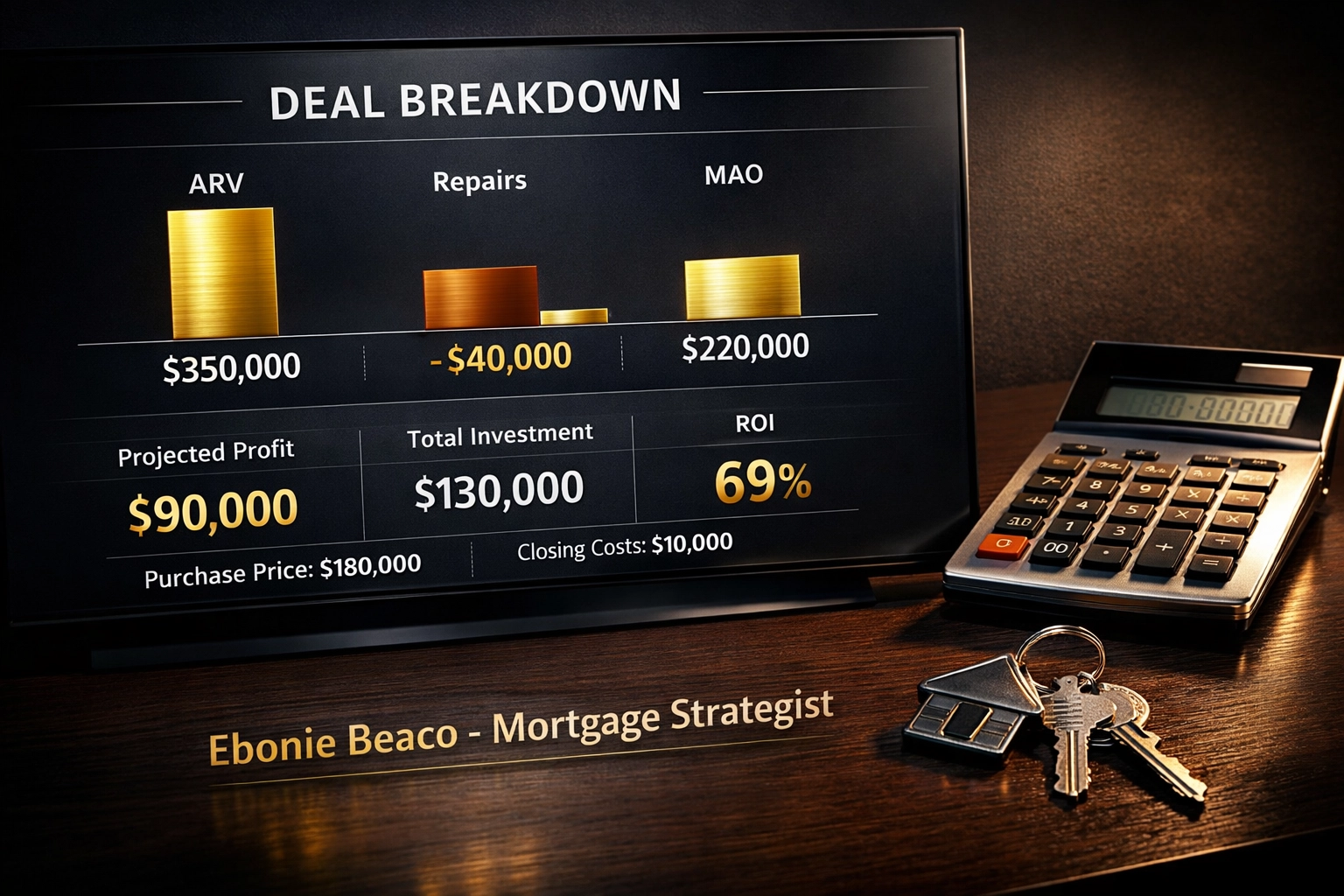
Action to take: Bring this calculator to every seller conversation. You negotiate better when you know your ceiling.
7) Dispositions: how to sell contracts fast without burning buyers
Build a real buyer list (not a random spreadsheet)
Cash buyer: An investor who can close quickly without traditional financing.
Practical use: Cash buyers reduce fallout risk and allow short inspection timelines.
Qualify buyers with:
- Proof of funds (recent statement or letter)
- Buying criteria (zip codes, beds/baths, max rehab)
- Closing timeline and title company preference
Action to take: Tag buyers by strategy (flip, BRRRR, landlord, short-term rental) so you do not blast irrelevant deals.
Write deal notes like a pro
Use a consistent layout:
- Property basics: beds/baths, sqft, year built
- Access: lockbox or showing windows
- Condition: 5 bullet points, no fluff
- Comps: 3 sold comps with distance and dates
- Rehab: low/medium/high range
- Terms: EMD, inspection period, assignment language, closing date
Action to take: Send fewer deals, better packaged. Serious buyers pay for clarity.
8) Financing: the wholesaler’s advantage when buyers need speed
Even if your buyer is “cash,” many are using short-term financing behind the scenes.
Hard money loans
Hard money loan: Asset-based, short-term lending often used for flips.
Practical use: Buyers close quickly and renovate fast.
Bridge loans
Bridge loan: Short-term financing used to acquire before a longer-term refinance or sale.
Practical use: Helps buyers close when timing is tight.
Fix and flip loans
Fix and flip loan: Financing that can include purchase and rehab funds.
Practical use: Buyers can take larger projects without draining cash reserves.
DSCR rental property loans (landlord loans)
DSCR loan: Rental property loan qualified primarily on property income and DSCR ratio.
Practical use: Buyers can scale rentals even with complex income or high DTI.
HELOC and cash-out refinance for repeat investors
HELOC: Revolving line of credit secured by home equity.
Practical use: Investors tap equity to fund down payments or renovations.
Cash-out refinance: Replacing a mortgage with a larger one and taking the difference in cash.
Practical use: Investors recycle equity after appreciation or renovations.
If you want a plain-English overview of mortgage terms and how the process typically works, you can compare the basics here: https://www.homeloansnetwork.com/mortgage-basics and https://www.homeloansnetwork.com/loan-process
Action to take: Ask every buyer how they fund deals. When you understand their capital stack, you can structure better timelines and reduce cancellations.
9) Compliance and risk: protect your reputation and your pipeline
Contract clarity
Assignment clause: Contract language allowing you to assign your interest to another buyer.
Practical use: Prevents legal and closing surprises.
Title and lien awareness
Title search: Research into ownership, liens, judgments, and defects.
Practical use: Catches deal killers early, before you burn your buyer list.
Timeline discipline
Inspection period: Time for your buyer (or you) to evaluate property condition and title.
Practical use: Keeps your exits clean if the deal is not real.
Action to take: Build a tight relationship with a title company that is investor-friendly and communicates fast.
10) A weekly execution plan (simple, boring, effective)
Monday: List build and skip trace
- List build: 200 to 500 records
- Skip trace: phone + email where possible
Tuesday to Thursday: Outreach and follow-up
- Calls: 2-hour call blocks
- Text: short, compliant, conversational
- Follow-up: set reminders in a CRM
Friday: Offers and buyer conversations
- Run comps and MAO
- Send 2 to 5 written offers
- Pre-market to top buyers if you have a strong lead
Saturday: Drive for dollars
- Add 25 to 75 new properties
- Take photos and notes
Action to take: Do this for 6 weeks without changing strategies every week. Consistency beats “new tactics.”
11) When you are ready to level up: pair deal flow with a financing plan
If you wholesale, you are already doing the hardest part: finding discounted property.
The natural next step is knowing how end buyers finance, and how you might finance your own future flips, BRRRRs, or rental portfolio across California, Florida, Georgia (Atlanta), Illinois (including Chicago), Michigan, Indiana, Alabama, Arkansas, Kentucky, Missouri, and Virginia.
Schedule a 1 on 1 at https://calendly.com/homeloansnetwork
Ebonie Beaco
Mortgage Strategist | Senior Loan Officer
Home Loans Network powered by Loan Factory Inc.
NMLS #2389954
HomeLoansNetwork.com
312-392-0664