The Legal Truth About Wholesale Real Estate: Navigating 2026 Regulations

Meta Title: Is Wholesale Real Estate Legal in 2026? State Rules Explained
Meta Description: Learn the legalities of wholesaling houses in 2026. Explore disclosure rules, equitable interest, and state-specific laws in Ohio, Washington, and Virginia.
Wholesaling remains a legal and highly effective entry point into real estate investing, provided you understand the fundamental rules governing equitable interest in 2026. At its core, the process involves securing a property under contract and then selling the rights to that contract to a cash buyer before the closing date. You are essentially trading your contractual position rather than the physical real estate, which distinguishes you from an agent or broker. Jump in to this strategy by focusing on distressed or off-market deals where homeowners are motivated to sell quickly for a variety of personal reasons. It is vital to recognize that your legal standing relies on being a principal in the transaction rather than a third-party representative for either side. Many new investors find success in markets like Chicago or Atlanta because they lead with transparency and clear communication throughout the negotiation process. Explore the local mortgage basics in your specific area to ensure you are not inadvertently crossing the line into unlicensed real estate activity. By grounding your business in these core legal principles, you can confidently navigate the complexities of the current housing market while building a solid reputation.

Visual Description: A clean, professional, and modern office setting with a legal desk, a leather-bound folder, and a high-end pen, representing the professional nature of real estate contracts. Footer: Ebonie Beaco - Mortgage Strategist.
Equitable interest is the legal backbone that allows wholesaling houses to function without a real estate license in most jurisdictions across the United States. When you sign a purchase agreement with a seller, you gain the right to buy that property at a specific price, creating a tangible asset known as a contract right. This contractual right is classified as personal property that you can legally assign to another investor for an assignment fee. Problems usually arise when a wholesaler markets the house as if they already own it or represents the seller as an agent would in a traditional listing. You must always clarify that you are selling your interest in the contract, not the physical bricks and mortar of the structure. This distinction protects you from accusations of practicing real estate without a license, which is a common pitfall for the uninformed investor. Accessing professional FAQ resources can help you refine your language so your marketing materials reflect your actual legal position accurately. Professionalism in this area ensures that your off-market deals are viewed as legitimate business opportunities by both sellers and sophisticated buyers.
As we move through 2026, several states have introduced specific hurdles that wholesalers must navigate to remain operational and legally compliant. For instance, Ohio now requires a mandatory disclosure form that tells homeowners exactly who you are and that you might be making a profit from the assignment. Washington has taken a stricter stance, requiring a real estate license for most off-market transactions involving wholesale contracts to ensure consumer protection. Virginia also implemented rules where completing more than two deals a year triggers the need for a professional license or working under a licensed entity. These changes reflect a growing trend toward transparency and standardized practices in the real estate investing space across the country. Staying ahead of these local laws ensures your business model remains sustainable and free from unnecessary legal disputes or regulatory fines. You can review our about us section to see how we prioritize transparency and education for all our investor clients. Understanding these nuances is the first step toward scaling a business that can withstand shifting legislative environments in states like Michigan and Alabama.
Transparency is your greatest ally when structuring off-market deals to avoid legal scrutiny from state boards or disgruntled transaction parties. You should always include clear language in your contracts stating that you are a real estate investor acting for profit in this specific transaction. Sellers need to know that you may not be the end buyer and that you intend to assign the contract to another party for a fee. This honesty prevents claims of fraud or misrepresentation if the seller later discovers you made a five-figure profit on the assignment. In competitive markets like Chicago, Illinois, or Atlanta, Georgia, being upfront builds a stronger reputation with both homeowners and experienced cash buyers. Ethical wholesaling involves making sure everyone at the closing table understands their specific role in the transaction from start to finish. If you are unsure how to phrase these disclosures, consulting with a real estate attorney in your target market is a wise investment. Maintaining this level of integrity ensures that your loan process remains smooth if you ever transition into buying and holding the properties yourself.
To understand how these legal concepts translate into financial success, let us analyze a typical wholesale deal breakdown for a property located in a growing market like Richmond, Virginia. Suppose you identify an off-market house with an After Repair Value, or ARV, of approximately $300,000 based on recent comparable sales in the neighborhood. You negotiate a purchase price of $175,000 with a motivated seller who needs to move quickly and prefers a hassle-free cash transaction. After inspecting the property, you estimate that it requires roughly $50,000 in renovations to bring it up to modern market standards for a traditional buyer. You then market your equitable interest in this contract to your list of cash buyers for an total assignment price of $190,000. A local fix and flip investor agrees to the terms, allowing you to collect a $15,000 assignment fee at the time of closing. This fee represents the profit for your work in finding, analyzing, and securing a deal that still offers the end buyer a significant equity cushion. Compare these figures carefully to ensure your spread remains attractive to investors while staying well within the boundaries of a legal assignment.
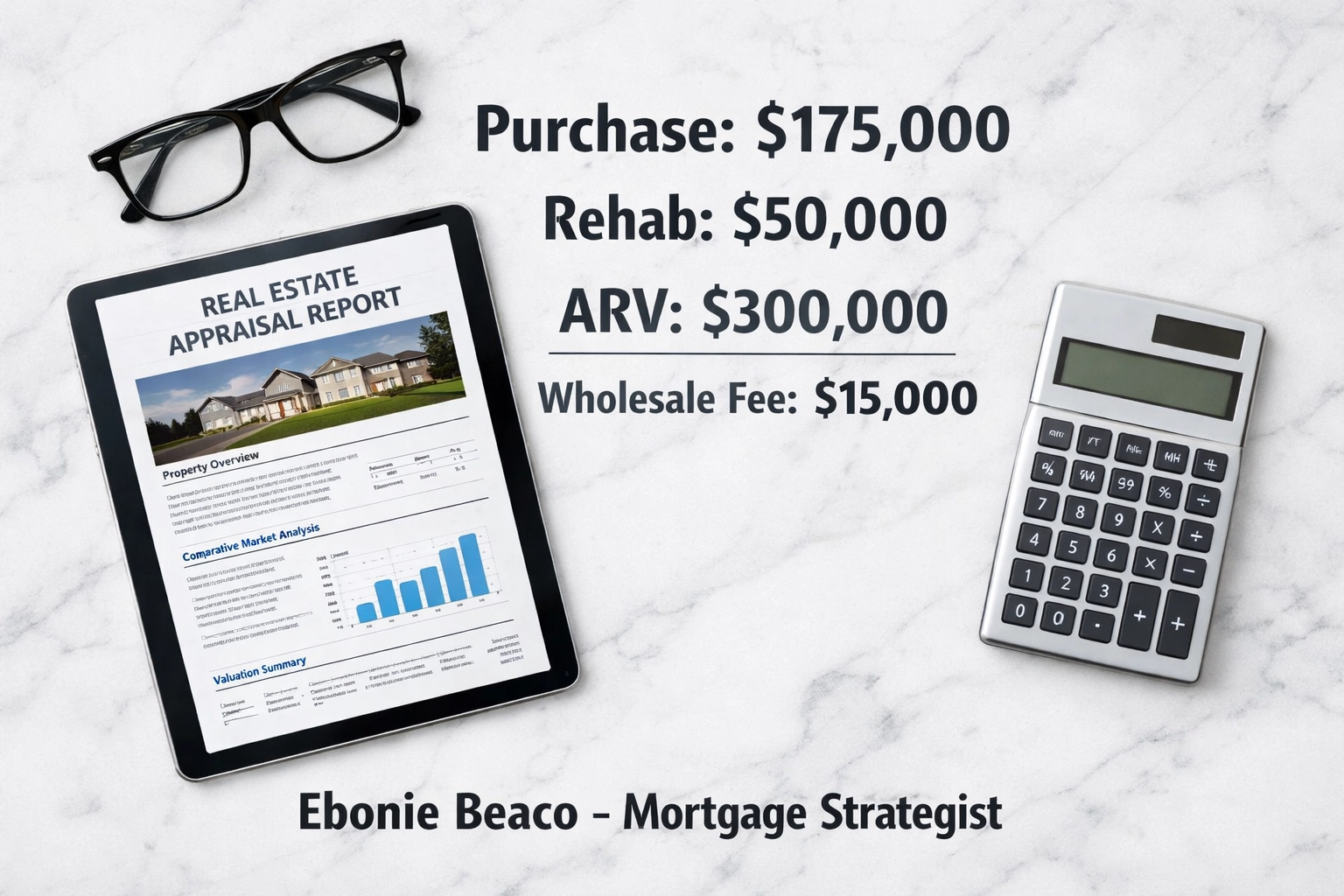
Visual Description: A deal breakdown graphic showing the following numbers: Purchase Price: $175,000, Estimated Rehab: $50,000, ARV: $300,000, Assignment Fee: $15,000. Footer: Ebonie Beaco - Mortgage Strategist.
While you can start wholesaling without a license in many places, obtaining one can often open more doors for your long-term real estate investing career. A license allows you to list properties on the MLS and collect commissions, providing a backup plan if a wholesale deal does not close as planned. It also subjects you to a higher ethical standard, which many high-end cash buyers find reassuring when they are reviewing your available deals. As you scale into fix and flips or rental property ownership, having that professional background helps when you are seeking interest-only mortgage options or other creative financing. Many successful investors in Florida and California started as wholesalers before transitioning into full-scale portfolio management with multi-family units. Balancing your legal requirements with a growth mindset is the best way to thrive in the evolving 2026 real estate landscape. You should also consider how a license impacts your ability to market off-market deals to a wider audience without running afoul of state advertising laws. Investing in your own professional education is a move that pays dividends as you move into larger, more complex real estate transactions.
The key to navigating the legal truth of wholesaling is staying educated and maintaining a circle of professional advisors who understand the local market. Consult with a real estate attorney in your specific area to review your assignment contracts and mandatory disclosure statements for compliance. Markets change rapidly, and what worked a few years ago might be under regulatory fire by the end of 2026. By focusing on equitable interest and full disclosure, you minimize the risk of legal complications or deal cancellations that can derail your progress. Whether you are working in Alabama, Indiana, or Kentucky, the principles of professional conduct remain the same across the real estate industry. Real estate investing is a marathon, and building your foundation on legal compliance is the only way to win in the long run. Use our mortgage calculators to help your buyers understand their potential costs, which makes your deals even more attractive. Proactive risk management is what separates the temporary wholesalers from the established real estate professionals who build lasting wealth.
Transitioning from a wholesaler to a property owner often requires a shift in how you view real estate financing and complex deal structures. Once you have mastered the art of finding off-market deals, you might decide to keep a few properties for yourself to build long-term wealth through rentals. This is where programs like DSCR loans or fix and flip financing become essential tools in your daily investor toolkit. Understanding how a lender views your wholesale experience can help you secure better terms when you decide to transition from assigning to owning. You can use your knowledge of equity and market values to present strong loan packages that get approved quickly in states like Missouri or Arkansas. Building a relationship with a mortgage strategist who understands the wholesaling world is a significant advantage in any competitive housing market. Access our online forms to start exploring how your next deal can be funded with professional support. By aligning your wholesaling business with strategic financing partners, you create a roadmap for unlimited growth in the real estate sector.
📞 Work With Ebonie Beaco
If you are a wholesaler looking to:
- Close more deals
- Connect your buyers with financing
- Structure deals that actually get approved
- Learn how to grow into a real estate investor
I can help you every step of the way.
Ebonie Beaco
Mortgage Strategist | Senior Loan Officer
Home Loans Network powered by Loan Factory Inc.
NMLS #2389954
📱 Phone: 312-392-0664
📧 Schedule a 1 on 1 https://calendly.com/homeloansnetwork
🌐 Website: HomeLoansNetwork.com/contact-us
👉 Whether you need lending, deal structuring, or mentorship, reach out today.