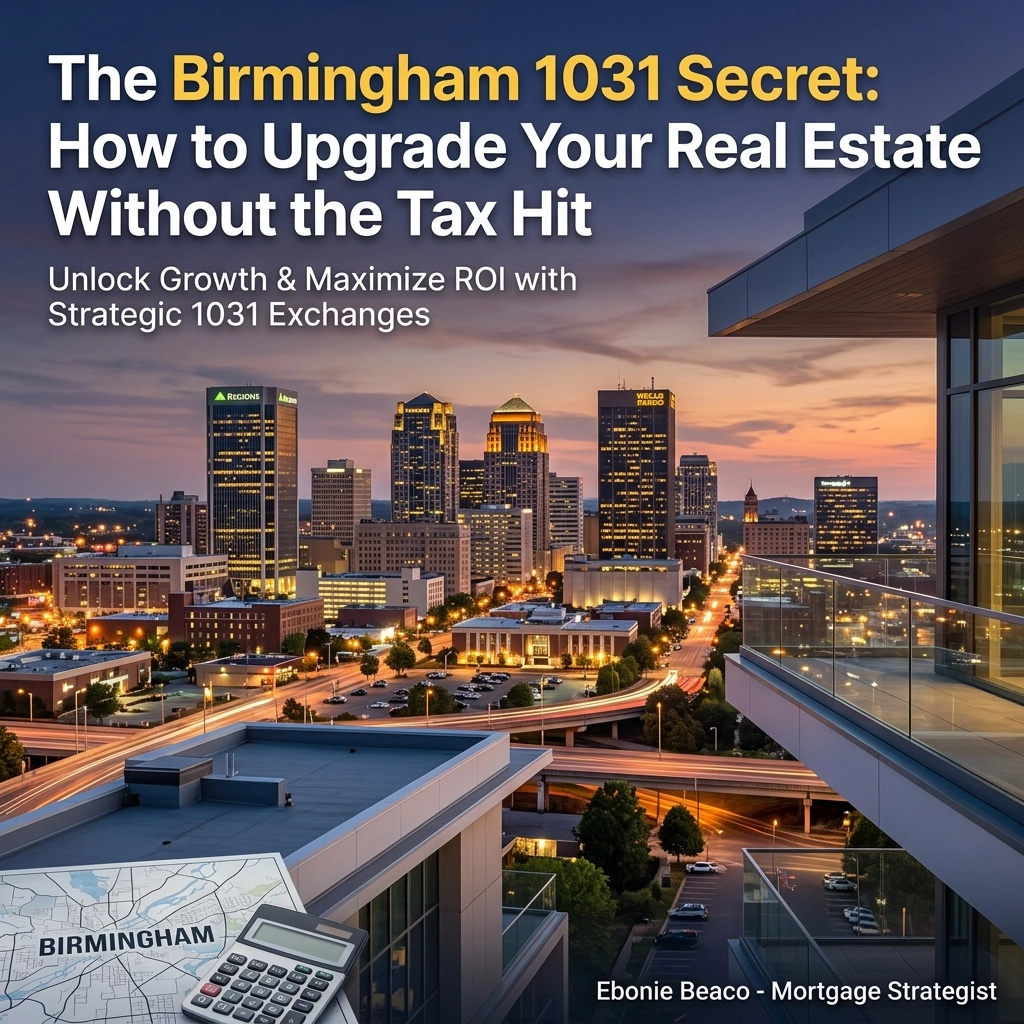
The Birmingham 1031 Secret: How to Upgrade Your Real Estate Without the Tax Hit
Thursday, April 2, 2026
If you own investment property in Alabama, you are sitting on a potential goldmine of equity. But there is a silent partner waiting to take a massive cut the moment you decide to sell: the IRS. Between federal capital gains taxes, state taxes, and depreciation recapture, you could easily see 25 percent to 33 percent of your hard earned profit vanish into thin air.
What if you could keep every single penny of that profit and roll it into a larger, more profitable asset?
This is not a loop hole for the ultra wealthy; it is a standard tool in the tax code known as the 1031 Exchange. For regional investors in Birmingham and across the state, this strategy is the fastest way to scale a portfolio from a few units to a massive commercial residential mix.
What is a 1031 Exchange?
A 1031 Exchange is a section of the Internal Revenue Code that allows an investor to defer paying capital gains taxes on the sale of an investment property if another "like-kind" property is purchased with the proceeds.
Like-kind property: This term is broader than most people realize. You can exchange a single family rental for a 24 unit apartment building, or a plot of raw land for a commercial retail space. As long as the properties are held for productive use in a trade, business, or for investment, they qualify.
Deferred tax: It is important to remember that this is a deferral, not a total cancellation. However, savvy investors often use the "swap 'til you drop" strategy, continuing to exchange properties throughout their lives. When the owner passes away, the heirs receive a "step-up in basis," effectively wiping out the deferred tax liability forever.
The High Stakes Rules of the Game
The 1031 Exchange is governed by strict timelines that are non negotiable. If you miss a deadline by even one minute, the entire exchange fails, and the tax bill becomes due immediately.
- The Identification Period: You have exactly 45 days from the date you sell your "relinquished" property to identify potential "replacement" properties in writing.
- The Exchange Period: You must close on your replacement property within 180 days of the sale of your original property.
- The Qualified Intermediary (QI): You cannot touch the money. You must hire a third party QI to hold the funds between the sale and the purchase. If you take "constructive receipt" of the cash, the tax hit is triggered.
Explore more about the loan process to see how timing plays into your overall acquisition strategy.
 Image Description: A professional landscape photo showing a modern apartment complex in Birmingham, Alabama, with a clean graphic overlay showing the 45-day and 180-day timeline. Title: "The Birmingham 1031 Secret: How to Upgrade Your Real Estate Without the Tax Hit" and text "Ebonie Beaco - Mortgage Strategist".
Case Study: Scaling from a 24-Unit Portfolio to a Massive Residential Mix
Let's look at a real world scenario involving a regional investor named Marcus. Marcus owned a 24 unit residential portfolio in the Birmingham area that he had managed for a decade. While the property was profitable, the maintenance costs on the aging buildings were eating into his cash flow.
Marcus wanted to upgrade to a newer, 48 unit commercial residential mixed use property in a high growth corridor, but he was terrified of the tax bill.
The Financial Breakdown
The Relinquished Property (Current Portfolio):
- Original Purchase Price: $1,500,000
- Current Market Value: $3,200,000
- Current Mortgage Balance: $900,000
- Estimated Capital Gain: $1,700,000 (excluding depreciation recapture)
If Marcus sold this property traditionally, his tax bill (Federal + Alabama State + Recapture) could easily exceed $450,000. That is nearly half a million dollars that would never work for him again.
The 1031 Exchange Strategy: By utilizing a 1031 Exchange, Marcus was able to keep that $450,000. Instead of having $1,850,000 in net proceeds after taxes and debt payoff, he had the full $2,300,000 in equity to move into his next deal.
The Replacement Property (Mixed Use Complex):
- Purchase Price: $8,000,000
- Down Payment (from 1031): $2,300,000
- New Loan Amount: $5,700,000
Because he deferred his taxes, Marcus was able to afford a property worth $8 million instead of being capped at roughly $6 million. This increased his rental income and his future appreciation potential by millions.
Compare different loan programs to see which financing fits your next big move.
 Image Description: A realistic landscape shot of a vibrant mixed-use building with retail on the bottom and luxury apartments on top. A digital chart is superimposed showing the "Tax Savings: $450,000" and "Reinvestment Power: $8,000,000". Title: "The Birmingham 1031 Secret: How to Upgrade Your Real Estate Without the Tax Hit" and text "Ebonie Beaco - Mortgage Strategist".
How Financing Supercharges the 1031 Exchange
Many investors believe they must pay cash for the replacement property, but that is a myth. In fact, most 1031 Exchanges involve a new mortgage. To avoid "boot" (taxable value left over), your replacement property must be of equal or greater value than the one you sold, and you must reinvest all the net cash proceeds.
In Birmingham, we often use DSCR Investor Loans (Debt Service Coverage Ratio) for these transactions. These loans do not require personal income verification or tax returns. Instead, the lender looks at the rental income of the property itself to ensure it covers the mortgage payment.
The Calculation for DSCR Qualification:
- Monthly Gross Rental Income: $65,000
- Monthly Debt Service (PITI): $48,000
- DSCR Ratio: 1.35 ($65,000 / $48,000)
A DSCR ratio of 1.20 or higher is typically the "sweet spot" for lenders. This allows an investor like Marcus to move quickly and secure financing without the red tape of traditional bank loans.
Tips for a Seamless Alabama Exchange
1. Hire the QI Before You List: Do not wait until you have a signed contract to find a Qualified Intermediary. You need the paperwork in place before the first closing occurs.
2. Watch the "Boot": If you sell a property for $1 million but only buy a replacement for $900,000, that $100,000 difference is considered "boot" and is fully taxable. The goal is always to "trade up."
3. Use the 200% Rule: When identifying properties, you can identify up to three properties of any value, or any number of properties as long as their combined fair market value does not exceed 200 percent of the value of the property sold.
4. Diversify Your Portfolio: Use the exchange to move from one 24 unit building into a portfolio of four 6 unit buildings in different neighborhoods to spread your risk.
 Image Description: A landscape photo of a group of diverse real estate investors shaking hands in front of a Birmingham skyline. A graphic on the side lists "The 3 Identification Rules". Title: "The Birmingham 1031 Secret: How to Upgrade Your Real Estate Without the Tax Hit" and text "Ebonie Beaco - Mortgage Strategist".
Why Birmingham? Why Now?
The Birmingham market has seen steady appreciation and strong rental demand. This makes it a prime location for investors to harvest equity from older, "value add" properties and move into stabilized, "Class A" residential or mixed use portfolios.
The leverage provided by the 1031 Exchange, combined with specialized mortgage strategies, creates a wealth building engine that is hard to beat. If you are holding property that has significantly increased in value, you are essentially giving the government an interest free loan on your capital gains every day you wait to exchange.
Stop letting taxes dictate your growth. Start using the tax code to fund your expansion.
Access our mortgage calculators to run your own scenarios and see how much equity you can leverage into your next acquisition.
Ready to scale your Alabama portfolio?
The clock starts ticking the moment you close your sale. Let's build a strategy that keeps your money in your pocket and your portfolio growing.
Schedule a 1 on 1 at https://calendly.com/homeloansnetwork
Ebonie Beaco Mortgage Strategist | Senior Loan Officer Home Loans Network powered by Loan Factory Inc. NMLS #2389954 HomeLoansNetwork.com 312-392-0664