The 70% Rule in 2026: Is This Classic Wholesale Real Estate Strategy Still Relevant?

Navigating the landscape of wholesale real estate in 2026 requires a sharp eye for value and a disciplined approach to property evaluation. For decades, the 70% rule has served as a primary filter for investors looking to secure off-market deals with enough equity to satisfy cash buyers. This guideline suggests that an investor should pay no more than 70% of the after-repair value (ARV) of a property, minus the estimated costs of necessary renovations. While the housing market has experienced significant shifts in interest rates and inventory levels across Alabama, Michigan, and Florida, the core logic behind this formula remains a vital starting point for wholesaling houses. You use this metric to determine your Maximum Allowable Offer (MAO), ensuring that the spread is wide enough to cover your wholesale fee and the profit expectations of your end-buyer. Applying this strategy correctly helps you avoid overpaying for distressed assets and keeps your reputation solid within the local real estate investing community.
To use this rule effectively, you must first master the technical definitions of its components to ensure your data entry is accurate. After-Repair Value, or ARV, is a dictionary-style term representing the estimated market value of a property once it has been fully renovated to meet current local standards. This figure is not a guess; it is derived from a meticulous analysis of comparable sales, or "comps," within a tight radius of the subject property over the last six months. Estimated Repairs encompass the total financial outlay required for labor, materials, permits, and professional services needed to bring the home to its ARV state. In markets like Chicago or various cities in Georgia, labor costs can vary wildly, so your repair estimates must reflect the current economic reality of your specific zip code. By subtracting these renovation costs from a percentage of the ARV, you establish a safety net that protects every party involved in the transaction. You can find more about the foundational elements of property valuation by visiting https://www.homeloansnetwork.com/mortgage-basics to see how lenders view value.
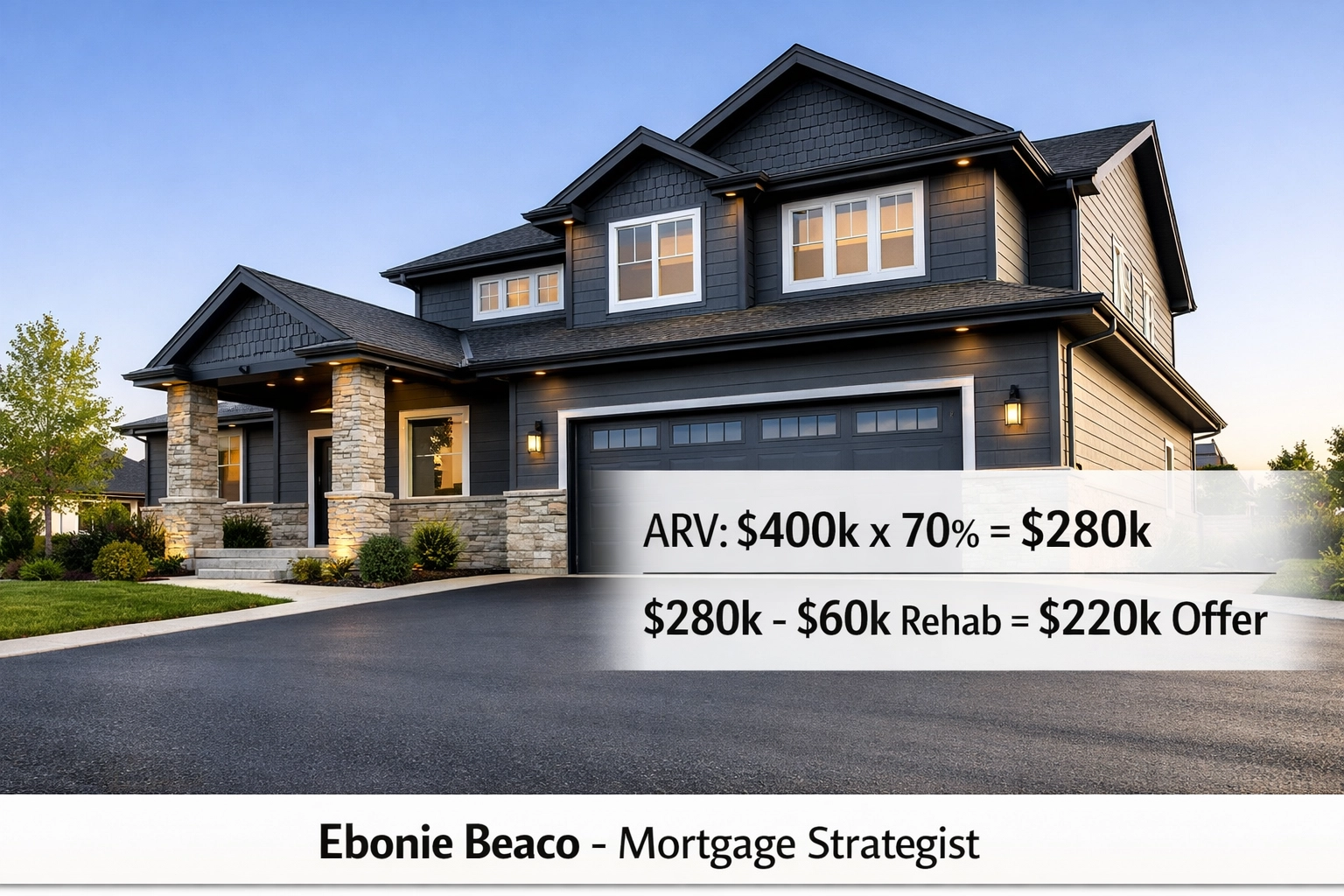
Modern suburban home, branding footer "Ebonie Beaco - Mortgage Strategist", visible deal numbers: ARV: $400k x 70% = $280k - $60k Rehab = $220k Offer.
Let’s dive into a practical calculation example to see how this strategy functions for a modern suburban home in a competitive market like Virginia or Indiana. Imagine you find a distressed property where the ARV is determined to be $400,000 based on recent sales of renovated homes in the same neighborhood. Following the formula, you first multiply $400,000 by 70%, which gives you a base figure of $280,000. Next, you conduct a walkthrough and determine that the property requires $60,000 in structural and cosmetic repairs to reach that peak market value. Subtracting the $60,000 renovation budget from your $280,000 base leaves you with a Maximum Allowable Offer of $220,000 for the seller. If you negotiate a purchase price of $210,000, you have created a $10,000 wholesale fee for yourself while still delivering the deal to a cash buyer at the $220,000 mark. This specific breakdown provides the end-buyer with enough equity to justify the risks associated with a fix-and-flip project or a long-term rental strategy.
The 30% margin built into this rule is designed to account for much more than just the final profit of the person buying the deal from you. This cushion must cover the closing costs on both the buy and sell side, which can involve title insurance, escrow fees, and transfer taxes that vary by state. It also accounts for holding costs such as property taxes, insurance premiums, and utilities while the home is under construction. Furthermore, you must consider the cost of capital, as most investors utilize hard money loans or bridge loans that carry higher interest rates than traditional financing. In states like California or Florida, where insurance costs have risen, this 30% buffer is often the only thing preventing an investor from facing a financial loss if the project takes longer than anticipated. Understanding these underlying expenses helps you explain the validity of your offer to sellers who may not understand why a discount is necessary for off-market deals.
Market conditions in 2026 have forced many real estate professionals to ask if the 70% rule is too conservative for high-demand areas. In hyper-competitive markets like Chicago or parts of Virginia, inventory is so low that cash buyers are often willing to accept a 75% or even 80% rule to secure a property. When you are wholesaling houses in these regions, sticking strictly to 70% might mean you never get a contract signed because other investors are willing to work with thinner margins. This is especially true for properties in "A" class neighborhoods where the risk of the value dropping is lower and the speed of the resale is much higher. You should constantly analyze the "buy box" of your local investors to see if they have adjusted their expectations based on current local demand. Accessing updated information on market trends can be done through the https://www.homeloansnetwork.com/faq section to help you stay ahead of these regional shifts.
Financing plays a massive role in whether the 70% rule yields a successful exit for a wholesaler. Many of your end-buyers are likely using DSCR investor loans or other non-QM mortgage loans to fund their long-term rental portfolios after the initial renovation. These lenders look closely at the debt service coverage ratio, which compares the rental income to the monthly mortgage payment, including taxes and insurance. If your initial wholesale deal was calculated correctly, the investor will have enough equity to refinance out of their bridge loan and into a permanent 30-year fixed rate. This process, often referred to as the BRRRR method, relies entirely on the accuracy of your initial ARV and repair estimates. If the numbers are off, the investor may find themselves "stuck" in a high-interest loan because the property doesn't appraise high enough for a full cash-out refinance. You can explore various funding scenarios and how they impact investor yields at https://www.homeloansnetwork.com/loan-programs/interest-only-mortgage.

A professional chart comparing the 70% rule vs the 80% rule in high-cost markets like California, showing the impact on investor cash flow and equity.
Geography is another factor that dictates how strictly you should apply these percentages to your real estate investing business. In Arkansas or Michigan, where home prices are lower, a 70% rule might result in a dollar amount that is too small to cover a realistic renovation budget. For instance, on a $100,000 ARV home, the 30% margin is only $30,000, which can be quickly swallowed by a roof replacement and a new HVAC system. In these lower-priced markets, you might need to use a "70% minus repairs" approach but ensure there is a minimum profit floor of $20,000 to $30,000 for the buyer. Conversely, in high-priced markets like California, the dollar amount represented by 20% or 30% is so large that investors can still make a substantial profit even if they pay 80% of the ARV. Your job as a strategist is to look beyond the percentage and evaluate the actual dollar-for-dollar profit potential for your specific market. For those dealing with high-value properties, reviewing https://www.homeloansnetwork.com/loan-programs/jumbo-loans can provide insight into how larger transactions are structured.
In the final analysis, the 70% rule is a foundational guideline rather than a rigid law that cannot be broken. Successful wholesaling in 2026 requires a blend of this classic formula and a deep understanding of modern financing tools like HELOC loans and cash-out refinance strategies. You must remain transparent with your sellers and your buyers, using data-driven examples to justify your offer and your assignment fee. By positioning yourself as a knowledgeable resource who understands the nuances of the housing market in Illinois, Florida, and beyond, you build a sustainable business. Use the 70% rule to quickly vet potential leads, but always perform a secondary, detailed analysis before committing to a contract. If you are ready to see how these investment strategies can be backed by professional financing, you should jump in and explore your options today.
Scedule a 1 on 1 at https://calendly.com/homeloansnetwork
Ebonie Beaco
Mortgage Strategist | Senior Loan Officer
Home Loans Network powered by Loan Factory Inc.
NMLS #2389954
HomeLoansNetwork.com
312-392-0664