The 6.12% Reality: Current Mortgage Rate Landscape
Editorial by Ebonie Beaco - Mortgage Strategist
Wednesday, March 18, 2026
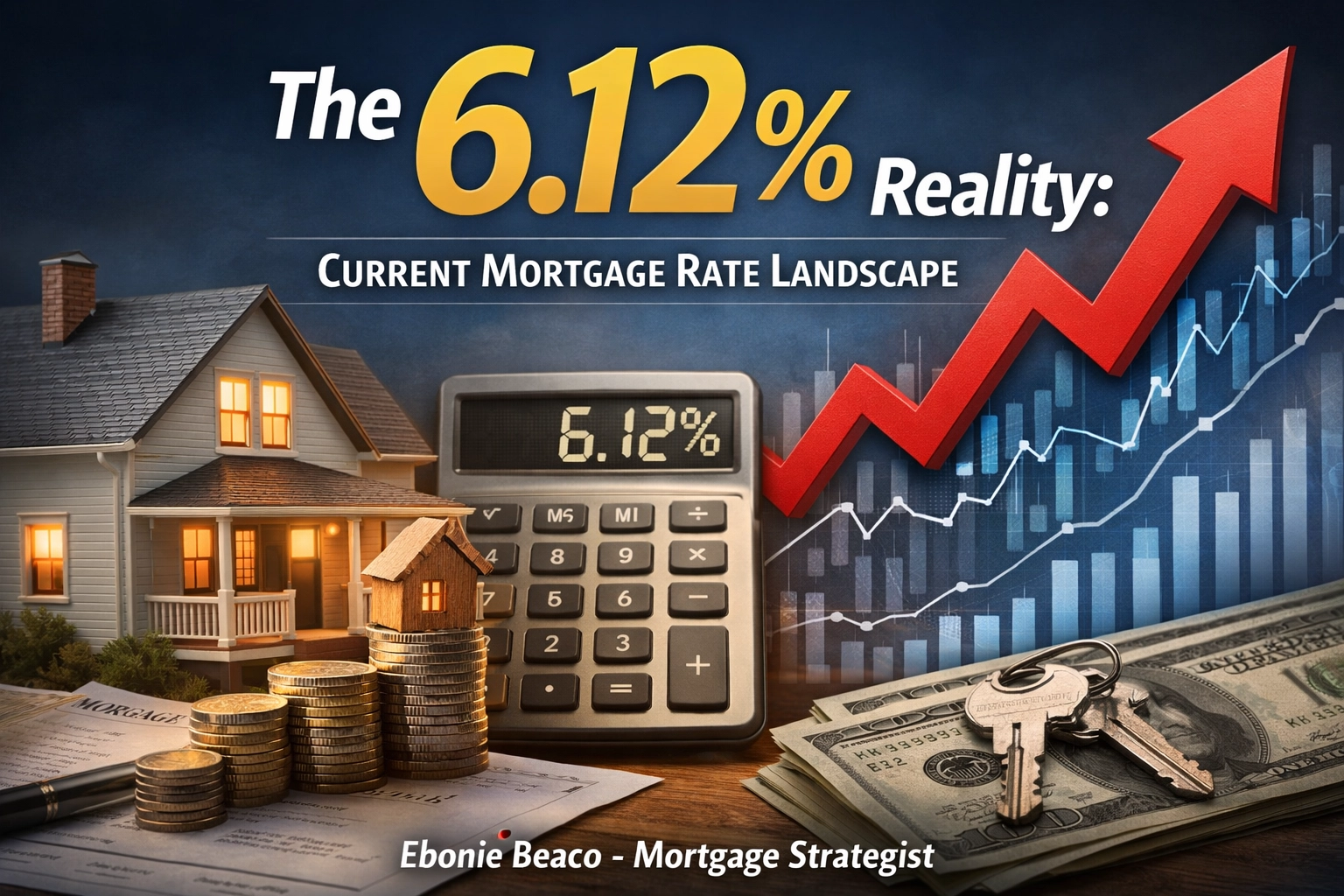
The mortgage landscape is shifting again. If you have been watching the headlines over the last 48 hours, you know that the "wait and see" approach is becoming a "move and adapt" strategy for many. As of March 17, 2026, the average 30-year fixed mortgage rate is holding steady at 6.12%, according to recent reporting by CBS News. You can find the detailed breakdown of these current figures at CBS News.
Staying informed is about more than just reading a number on a screen. It is about understanding how these percentages impact your ability to scale a portfolio in Florida, flip a property in Chicago, or access equity in your family home in Virginia.
Here is a look at the seven most critical updates from the industry over the last two days and what they mean for your wallet.
1. The 6.12% Anchor: March 17, 2026
The 30-year fixed rate has found a temporary home at 6.12%. While this is higher than the lows we saw in late 2025, it represents a stabilizing force in a market that has been through the ringer. For a homeowner in Alabama or Arkansas looking to buy, this rate provides a clearer picture for monthly budgeting than the volatility we experienced earlier this year.
2. The Fed Meeting (March 17-18, 2026)
Right now, the Federal Open Market Committee is meeting. Wall Street expects the benchmark rate to stay between 3.50% and 3.75%. Why should you care? The Fed does not set mortgage rates, but their outlook on inflation and geopolitical tension dictates how the bond market behaves. When the 10-year Treasury yield moves, mortgage rates usually follow. We are watching this closely to see if rates will dip into the high 5% range by the summer.
3. Purchase Applications Are Climbing
Despite rates sitting above 6%, purchase applications have actually increased this week. This suggests that buyers in markets like Georgia and Michigan are tired of sitting on the sidelines. There is a growing realization that waiting for a 3% rate: which may not return for years: is causing people to miss out on current inventory opportunities.
4. The Refinance Gap: 6.73% vs. 6.12%
There is a notable spread between purchase and refinance rates right now. While you might snag a 6.12% rate on a new home, 30-year refinance rates are averaging closer to 6.73%. For investors using a cash out refinance to fund their next deal, this spread is a critical part of the math.
5. Inventory Spikes in Florida and Virginia
New data from the last 48 hours shows a slight uptick in inventory in major metro areas across Florida and Virginia. This is a breath of fresh air for realtors who have been struggling with "inventory lock." More homes on the market means more room for negotiation, even if the interest rate is higher than it was two years ago.
6. 15-Year Fixed Rates Hit 5.50%
For those looking to build equity fast, the 15-year fixed rate is currently averaging around 5.50%. This is an attractive option for homeowners in Indiana or Illinois who want to pay off their debt quickly and can handle the higher monthly payment that comes with a shorter term.
7. Non-QM and DSCR Demand
We are seeing a massive surge in interest for DSCR Investor Loans (Debt Service Coverage Ratio). Investors in California and Georgia are moving away from traditional bank financing and toward these specialized products that focus on the property's income rather than the borrower's personal tax returns.
Understanding the Strategy Behind the Numbers
To navigate this market, you have to look past the primary headline. Whether you are a first-time buyer or a seasoned landlord, the strategy you choose should be based on your long-term goals.
The Power of DSCR for Rental Portfolios
A DSCR Loan is a mortgage product for investment properties where qualification is based on the rental income generated by the property rather than your personal income.
Definition: DSCR (Debt Service Coverage Ratio)
A calculation used by lenders to ensure a property generates enough monthly income to cover the mortgage payment.
If you are looking at a multi-unit building in Chicago or a short-term rental in Florida, the DSCR is your best friend. Lenders typically look for a ratio of 1.15 to 1.25.
Practical Example: The Florida Rental Deal
Imagine you are buying a rental property in Orlando for $400,000.
- Monthly Rental Income: $3,200
- Monthly Mortgage Payment (PITI): $2,400
- Calculation: $3,200 / $2,400 = 1.33 DSCR
Because the ratio is above 1.0, the property "covers itself," making it a strong candidate for financing without needing to show your personal pay stubs.
 Instruction: Create a financial graphic showing the DSCR calculation: Rent $3,200 divided by PITI $2,400 equals 1.33. Title: "The 6.12% Reality: Current Rate Landscape". Branding at bottom: "Ebonie Beaco - Mortgage Strategist". No money icons.
Accessing Equity: HELOC vs. Cash-Out Refinance
Many homeowners in high-growth states like Virginia and California are sitting on a goldmine of equity. The question is how to use it. You have two main paths: a HELOC or a Cash-Out Refinance.
Definition: HELOC (Home Equity Line of Credit)
A revolving line of credit that allows you to borrow against your home equity as needed, similar to a credit card but secured by your property.
Definition: Cash-Out Refinance
Replacing your current mortgage with a new, larger loan and taking the difference in cash.
If your current primary mortgage is at 3% or 4%, a Cash-Out Refinance might not be the best move because you would have to give up that low rate on the entire balance. In this case, a HELOC allows you to keep your low primary rate while accessing cash for renovations or new investments at a separate, variable rate.
Practical Example: The Chicago Equity Strategy
You own a home in a Chicago suburb valued at $600,000. Your current mortgage balance is $350,000.
- Home Value: $600,000
- Max Loan-to-Value (80%): $480,000
- Current Mortgage: $350,000
- Available Equity for HELOC: $130,000
You could use that $130,000 as a down payment on two more rental properties or to fund a fix and flip project in a developing neighborhood.
 Instruction: Create a chart showing Home Value $600k, Mortgage $350k, and the remaining 80% LTV calculation leading to $130k in available equity. Title: "The 6.12% Reality: Current Rate Landscape". Branding at bottom: "Ebonie Beaco - Mortgage Strategist". No money icons.
Fix and Flip Financing in Today's Market
For investors in Michigan and Indiana, the Fix and Flip Loan remains a vital tool. These are often hard money loans or bridge loans designed for short-term use.
Definition: Fix and Flip Loan
A short-term loan used to purchase and renovate a property with the intent to sell it for a profit within 12 months.
Definition: Bridge Loan
A temporary loan used to "bridge" the gap between the purchase of a new property and the sale of an existing one or the acquisition of long-term financing.
In the current environment, speed is everything. When a distressed property hits the market in a city like Detroit or Indianapolis, you cannot wait 45 days for a traditional bank approval. Hard money lenders look at the After Repair Value (ARV) of the home, allowing you to secure funding based on the potential of the project.
Practical Example: The Virginia Flip
- Purchase Price: $200,000
- Renovation Budget: $50,000
- Projected After Repair Value (ARV): $350,000
- Loan Amount (85% of Purchase + 100% of Reno): $220,000
By using a specialized flip loan, you preserve your own cash for other projects while the lender funds the majority of the acquisition and construction.
 Instruction: Create a deal breakdown graphic for a fix and flip. Purchase $200k, Reno $50k, ARV $350k. Title: "The 6.12% Reality: Current Rate Landscape". Branding at bottom: "Ebonie Beaco - Mortgage Strategist". No money icons.
Expanding to Multi-Unit and Commercial Properties
As you grow, you might look toward apartment buildings or commercial real estate. Financing a 12-unit building in Georgia is different than financing a single-family home. Lenders will scrutinize the net operating income (NOI) of the building.
Definition: Non-QM Mortgage Loans
Loans that do not meet the strict criteria of Fannie Mae or Freddie Mac, often used by self-employed borrowers or those with unique financial situations.
Whether you are using bank statement loans because you are a self-employed entrepreneur in California or you are a foreign national investor looking to park capital in US real estate, there are programs designed for your specific profile.
 Instruction: Create a professional graphic listing different loan types: DSCR, Non-QM, HELOC, and Bridge Loans. Title: "The 6.12% Reality: Current Rate Landscape". Branding at bottom: "Ebonie Beaco - Mortgage Strategist". No money icons.
The Path Forward
The 6.12% rate is not a barrier; it is a parameter. Successful investors and homeowners in Alabama, Florida, Illinois, and beyond are those who understand how to structure deals within the current reality.
If you are looking to purchase a home, check out our home purchase resources. If you are an investor trying to figure out if the numbers on a rental property still work, exploring mortgage basics or using our mortgage calculators can provide the clarity you need.
The market moves fast, but your strategy should be steady. By focusing on cash flow, equity preservation, and the right loan products, you can navigate the 6.12% landscape with confidence.
Explore your options and compare your scenarios today.
Scedule a 1 on 1 at https://calendly.com/homeloansnetwork
Ebonie Beaco
Mortgage Strategist | Senior Loan Officer
Home Loans Network powered by Loan Factory Inc.
NMLS #2389954
HomeLoansNetwork.com
312-392-0664