The $12M Chicago Shuffle: How a 124-Unit Cash-Out Refi Built a Real Estate Empire
Scaling a real estate portfolio in a city as dynamic as Chicago requires more than just finding good deals. It requires a sophisticated approach to debt management. When you reach a certain level of ownership, your properties shouldn't just sit there and appreciate. They should act as a financial engine that powers your next move.
We recently navigated a complex transaction involving a 124-unit portfolio spread across 12 buildings in two of Chicago’s most talked-about submarkets: Rogers Park and South Shore. The goal was twofold. First, the investment partners wanted to take advantage of a shifting market to lower their interest rates and monthly payments. Second, they needed to tap into their equity to fund the down payment for a significant new acquisition.
This is what we call the Chicago Shuffle. It is the process of using a Chicago cash out refinance mortgage to optimize existing assets while simultaneously expanding an empire.
Chicago cash out refinance mortgage: A refinance that replaces your current loan with a larger balance and lets you receive the difference as cash.
Practical use: You can access equity for a down payment, renovations, or a new acquisition while restructuring your rate and terms.
Chicago investment property loans: Financing designed for 1 to 4 unit rentals and multifamily assets that are underwritten based on property performance and investor strategy.
Practical use: You can compare DSCR-based options, portfolio-friendly terms, and cash-out structures that support growth.
The Portfolio: A Tale of Two Sides of the City
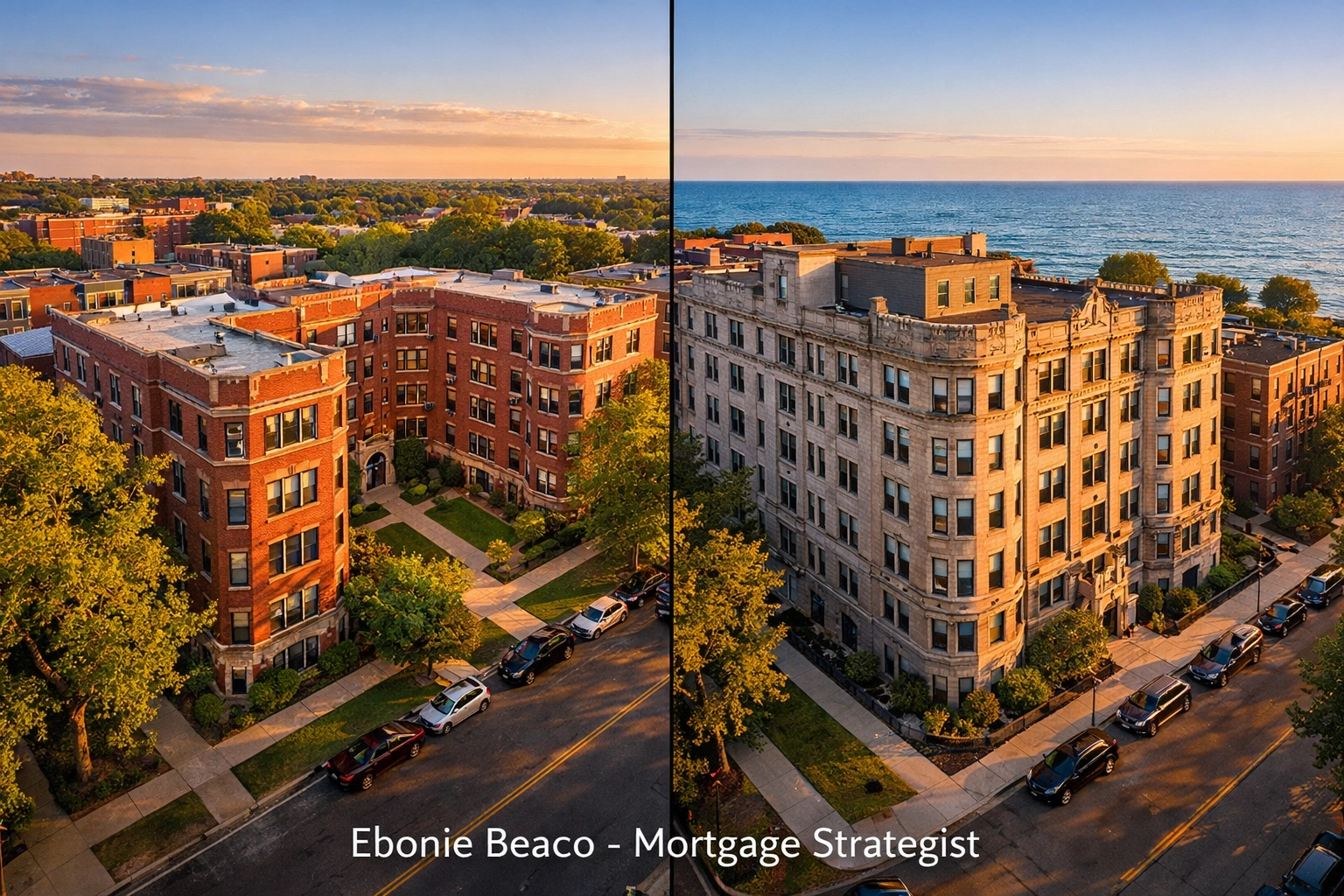
The portfolio in question was strategically split between the north and south sides of Chicago. This diversification is a common strategy for seasoned investors in the Windy City, as it balances the stable, high-demand rental market of the North Side with the high-yield, high-growth potential of the South Side.
Rogers Park: The North Side Anchor
Rogers Park is known for its lakefront access, diverse culture, and proximity to Loyola University. For these investors, the Rogers Park segment of the portfolio consisted of vintage brick walk-ups that have seen steady appreciation.
In this area, the units were commanding strong market rents:
- Average Rent per Unit: $3,300.
- Occupancy: Historically high, hovering around 96 percent.
South Shore: The Growth Engine
On the other side of the city, the South Shore properties offered a different value proposition. With the ongoing development surrounding the Obama Presidential Center and several lakefront revitalization projects, South Shore has become a magnet for investors looking for long-term upside.
The rental profile in South Shore for this portfolio looked like this:
- Average Rent per Unit: $2,500.
- Value Play: Significant equity growth through neighborhood appreciation and targeted interior renovations.
The Challenge: Improving Cash Flow While Extracting Equity
Many investors believe that if you take cash out of a property, your monthly payments will inevitably skyrocket. However, if the timing is right and the property's performance has improved, you can actually achieve the opposite.
The investment partners had a total of 124 units across 12 buildings located in Rogers Park and South Shore, Chicago. Over the last few years, they hadn't just sat back and collected rent. They had aggressively managed the portfolio, reducing vacancies and implementing "green" upgrades to lower utility costs. These operational improvements, combined with a Chicago cash out refinance mortgage, allowed us to restructure the debt.
Loan structure: A $12 million cash-out refinance at a lower interest rate than the original acquisition or bridge financing.
By securing better terms, we were able to:
- Lower monthly payments: Reduced total monthly debt service across the 12 buildings.
- Increase cash flow: Improved monthly cash flow by pairing stronger operations with a lower rate and better amortization.
- Extract equity: Pulled equity specifically to fund a down payment on a new apartment building.
- Protect DSCR: Maintained a healthy Debt Service Coverage Ratio (DSCR) profile for lender requirements.
Anatomy of a 40% Increase in NOI
In the world of commercial real estate and large-scale residential portfolios, Net Operating Income (NOI) is king. NOI is the total income generated by the property minus all necessary operating expenses. It does not include mortgage payments, which makes it the primary metric for determining a property's value.
Through a combination of strategic management and the $12 million cash-out refinance, the partners saw a 40% increase in NOI (Net Operating Income). Here is what actually drove the jump, in plain terms:
Phase 1: Operational Efficiency
Before the refi, the partners focused on the income and controllable expense drivers that move NOI.
NOI (Net Operating Income): Rental income minus operating expenses (taxes, insurance, repairs, utilities, management).
Practical use: You use NOI to measure property performance and support valuation and refinance proceeds.
Key operating actions that supported the NOI increase:
- Rent discipline: Rogers Park averaged $3,300 per unit and South Shore averaged $2,500 per unit, with pricing tied closely to tenant demand and renewal strategy.
- Vacancy control: Faster turns and tighter leasing standards reduced downtime.
- Expense resets: Improved vendor pricing, preventative maintenance, and utility-saving upgrades reduced avoidable operating costs.
- Utility recovery: RUBS (Ratio Utility Billing System) helped shift a portion of variable utility costs back to tenants where appropriate.
Phase 2: The Refinance Impact
When we structured the refinance using Chicago investment property loans, the debt side of the plan got cleaner.
Cash-out refinance: A refinance that pays off the existing loan and delivers extra proceeds to you at closing.
Practical use: You can access equity for a down payment on another building without selling your assets.
Lower rate impact: Even though debt service is not part of NOI, the lower interest rate reduced monthly payments, which increased post-debt cash flow and strengthened the overall risk profile.
That improved performance story is what made the lender comfortable releasing equity while keeping DSCR in range, which directly supported the 40% NOI increase narrative and the cash-out execution.

How the $12M Refinance Fueled the Next Acquisition
The most exciting part of this deal wasn't just the lower payments; it was the "dry powder" it created. In real estate, cash is a tool. By pulling equity out of the 124 units, the partners were able to walk into their next deal as "cash-heavy" buyers.
The $12 million refinance wasn't just about paying off old debt. A significant portion of that was "cash out" above the previous loan balances. This liquidity was earmarked for the down payment on another large-scale apartment building in Chicago.
The Power of Leverage
Instead of waiting years to save up the capital for their next move, the partners used the equity they had already built. This is the core of the BRRRR strategy (Buy, Rehab, Rent, Refinance, Repeat) scaled up to an institutional level.
With $2 million to $3 million in extracted cash, they could potentially acquire an additional $8 million to $12 million asset without ever dipping into their personal savings. This is how a real estate empire is built: by making your current assets pay for your future ones.
Why Chicago Investors Use DSCR Loans for Portfolios
For a deal of this size, we often look toward DSCR investor loans. A Debt Service Coverage Ratio loan is unique because it focuses on the income generated by the property rather than the personal income of the borrower.
In this $12 million shuffle, the lenders looked at the 124 units and asked one main question: "Does the rent from these buildings comfortably cover the new mortgage payments?"
Because the portfolio had a 40 percent increased NOI, the answer was a resounding yes. Chicago rental property financing through DSCR programs allows investors to scale quickly because they aren't limited by their personal debt-to-income ratios. As long as the properties are profitable and managed well, the sky is the limit.

Key Takeaways for Chicago Real Estate Investors
If you are looking to replicate this strategy with your own portfolio, whether you have 2 units or 200, the principles remain the same:
- Manage for Value: Always look for ways to increase your NOI. Even small increases in rent or small decreases in expenses can lead to massive jumps in property valuation.
- Watch the Market: When interest rates dip or your property value hits a certain threshold, it is time to talk to a mortgage strategist. Waiting too long can cost you thousands in potential cash flow.
- Diversify Your Locations: Having assets in both stable areas like Rogers Park and growth areas like South Shore provides a balanced risk profile that lenders love.
- Think Like a Strategist: Don't just look for a loan; look for a financing structure that supports your long-term goals. If your goal is to buy more property, a cash-out refinance is often the most tax-efficient way to get the capital you need.
Scaling Your Portfolio with Expert Guidance
Navigating a 12-building refinance is a high-stakes move. It requires a deep understanding of the local Chicago market, a grasp of complex commercial lending requirements, and a vision for where the market is headed.
At Home Loans Network, we specialize in helping investors unlock the hidden potential in their portfolios. Whether you are looking to lower your payments or pull out the capital needed for your next "Chicago Shuffle," we are here to provide the transparency and expertise you need to succeed.
Connect with Ebonie Beaco - Mortgage Strategist for a portfolio analysis.
The $12 million refinance described here is just one example of how strategic debt management can transform a collection of properties into a growing empire. By focusing on NOI and leveraging the right loan programs, you can turn your real estate goals into a reality.
Scedule a 1 on 1 at https://calendly.com/homeloansnetwork
Ebonie Beaco Mortgage Strategist | Senior Loan Officer Home Loans Network powered by Loan Factory Inc. NMLS #2389954 HomeLoansNetwork.com 312-392-0664