Tapping Into Your Equity: HELOC or Cash-Out Refinance?

![[HERO] Tapping Into Your Equity: HELOC or Cash-Out Refi?](https://cdn.prod.website-files.com/69b5f571b4bcdf3853a5c52b/69c35ce569d6a0dae6168af0_rktGcnARAjF.webp)
Home equity has reached historic highs across the United States. Whether you own a primary residence in Chicago, a vacation rental in Florida, or a growing portfolio of doors in Virginia, the value locked in your property is a powerful financial tool. Two primary methods exist to access this wealth: the Cash-Out Refinance and the Home Equity Line of Credit (HELOC).
Deciding between these two paths requires a clear understanding of your long-term goals and your current mortgage structure. If you are sitting on a low interest rate from several years ago, the choice becomes even more critical. Explore the mechanics of these options to determine which strategy aligns with your investment or renovation plans.
Defining the Terms
Cash-Out Refinance Definition: A new mortgage loan that replaces your existing primary mortgage with a higher balance, providing the difference in a lump sum. Practical Application: This allows you to reset your mortgage terms while pulling out a significant amount of equity for large, immediate expenses like a down payment on a new investment property.
Home Equity Line of Credit (HELOC) Definition: A revolving line of credit secured by your home equity that acts similarly to a credit card. Practical Application: You can draw funds as needed, pay them back, and draw again, making it ideal for ongoing renovation projects where costs are spread over time.
Learn more about mortgage basics at Home Loans Network.
How a Cash-Out Refinance Works
A cash-out refinance involves liquidating a portion of your home’s value by taking out a brand-new mortgage. You pay off your old loan, and the remaining funds are yours to use.
In markets like California or Florida, where property values have escalated rapidly, homeowners often use this to consolidate debt or fund the BRRRR strategy (Buy, Rehab, Rent, Refinance, Repeat). Because this is a primary mortgage, it typically carries a lower interest rate than a second mortgage or a credit card.
However, you must consider that a cash-out refinance replaces your entire loan. If your current rate is 3%, and today’s market rates are 6.5%, you are replacing your entire balance with a higher-rate loan. This is where the math becomes vital for landlords and homeowners alike.
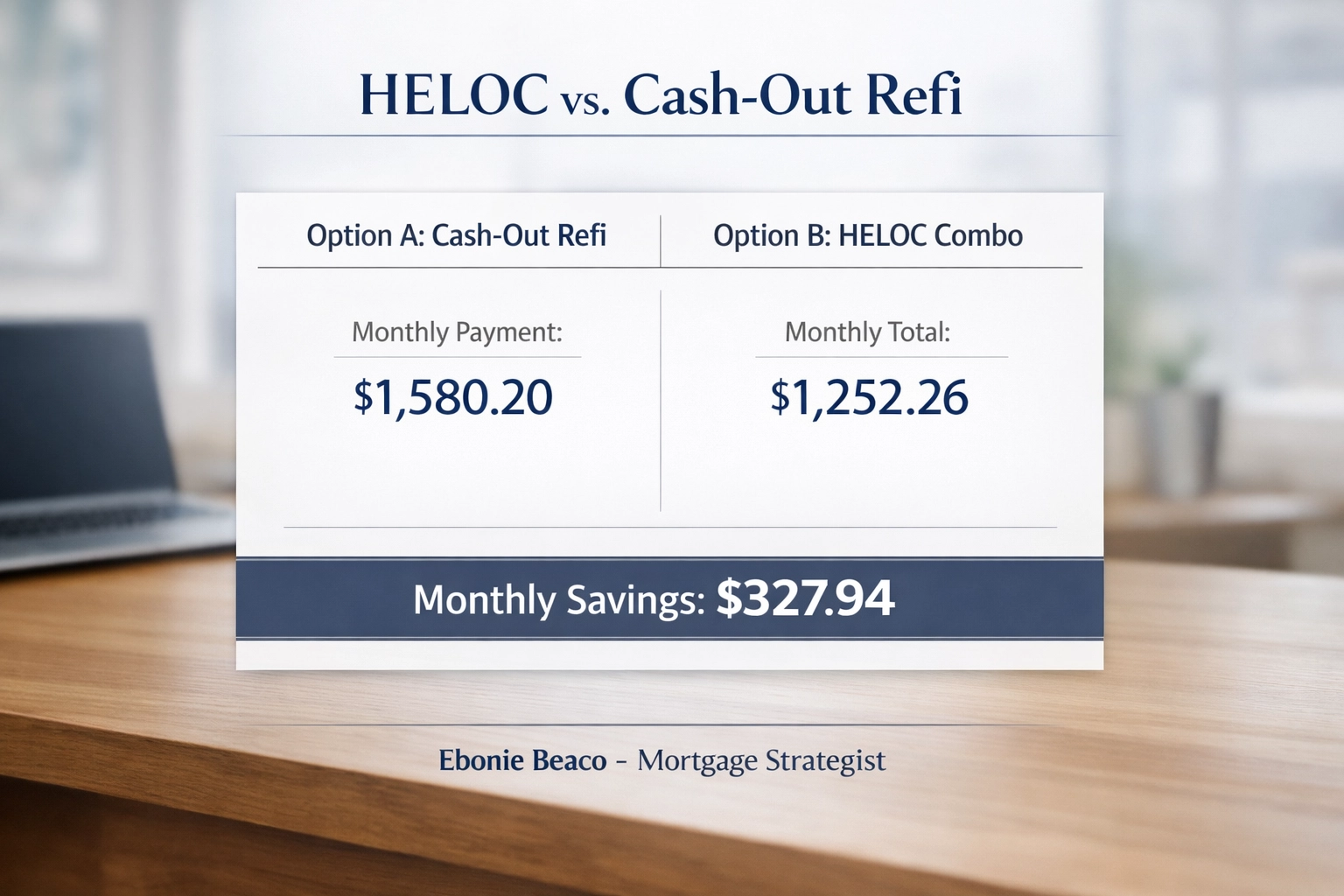 Image Note: Title "HELOC vs. Cash-Out Refi". Include the calculation table below. Add "Ebonie Beaco - Mortgage Loan Officer" at the bottom.
The Calculation: Cash-Out Refi vs. HELOC
Let’s look at a real-world scenario. Imagine you own a home in Virginia valued at $500,000. You currently owe $200,000 at a 3.5% interest rate. You need $50,000 to renovate the property or use as a down payment for a rental in Alabama.
Option A: Cash-Out Refinance
You take a new loan for $250,000 at a current rate of 6.5%.
- New Total Loan: $250,000
- Interest Rate: 6.5%
- New Monthly Principal & Interest: $1,580.20
Option B: HELOC (Keeping the First Mortgage)
You keep your $200,000 mortgage at 3.5% and take a $50,000 HELOC at 8.5% (Interest-Only for the draw period).
- First Mortgage Payment: $898.09
- HELOC Interest-Only Payment: $354.17
- Total Monthly Cost: $1,252.26
The Difference: In this specific scenario, keeping your low-rate first mortgage and adding a HELOC saves you $327.94 per month.
Understanding the HELOC Structure
A HELOC is often referred to as a "second mortgage" because it sits behind your primary loan. It consists of two distinct phases:
- The Draw Period: Usually lasting 5 to 10 years. During this time, you can take money out up to your limit. Most lenders only require interest-only payments during this phase.
- The Repayment Period: Lasting 10 to 20 years. You can no longer draw funds, and you must pay back both principal and interest.
For investors in Arkansas or Michigan looking to fix and flip, a HELOC provides the flexibility to pay interest only while the work is being done, then pay the balance off once the property is sold.
Check our mortgage calculators to run your own numbers.
Key Comparison Points
Interest Rates
Cash-out refinances typically offer fixed interest rates. This provides stability for your monthly budget. HELOCs usually feature variable interest rates that fluctuate with the prime rate. While some lenders offer a fixed-rate option for HELOCs, they are less common and often come with higher initial costs [1].
Closing Costs
A cash-out refinance is a full mortgage transaction. You can expect to pay 2% to 6% of the loan amount in closing costs, covering appraisals, title insurance, and origination fees [2]. HELOCs generally have much lower upfront costs, and some lenders even waive them entirely in exchange for keeping the line open for a certain period [3].
Loan-to-Value (LTV) Limits
Most lenders allow you to borrow up to 80% of your home's value for a cash-out refinance. HELOC guidelines are often similar, though some specialized programs for high-credit borrowers might allow for slightly higher leverage. If your property in Georgia or Illinois has significant equity, you have a higher chance of approval.
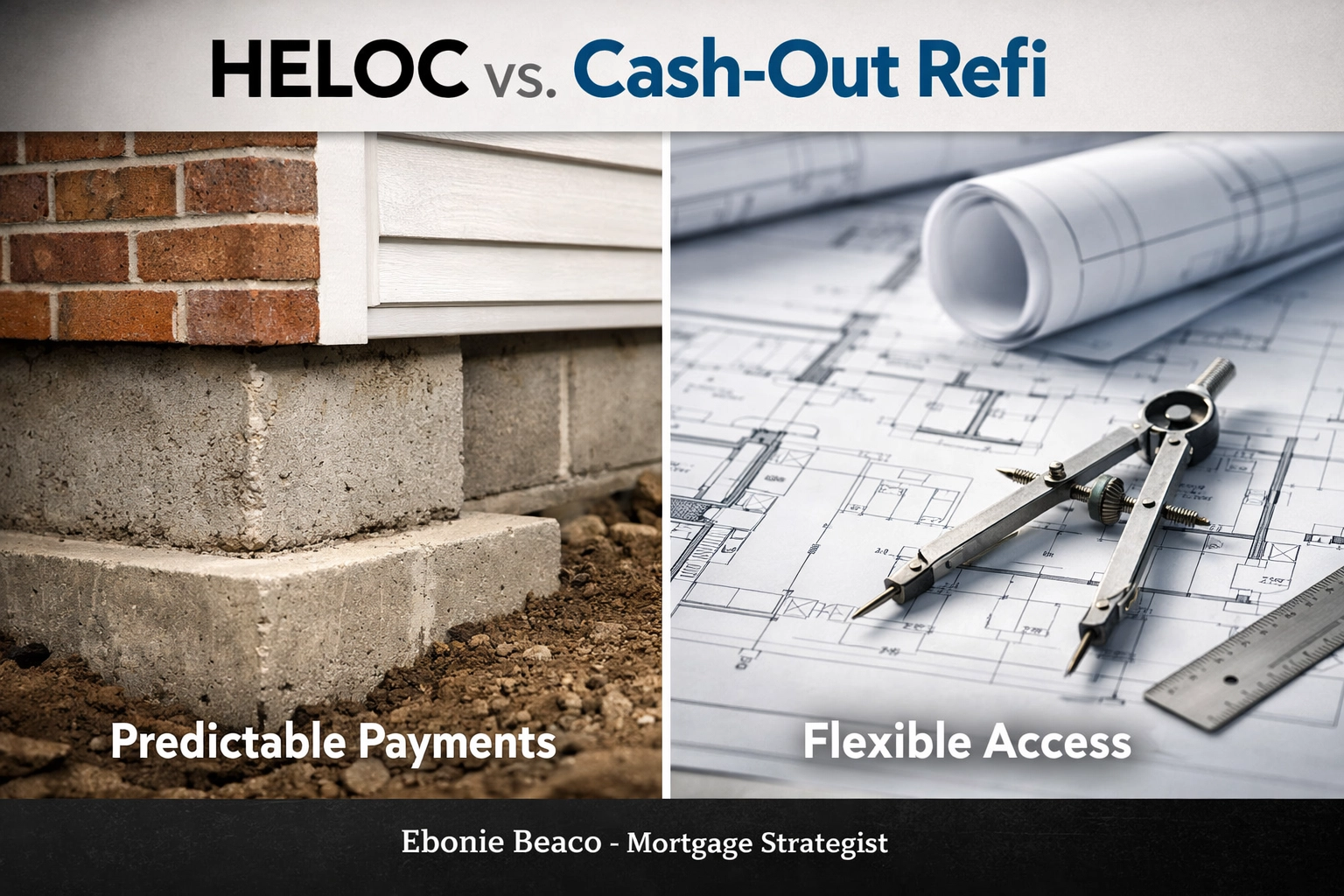 Visual: A comparison chart showing "Predictable Payments" under Cash-Out Refi and "Flexible Access" under HELOC.
The Investor’s Perspective: Scaling Your Portfolio
Real estate investors often view equity as "lazy money." If your equity is just sitting in a property in Kentucky or Missouri, it isn't working for you.
Using Equity for DSCR Loans
Investors often pull cash out of a primary residence to fund the down payment on a DSCR (Debt Service Coverage Ratio) loan. A DSCR loan allows you to qualify for a rental property based on the property’s income rather than your personal income. By using a HELOC or Cash-Out Refi to secure that 20% or 25% down payment, you can scale your portfolio without depleting your personal savings.
Short-Term Rental Financing
If you are eyeing an Airbnb property in a high-traffic area of Florida, the speed of access is significant. A HELOC acts as a "ready-to-go" fund. When the right deal hits the market, you can write a check immediately, positioning you as a cash buyer while other investors are still waiting for loan approvals.
Explore our loan process here.
Which Option Fits Your Strategy?
Jump in with a Cash-Out Refinance if:
- Current market interest rates are lower than or similar to your existing rate.
- You need a large, one-time lump sum for a specific investment.
- You prefer the security of a fixed monthly payment for the next 30 years.
- You are consolidating high-interest debt that carries rates much higher than a mortgage.
Access a HELOC if:
- You currently have a very low interest rate on your primary mortgage that you do not want to lose.
- You need flexible access to funds for ongoing projects.
- You want lower upfront closing costs.
- You plan to pay the balance back quickly (e.g., after a flip or a bonus).
Read our FAQ for more details.
Geographical Considerations
In states like California and Virginia, where home values are high, the amount of equity available can be substantial. For example, a homeowner in San Diego might have $400,000 in equity, while a landlord in Birmingham might have $60,000.
Regardless of the market size, the strategy remains the same: use the equity to improve your financial position without over-leveraging. In Chicago, many multi-unit owners use cash-out refinances to fund the renovation of vacant units, which in turn increases the rental income and the overall value of the building.
Final Thoughts on Equity Management
Your home is likely your largest asset. Tapping into that equity is a significant decision that should be handled with a clear strategy. Whether you choose the stability of a Cash-Out Refinance or the flexibility of a HELOC, the goal is to make your money work harder for you.
Compare the costs, look at the long-term interest impact, and choose the path that supports your growth as a homeowner or investor.
Should you choose a HELOC or a Cash-Out Refi? Contact Ebonie Beaco to find the best fit for your goals.
Schedule a 1 on 1 at: https://calendly.com/homeloansnetwork
Ebonie Beaco Mortgage Strategist | Senior Loan Officer Home Loans Network powered by Loan Factory Inc. NMLS #2389954 HomeLoansNetwork.com 312-392-0664
References: [1] Bankrate. "HELOC vs. Cash-out Refinance: Which is better?" [2] Investopedia. "Cash-Out Refinance vs. Home Equity Loan: What's the Difference?" [3] Forbes Advisor. "HELOC vs. Cash-Out Refinance: Key Comparison."