Self-Employed Borrower Programs
If you run your own business, you know that the tax code is designed to help you keep more of your money through write-offs. While that is great for your bottom line in April, it often creates a massive hurdle when you try to buy a home or refinance a property in markets like Chicago, Miami, or Atlanta. Traditional lenders look at the "net income" on your tax returns, which is usually much lower than what you actually make.
Self-Employed Borrower Programs are mortgage solutions designed specifically for business owners, freelancers, and independent contractors who need alternative ways to prove their ability to repay a loan. These programs use bank statements, profit and loss statements, or 1099 forms instead of traditional tax returns.
At Home Loans Network, we focus on transparency. We believe that being your own boss should not stop you from owning a home or building a real estate portfolio. Whether you are a fix-and-flip investor in Michigan or a homeowner looking for a home purchase in Florida, these programs are built for your reality.
Jump in and explore how these specialized loans work and why they are the go-to choice for modern entrepreneurs.
The Challenge of Traditional Financing
Standard mortgage guidelines, often set by Fannie Mae or Freddie Mac, require two years of personal and business tax returns. For many self-employed individuals in states like Virginia or Indiana, those tax returns show a small fraction of their actual cash flow due to heavy depreciation and business expenses.
Tax Return Income: The net profit shown after all deductions and expenses are accounted for on a federal tax return.
- Practical application: This figure is what traditional banks use to calculate your debt-to-income ratio, often leading to a loan denial even if you have plenty of cash.
When your "on-paper" income does not match your "in-pocket" income, you need a different path. This is where Non-QM Mortgage Loans come into play. These are "Non-Qualified Mortgages" that do not follow the strict federal box but are still safe, regulated, and effective tools for buying real estate.
Bank Statement Loans: The Gold Standard for Business Owners
The most popular option for self-employed borrowers is the Bank Statement Loan. Instead of looking at tax returns, lenders analyze your actual revenue.
Bank Statement Loan: A mortgage program that uses 12 to 24 months of personal or business bank deposits to determine qualifying income.
- Practical application: This allows a business owner with $50,000 in monthly deposits to qualify based on that cash flow, even if their tax return shows a loss.
In high-growth markets like Georgia or Alabama, many small business owners use this to scale their lifestyle alongside their business.
How the Calculation Works
Lenders typically look at your total deposits over 12 or 24 months. If you use business bank statements, they apply an "expense factor" (usually around 50%) to account for the costs of running the business. If you use personal bank statements and can show the money is transferred from a business account, you might be able to use 100% of those deposits.
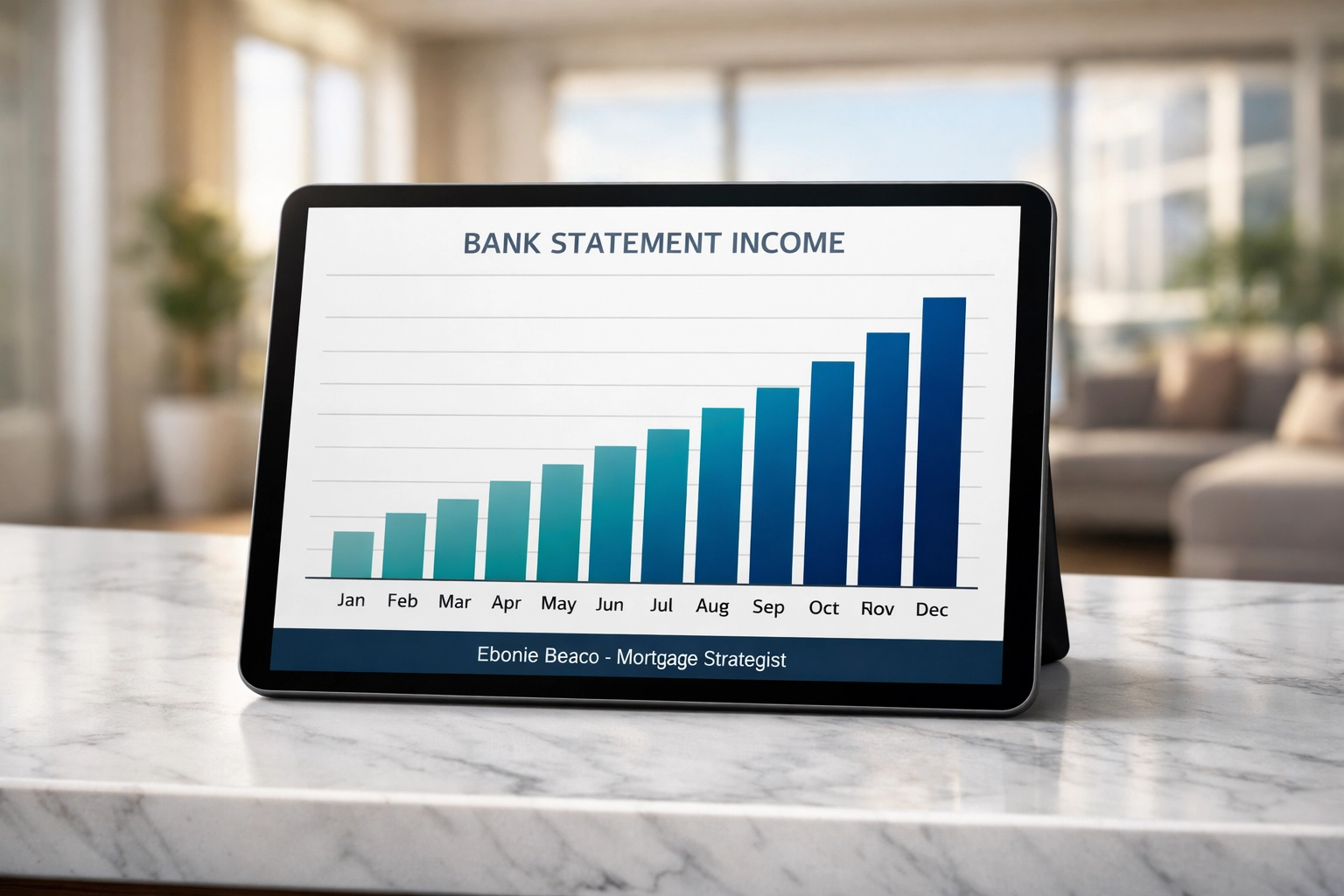
Visual breakdown of a Bank Statement Income Calculation: $240,000 total annual deposits / 12 months = $20,000 monthly. 50% expense factor = $10,000 qualifying monthly income. Ebonie Beaco - Mortgage Strategist
1099 Income Loans for Contractors
If you are an independent contractor or a consultant: common in the tech hubs of Northern Virginia or the creative sectors of California: you likely receive 1099 forms rather than W-2s.
1099 Loan Program: A specialized loan that uses the gross amount shown on 1099 forms to calculate income, often applying a standard expense haircut without requiring tax returns.
- Practical application: A consultant earning $150,000 on a 1099 can qualify for a mortgage using that figure as the baseline, avoiding the complications of Schedule C deductions.
This is a game-changer for gig economy workers and high-end specialists who want to access mortgage basics without the paperwork nightmare.
Profit and Loss (P&L) Statement Loans
Sometimes, bank statements do not tell the whole story. If your business has high turnover but very specific margins, a P&L loan might be the better fit.
P&L Loan: A mortgage where the borrower’s income is verified through a Profit and Loss statement prepared and signed by a CPA or licensed tax preparer.
- Practical application: This is ideal for businesses with fluctuating seasonal income in states like Missouri or Kentucky, where a CPA can provide a professional overview of the company's health.
For many, this is the most transparent way to show financial strength. It bypasses the "paper losses" on a tax return while still providing a professional verification of earnings.
Asset Depletion: Leveraging Your Wealth
If you have significant liquid assets but do not necessarily take a traditional "paycheck," asset depletion might be your ticket to a new home.
Asset Depletion: A qualifying method where a lender divides your total liquid assets by a set number of months (often 36 to 84) to create a "monthly income" figure.
- Practical application: A retiree or a successful entrepreneur in Florida with $1 million in a brokerage account can "create" a monthly income of roughly $11,900 for qualification purposes.
This strategy is frequently used for jumbo loans or for purchasing high-end vacation homes.
Requirements and Expectations
While these programs offer flexibility, they are not "no-doc" loans. Lenders still need to ensure the loan is a sound investment. Here is what you can generally expect:
- Credit Score: Most programs look for a minimum score between 620 and 660. Better scores usually lead to better rates.
- Down Payment: Expect to put down 10% to 20%. Because these loans carry more perceived risk than a government-backed FHA loan, a larger "skin in the game" is often required.
- Time in Business: You generally need to show you have been self-employed in the same industry for at least two years.
- Cash Reserves: Lenders may want to see 3 to 12 months of mortgage payments tucked away in a savings account.

Checklist for Self-Employed Borrowers: 12-24 Months Bank Statements, Business License, CPA Letter, 3-6 Months Reserves. Ebonie Beaco - Mortgage Strategist
Why Location Impacts Your Strategy
The real estate market in a city like Chicago operates differently than rural Arkansas. In competitive markets, being pre-approved with a specialized self-employed program means you can move as fast as a W-2 buyer.
In Florida and California, where property values are higher, using these programs to qualify for a higher loan amount can be the difference between getting the house you want and settling for something less. You can check your potential payments using mortgage calculators to see how different loan amounts fit your budget.
Comparing Your Options
| Feature | Traditional Loan | Bank Statement Loan | P&L Loan |
|---|---|---|---|
| Income Doc | Tax Returns (W-2/1040) | 12-24 Mo Statements | CPA Prepared P&L |
| Best For | High Net Income on Paper | High Gross Revenue | Specific Profit Margins |
| Typical Down | 3% - 5% | 10% - 20% | 15% - 20% |
| Flexibility | Rigid | High | High |
Real-World Scenario: The Chicago Consultant
Imagine a consultant in Chicago who grossed $250,000 last year. After business expenses, marketing, and home office deductions, their tax return shows a net income of only $45,000.
A traditional lender looks at that $45,000 and determines the borrower can only afford a very small mortgage. However, using a 12-month Bank Statement program, the lender sees the $250,000 in gross deposits. Applying a 50% expense factor, the qualifying income jumps to $125,000. This increase in "qualifying income" allows the consultant to purchase a home that actually fits their lifestyle.
Scaling for Investors
If you are a real estate investor, these programs are often the first step toward more advanced strategies like DSCR rental property loans. Many investors start by using a bank statement loan to buy their primary residence, then leverage that equity for future investment properties.
If you have questions about how your specific business structure impacts your eligibility, you can find many answers in our FAQ section.
Take the Next Step
Don't let your tax write-offs stand in the way of your property goals. Whether you are looking to refinance an existing loan or buy your first home, there is likely a program built for your specific financial situation.
Explore your options, compare the numbers, and move forward with confidence. Your business success should be an asset in the mortgage process, not a liability.
Schedule a 1 on 1 at https://calendly.com/homeloansnetwork
Ebonie Beaco
Mortgage Strategist | Senior Loan Officer
Home Loans Network powered by Loan Factory Inc.
NMLS #2389954
HomeLoansNetwork.com
312-392-0664