Retail Is Not Dead: February Mall-Traffic Surge + What Lenders Want to See on Retail Deals Right Now (Florida Edition)
If you have been listening to the "retail is dead" crowd for the last five years, you have probably missed out on some of the most consistent cash-flow opportunities in the commercial space.
As a mortgage strategist, I watch the same traffic and leasing signals lenders use, and the February 2026 numbers matter for Florida investors targeting Miami, Orlando, and Tampa.
While the "Retail Apocalypse" was supposed to be in full swing by now, we are seeing the exact opposite.
People are not just going back to the mall; they are staying longer, spending more, and using these spaces as their "third place" outside of home and work.
If you are underwriting Florida investment property loans or comparing Florida retail property financing options, you need to understand why this shift is happening and how to position your deal so a lender actually wants to fund it.
The February 2026 Surge: By the Numbers
The data from February 2026 shows a massive year-over-year gain across all mall formats. We aren't just talking about a tiny bump: we are talking about significant, sustained foot traffic.
- Open-Air Shopping Centers: These were the big winners with 7.3% year-over-year growth. Investors love these because of the lower common area maintenance (CAM) costs compared to indoor malls.
- Outlet Malls: Not far behind at 7.2% growth, which matters in Florida where shopping tourism is a real demand driver and outlet centers often benefit from visitor traffic in corridors tied to Orlando, Tampa, and South Florida.
- Indoor Malls: Even the "traditional" indoor mall saw a 5% increase.
What is even more interesting is when people are shopping. The strongest gains occurred during the evening hours between 5 PM and 8 PM. This tells us that these centers are no longer just places to buy a pair of jeans: they are evening destinations.
Why the "Third Place" Concept is Driving CRE Value
In the real estate world, we talk about the "third place": a social environment that isn't your house and isn't your office. With remote work still a major factor in 2026, people are desperate for physical connection.
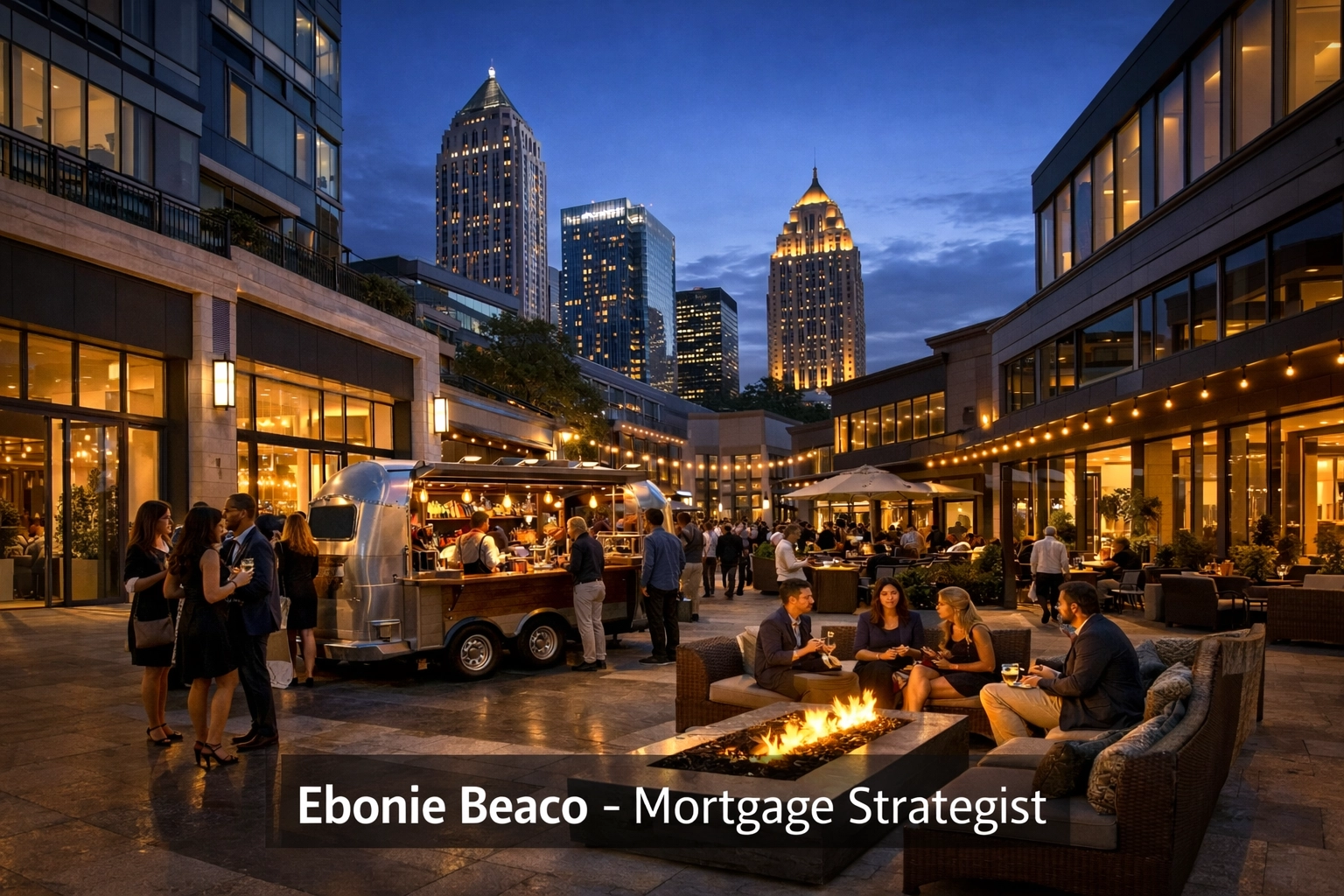
Today’s successful retail centers are integrating "experiential" elements that the internet simply cannot replicate. We are seeing craft beer trucks in outlet parking lots, specialized high-end restaurant concepts, and interactive entertainment zones.
For an investor, this means the tenant mix is more important than it has ever been. If you are looking at a strip center or a mall that is 100% apparel, you might struggle to get financing. But if that center has a mix of "clicks-to-bricks" retailers, a solid fitness anchor, and high-traffic dining, you are looking at a goldmine.
What Lenders Want to See on Retail Deals Right Now
When you come to me for a commercial real estate loan, the first thing I am looking at isn't just the property: it is the sustainability of the income. In 2026, lenders have shifted their focus from "size of the anchor" to "quality of the traffic."
Here is exactly what we are looking for when we evaluate a retail deal:
1. DSCR (Debt Service Coverage Ratio)
The DSCR is the holy grail of commercial lending. It measures the property’s ability to cover its debt payments with its net operating income (NOI).
- Definition: DSCR = Net Operating Income / Total Debt Service.
- Practical Application: Most lenders want to see a DSCR of 1.25 or higher. If your property brings in $125,000 in annual profit and your mortgage payments are $100,000, your DSCR is 1.25. In the current 2026 environment, a higher DSCR gives you more leverage to negotiate better interest rates.
2. Tenant Diversification and "Amazon-Proof" Businesses
We look for tenants that provide services people can't get online. This includes medical outpatients, high-end salons, boutique gyms, and "eat-ertainment" venues. A diverse rent roll reduces the risk of the entire building going dark if one sector of the economy dips.
3. Integrated Logistics (BOPIS)
Does the property support "Buy Online, Pick Up In-Store" (BOPIS)? Properties that have been retrofitted to act as mini-logistics hubs for the surrounding neighborhood are seeing much higher valuations. This dual-purpose functionality makes the asset much more resilient.
Case Study: The 12-Unit Retail Center Strategy
Let's look at a real-world scenario for an investor analyzing a retail strip in Florida, like an infill pocket near Miami, a growth corridor outside Orlando, or a suburban node near Tampa.
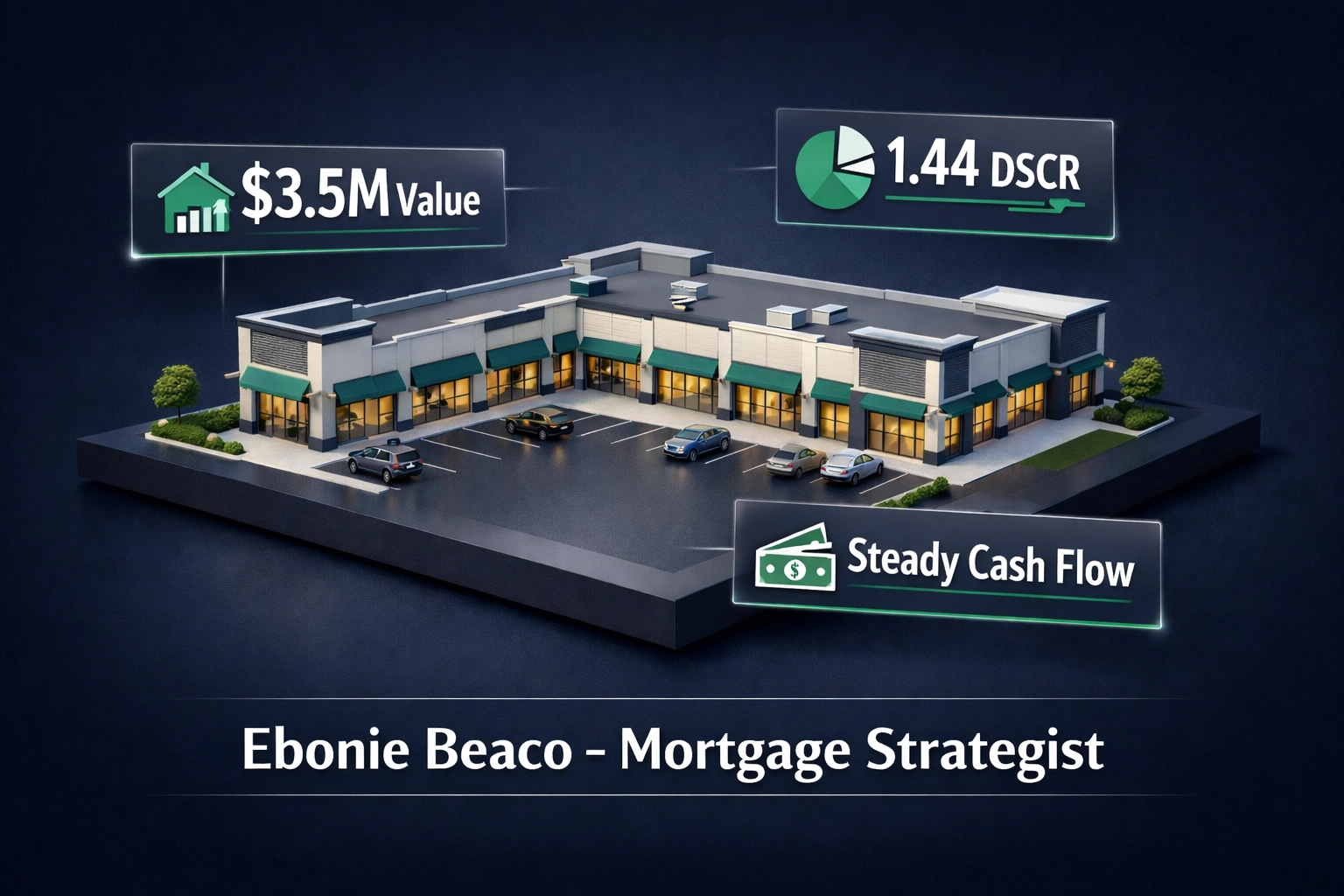
Imagine you are looking at a 12-unit retail strip valued at $3,500,000.
- Purchase Price: $3,500,000
- Down Payment (25%): $875,000
- Loan Amount: $2,625,000
- Annual Net Operating Income (NOI): $310,000
- Annual Mortgage Payment (Debt Service): $215,000
In this case, the DSCR would be 1.44.
This is a "slam dunk" deal for a lender. Why? Because even if one or two tenants move out, the property still generates enough cash flow to pay the bank and provide a profit to the investor. When we see traffic numbers like the 7.3% surge in February, it gives us the confidence that those vacancies will be filled quickly by hungry entrepreneurs.
Florida Opportunities: Miami, Orlando, Tampa (Where the Heat Is)
If you are focused on Florida retail property financing, here is where lenders tend to get most comfortable right now:
- Miami: Dense rooftops and high daily traffic can support service-heavy tenant mixes (medical, fitness, food, personal services) that underwrite well for Florida investment property loans.
- Orlando: Tourism and shopping tourism support outlets and experiential retail, especially when your rent roll shows durable brands and strong sales per square foot.
- Tampa: Population growth and business expansion continue to support neighborhood centers with needs-based tenants (grocery, pharmacy, quick-service) and evening dining concepts.
How Home Loans Network Can Help You Scale
Category: Commercial Loans
Commercial real estate is a different beast than residential. You need a strategist who understands how to package a deal, explain the tenant mix to an underwriter, and navigate the complexities of 2026 interest rate environments.
Whether you are looking for a Bridge Loan to reposition a struggling mall, or a long-term DSCR Investor Loan for a stabilized retail strip, we have the programs to make it happen.
We specialize in:
- Commercial Real Estate Loans for multi-unit retail.
- Bridge Financing for value-add acquisitions.
- Hard Money Loans for quick closings on distressed assets.
- Portfolio Lending for investors looking to scale across multiple states.
The "Retail is Dead" narrative was a great headline for a few years, but the reality on the ground is that well-managed, experiential retail is thriving. If you have found a deal that fits this mold, don't let the old headlines scare you off. Let's look at the numbers and get your project funded.
Stop guessing and start closing. The traffic is back, the consumers are spending, and the lenders are ready to move on the right deals.
Schedule a 1 on 1 at https://calendly.com/homeloansnetwork
Ebonie Beaco
Mortgage Strategist | Senior Loan Officer
Home Loans Network powered by Loan Factory Inc.
NMLS #2389954
HomeLoansNetwork.com
312-392-0664