Record Highs: Home Prices Hit $394k While Rates Tease a Drop
Tuesday, March 17, 2026
If you have been watching the housing market lately, you know it feels like a high-stakes game of tug-of-war. On one side, we have home prices climbing to heights we haven’t seen before. On the other, mortgage rates are finally starting to show a bit of mercy.
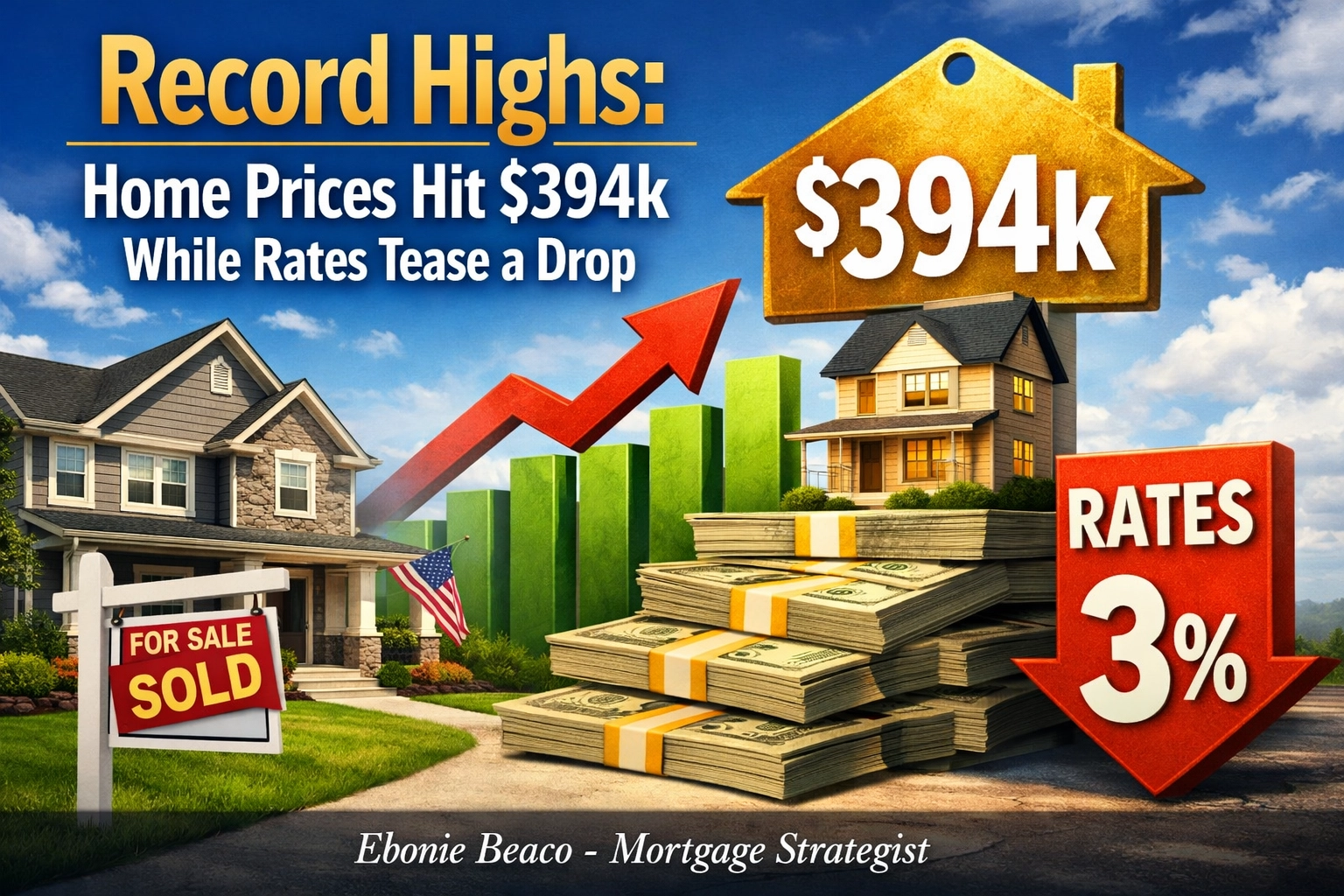
According to the latest data from Redfin, the median U.S. home sale price has officially hit a record high of $394,000. That is a 4.4% jump compared to this time last year. For many buyers in cities like Chicago, Atlanta, or Virginia Beach, that number feels like a steep mountain to climb. But here is the silver lining: mortgage rates are finally dipping. We are seeing the daily average for a 30-year fixed mortgage fall toward levels that offer some much-needed breathing room.
I am Ebonie Beaco, and as a Mortgage Strategist at Home Loans Network, I spend my days looking at these trends to help you navigate the complexity of real estate finance. Whether you are a first-time homebuyer in Michigan or a seasoned DSCR investor in Florida, understanding how these two forces interact is essential for your next move.
The State of the Market: Record Prices and Rate Relief
The fact that prices hit a record high while rates are falling tells us something significant about supply and demand. Even with higher costs, people still want to own property. In states like Alabama and Arkansas, the competition remains steady, while the California and Virginia markets continue to see aggressive bidding on well-priced homes.
Explore the Home Purchase options available if you are ready to jump into this environment. While $394,000 is the national median, your local market might look very different. The key is to look past the headline and focus on the math of your specific deal.
Mortgage Industry Dictionary
To help you stay ahead, let's define a few terms that frequently pop up in today’s headlines:
- DTI (Debt-to-Income Ratio): The percentage of your gross monthly income that goes toward paying debts. Benefit: A lower DTI gives you more leverage when applying for premium loan programs.
- LTV (Loan-to-Value): The ratio between the amount of your mortgage and the appraised value of the property. Benefit: Keeping your LTV below 80% often allows you to avoid private mortgage insurance.
- DSCR (Debt Service Coverage Ratio): A calculation used for investment properties that compares rental income to the mortgage payment. Benefit: This allows investors to qualify for loans without using personal income tax returns.

How Investors Are Navigating $394k Prices
For real estate investors, a record-high median price requires a shift in strategy. You cannot simply "buy and hope" in this market. You need a structured plan.
DSCR Investor Loans
Many of my clients in Florida and Georgia are leaning heavily into DSCR (Debt Service Coverage Ratio) loans. Since these loans focus on the property’s ability to generate cash flow rather than your personal paycheck, they are perfect for scaling a portfolio quickly. If a property in Chicago can bring in $3,500 in rent and the mortgage is $2,800, the "numbers work," regardless of the high purchase price.
Fix and Flip Financing
High prices often mean there is a lack of move-in-ready inventory. This creates a massive opportunity for fix-and-flip investors. By using short-term bridge loans or hard money, you can acquire distressed properties in Indiana or Kentucky, renovate them, and sell them into a market hungry for inventory. Check out our Loan Process to see how we move these deals from application to closing.
Airbnb and Short-Term Rentals
The short-term rental market remains a powerhouse in vacation hubs throughout California and coastal Florida. Even with a $394,000 price tag, a well-located Airbnb can often outperform a traditional long-term rental, provided you have the right financing structure in place.
Strategies for Current Homeowners: Tapping into Equity
If you already own a home, these record-high prices are actually good news for your net worth. Your home equity has likely exploded over the last 24 months.
Access that wealth through a HELOC (Home Equity Line of Credit) or a Cash-Out Refinance. Many homeowners in Virginia and Missouri are using this equity to:
- Consolidate high-interest credit card debt.
- Fund a down payment on a second investment property.
- Renovate their current home to increase its value even further.
Jump in and use our Mortgage Calculators to see how much equity you could potentially pull out. With rates starting to trend downward, a Home Refinance might be more attractive now than it was just six months ago.

Real-World Example: The Power of the DSCR Loan
Let’s look at a practical scenario for an investor looking at a property at that new median price point of $394,000.
The Scenario:
- Purchase Price: $394,000
- Down Payment (20%): $78,800
- Loan Amount: $315,200
- Estimated Monthly Rent: $3,200
- Estimated Monthly Mortgage (PITI): $2,500
The Calculation:
To find the DSCR, we divide the rent by the mortgage payment.
$3,200 / $2,500 = 1.28 DSCR
In this case, the property has a DSCR of 1.28. Most lenders look for a ratio of 1.20 or higher to qualify for the best terms. This investor can secure the property based on its own performance, keeping their personal debt-to-income ratio out of the equation. This is how professional landlords in Michigan and Illinois continue to grow despite record-high prices.

Why Rates Dropping "Teases" the Market
The term "tease" is appropriate because mortgage rates rarely drop in a straight line. They bounce. Economic reports, inflation data, and Federal Reserve meetings all play a role in the daily movement.
However, the trend is our friend. As rates decline, your purchasing power increases. A 0.5% drop in interest rates can save you hundreds of dollars a month on a $394,000 loan. For a buyer in California, where prices are often much higher, that difference can represent thousands of dollars in annual savings.
Compare your options and Select a Loan Officer who understands these nuances. At Home Loans Network, we prioritize transparency, ensuring you know exactly what is happening with your rate and your costs at every step.
The Importance of Being Ready
In a market where prices are at record highs, you cannot afford to be "just looking." You need to be "ready to buy." This means having your pre-approval in hand and your down payment funds verified.
Whether you are looking for Jumbo Loans in high-cost areas or Interest-Only Mortgages to maximize cash flow, the preparation is the same. You want to be the buyer that the seller chooses because your financing is rock solid.
Visit our FAQ page to answer any lingering questions about the process, or dive into our Mortgage Basics to brush up on your knowledge.
Moving Forward with Confidence
The headlines might seem intimidating, but every market cycle presents opportunities. Record prices reflect a strong desire for homeownership and a resilient economy. Falling rates represent an opening for those who have been waiting on the sidelines.
If you are an investor in Alabama, a homeowner in Virginia, or a first-time buyer in Chicago, the path forward is clear: focus on the data, understand your financing options, and move when the numbers align with your goals.
Explore more About Us and see why so many clients trust our transparent approach to lending. We are here to help you navigate these record-breaking times with clarity and confidence.
Schedule a 1-on-1 at https://calendly.com/homeloansnetwork
Ebonie Beaco
Mortgage Strategist | Senior Loan Officer
Home Loans Network powered by Loan Factory Inc.
NMLS #2389954
HomeLoansNetwork.com
312-392-0664