Rate-and-Term Refinance: Lower Your Monthly Payment
Navigating the landscape of home ownership and real estate investing requires a sharp eye on overhead costs. One of the most effective tools in your financial kit is the rate-and-term refinance. This strategy is designed specifically to optimize the structure of your debt without necessarily increasing your loan balance.
Whether you are a homeowner in Chicago looking for relief on your monthly mortgage or a landlord in Florida trying to increase the yield on a rental property, understanding how this process functions is essential. It is a straightforward path to improving your financial position by leveraging current market conditions or your improved credit profile.
Defining the Rate-and-Term Refinance
Rate-and-term refinance: A mortgage transaction where the primary goal is to change the interest rate, the loan term, or both, without taking out additional cash from the property's equity. Practical application: Use this to swap a high-interest loan for a lower one to reduce your monthly housing expense.
In the world of mortgage lending, this is often referred to as a "no-cash-out refinance." The new loan amount is typically limited to the payoff of the existing first mortgage plus any closing costs associated with the new loan. Unlike other programs like a cash-out refinance, the equity stays in the home, but the cost of carrying that home decreases.
The Mechanics of Lowering Your Monthly Payment
The primary driver behind most rate-and-term refinances is the monthly savings. When interest rates in the broader market drop, or when your personal financial profile improves, you have the opportunity to renegotiate the "rent" you pay on the bank’s money.
Securing a Lower Interest Rate
When mortgage rates trend downward in states like Virginia or Georgia, homeowners often rush to refinance. Even a 1% difference in your interest rate can result in hundreds of dollars in monthly savings. This is money that stays in your pocket rather than going toward interest expense.
Adjusting the Loan Term
The "term" refers to how many years you have to pay back the loan. If you currently have 22 years left on a 30-year mortgage, you could refinance back into a new 30-year term. By spreading the remaining balance over a longer period, your monthly payment drops significantly. Conversely, some homeowners choose to shorten their term (e.g., from 30 years to 15 years) to pay the home off faster, though this usually increases the monthly payment while saving a fortune in long-term interest.
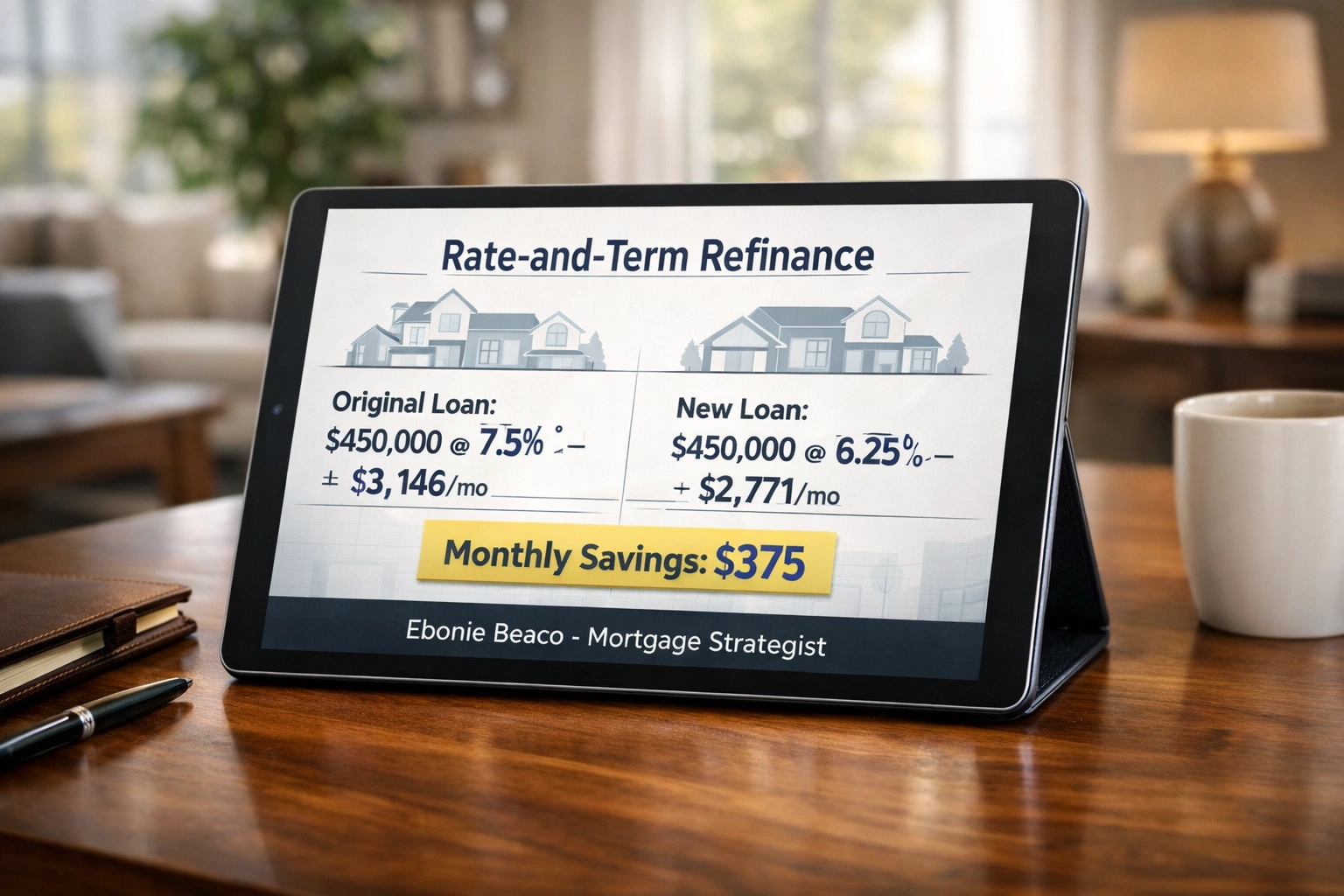 Visual Breakdown: Rate-and-Term Refinance Calculation. Original Loan: $450,000 at 7.5% (30-year) = $3,146/mo. New Loan: $450,000 at 6.25% (30-year) = $2,771/mo. Monthly Savings: $375. Annual Savings: $4,500. Title: Rate-and-Term Refinance. Ebonie Beaco - Mortgage Loan Officer.
Strategic Advantages for Real Estate Investors
For landlords and real estate investors in markets like Alabama or Arkansas, a rate-and-term refinance is a powerful tool for portfolio optimization. Investing is a game of margins, and your mortgage payment is likely your largest operating expense.
DSCR (Debt Service Coverage Ratio): A metric used by lenders to qualify a property based on its ability to cover mortgage payments with rental income. Practical application: If your current interest rate is eating your profits, a rate-and-term refinance can improve your DSCR, making the property more "bankable" for future financing.
Investors often use this strategy after a Fix and Flip project or when a bridge loan matures. By moving from a high-interest short-term bridge loan into a 30-year fixed-rate landlord loan, you stabilize the asset and lock in predictable cash flow.
Eliminating Private Mortgage Insurance (PMI)
Many homeowners who purchased properties in California or Florida with less than 20% down are currently paying Private Mortgage Insurance. As property values in these regions have climbed, many owners now have more than 20% equity based on current market valuations.
PMI (Private Mortgage Insurance): An insurance policy that protects the lender if you default, usually required on conventional loans with less than 20% down. Practical application: Refinance once your equity reaches 20% to drop the PMI and immediately lower your monthly obligation.
If you have seen significant appreciation in your local market, a rate-and-term refinance allows you to order a new appraisal. If the new appraisal proves you have sufficient equity, the PMI is removed in the new loan structure. This often results in a double-win: a lower interest rate and the removal of a $100–$300 monthly insurance premium.
Moving from Variable to Fixed Stability
If you currently hold an Adjustable-Rate Mortgage (ARM), you may be concerned about future rate hikes. An ARM might have started with a very low "teaser" rate, but as that period ends, the rate can adjust upward, causing your payment to spike.
Fixed-Rate Mortgage: A loan where the interest rate remains the same for the entire life of the loan. Practical application: Shift from an ARM to a fixed-rate loan to ensure your payment never changes, providing long-term peace of mind.
For residents in high-cost areas like Northern Virginia or Southern California, the certainty of a fixed payment is a major component of financial planning. A rate-and-term refinance facilitates this transition, protecting you from the volatility of the interest rate market.
Analyzing the "Break-Even" Point
Before proceeding with a refinance, it is vital to calculate your break-even point. Refinancing involves closing costs, which can include appraisal fees, title insurance, and lender fees. You need to know how long it will take for your monthly savings to cover those upfront costs.
Break-Even Point: The amount of time it takes for your monthly savings to equal the total cost of the refinance. Practical application: If your refinance costs $4,500 and you save $375 a month, your break-even point is 12 months.
Explore the mortgage calculators available to run these numbers for your specific scenario. If you plan to keep the property longer than the break-even period, the refinance is generally a sound financial move.
Market Insights: Regional Opportunities
The housing markets in the Midwest, specifically Indiana and Missouri, have seen steady growth that makes refinancing attractive for those who bought even just two or three years ago. In Chicago, where property taxes can be a significant burden, lowering the principal and interest portion of your payment through a refinance is one of the few ways to gain breathing room in your monthly budget.
For those operating in the short-term rental space in Florida or Arizona, lowering your debt service is the fastest way to increase your ROI. If your Airbnb or VRBO property is performing well, but the mortgage is a remnant of a higher-rate environment, it is time to analyze a new rate-and-term structure.
Preparing for the Refinance Process
To get started, you will want to gather your current mortgage statement, recent pay stubs (or bank statements if you are self-employed), and tax returns. The process is very similar to a purchase mortgage but often moves faster because there is no seller involved.
- Check your credit: Higher scores lead to lower rates.
- Verify your equity: Ensure your home value supports the loan amount.
- Compare programs: Look at conventional, FHA, or Non-QM options depending on your needs.
- Review the loan process: Understand the steps from application to clear-to-close.
Jump In and Evaluate Your Options
The decision to refinance should be based on clear data and long-term goals. Whether you are looking to free up cash for another investment or simply want to reduce your monthly bills, a rate-and-term refinance is a tried-and-true method for debt management.
Access the FAQ section to learn more about the common hurdles and solutions in the refinancing world. By staying informed, you position yourself to make the best possible choice for your family or your business.
Contact Ebonie Beaco to lower your payment or for mentoring at www.homeloansnetwork.com.
Schedule a 1 on 1 at https://calendly.com/homeloansnetwork
Ebonie Beaco Mortgage Strategist | Senior Loan Officer Home Loans Network powered by Loan Factory Inc. NMLS #2389954 HomeLoansNetwork.com 312-392-0664