Payday Protocol: How Wholesale Real Estate Investors Actually Get Paid

Getting started in wholesale real estate often feels like learning a new language where the final exam is a five-figure check. You might hear people talking about "the spread" or "the assignment," but understanding the actual mechanics of how the money moves from a cash buyer’s bank account into your own is essential for any serious investor. Whether you are operating in the busy streets of Chicago or looking for off-market gems in rural Virginia, the process of getting paid remains relatively consistent across different markets. It is not about simply finding a house and marking up the price; it is about providing a valuable service by sourcing inventory for investors who have the capital but lack the time to hunt for deals. By mastering the payment protocol, you ensure that your hard work translates into a legitimate profit at the closing table without unnecessary delays or legal hiccups.
Assignment Fee: A payment made to a wholesaler by an end buyer for the right to purchase a property under contract. This fee represents your profit for finding a distressed property and securing it at a price that still leaves plenty of room for an investor to renovate and resell.
The most common way to get paid when wholesaling houses is through an assignment of contract. Once you have a property under contract with a motivated seller, you essentially sell your interest in that contract to a cash buyer for an assignment fee. You and the buyer sign an assignment agreement that outlines the new purchase price, which includes your fee on top of the original price negotiated with the seller. In a typical 2026 scenario, a wholesaler might secure a property for $150,000 and assign it to a flipper for $165,000, creating a $15,000 payday. The title company handles the distribution of funds, ensuring the seller gets their $150,000 and you receive your $15,000 check or wire transfer. This method is efficient because it requires very little of your own capital, though it does require transparency since both the buyer and seller can often see your profit on the settlement statement.
 Visual: A modern, clean title company conference room with professional documents and a calculator. Footer: Ebonie Beaco - Mortgage Strategist
Double Closing: A transaction where the wholesaler buys the property from the seller and immediately resells it to the end buyer in two separate transactions. This strategy is used to keep the wholesale profit private from both the original seller and the end buyer.
Sometimes, a deal is so profitable that you might prefer a double closing to maintain privacy regarding your fee. If you are making a $40,000 or $50,000 spread on a single property in a high-value market like California or Florida, seeing that number might make a seller or buyer second-guess the deal. In a double closing, you actually close on the property first (Transaction A-B) using transactional funding or your own cash, and then immediately sell it to your end buyer (Transaction B-C). While this method involves two sets of closing costs and potentially a small fee for transactional funding, it allows you to operate with total discretion. Many successful investors use this when they want to build long-term relationships without the distraction of people focusing on the size of their profit margin. You can explore more about the mortgage basics to understand how different closing structures impact the final numbers.
Transactional Funding: Short-term financing used by wholesalers to facilitate a double closing. This is a bridge loan that typically lasts only 24 to 48 hours, allowing the wholesaler to technically own the property for a few minutes before reselling.
To ensure your payday is secured, you must work closely with an investor-friendly title company that understands the nuances of real estate investing. You should provide your updated wiring instructions to the title company at least 48 hours before the scheduled closing to avoid any last-minute banking errors. Additionally, modern regulations in 2026 require your business entity to maintain FinCEN Beneficial Ownership Information (BOI) compliance, or you might find your funds held up during the verification process. The title agent acts as the neutral third party that verifies all signatures are legitimate and that the cash buyer has deposited the full amount required to cover the purchase and your fee. When the dust settles and the deed is recorded, the title company issues your payment, which is the culmination of your marketing, negotiating, and deal-structuring efforts. If you have questions about this part of the journey, our FAQ section covers many common hurdles for new investors.
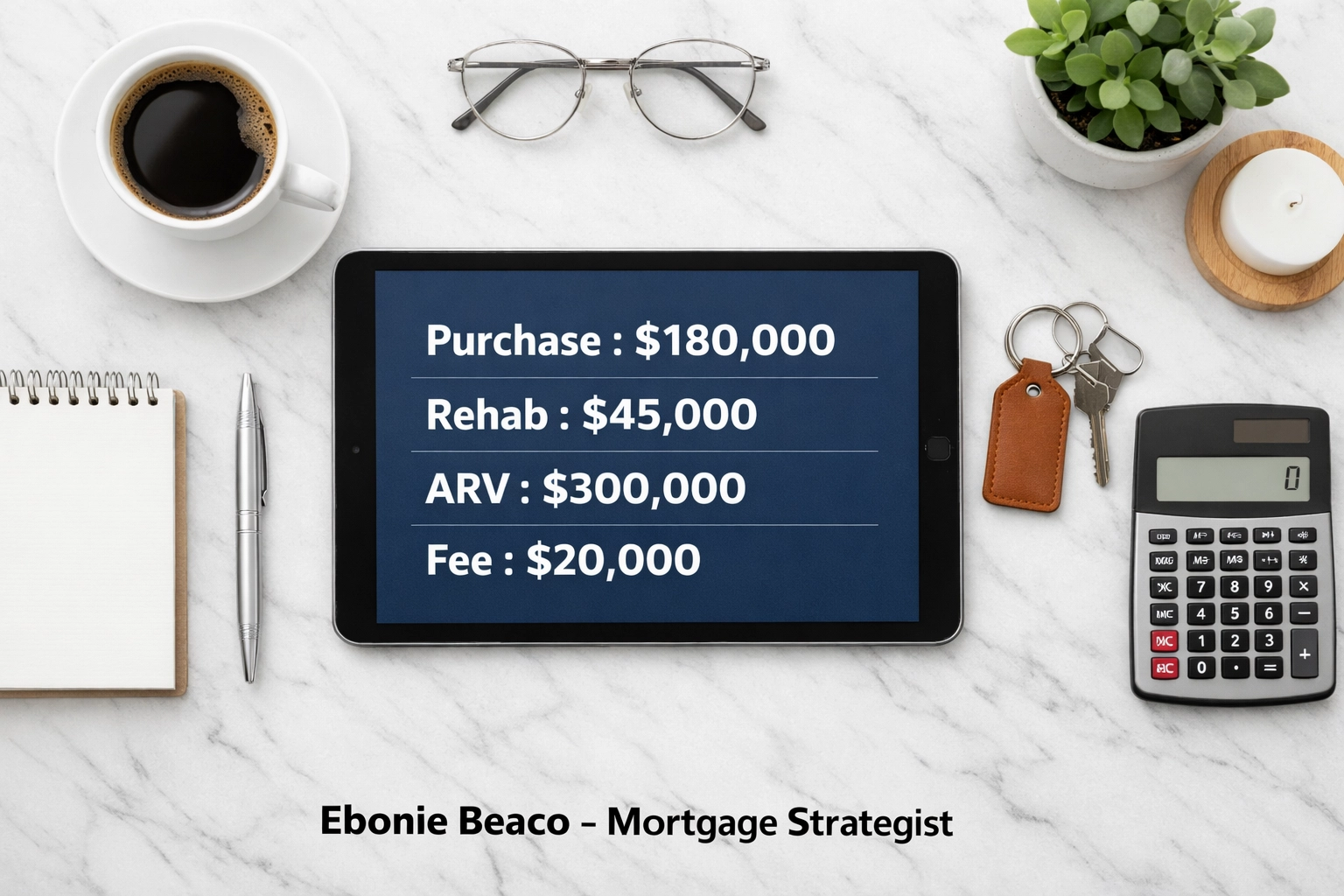 Visual: A detailed deal breakdown graphic showing: Purchase Price: $180,000, Rehab: $45,000, ARV: $300,000, Wholesale Fee: $20,000. Footer: Ebonie Beaco - Mortgage Strategist
Let’s look at a real-world deal breakdown to see how the numbers actually hit your bank account. Imagine you find a distressed three-bedroom home in Indiana with an After Repair Value (ARV) of $250,000. You negotiate a contract with the seller for $120,000, knowing the property needs about $50,000 in renovations. You then market this deal to your cash buyers list and find an investor willing to pay $140,000 for the property because it still fits their profit criteria.
Wholesale Deal Example:
- Original Contract Price: $120,000
- Assignment Fee: $20,000
- Investor Total Purchase Price: $140,000
- Estimated Rehab Cost: $50,000
- Total Investor Basis: $190,000
- After Repair Value (ARV): $250,000
- Investor Profit Potential: $60,000
In this scenario, everyone wins: the seller gets out of a burdensome property, the investor gets a deal with a $60,000 profit ceiling, and you walk away from the closing table with a $20,000 assignment fee.
 Visual: A professional house exterior in a suburban neighborhood representing a successful investment. Footer: Ebonie Beaco - Mortgage Strategist
As you gain experience with wholesale real estate, you may decide to stop assigning every deal and start keeping some for yourself. This is where moving from a wholesaler to a fix-and-flipper or a landlord becomes a powerful wealth-building strategy. Instead of taking a one-time fee, you might use a hard money loan to fund the renovation or a DSCR investor loan to turn the property into a long-term rental. Transitioning into these roles requires a deeper understanding of financing, but the long-term equity gains can far outweigh a standard assignment fee. Whether you are wholesaling to build up your initial capital or you are ready to finance your own portfolio, having a mortgage strategist who understands the investor mindset is a massive advantage. You can always check our testimonials to see how we have helped other investors bridge the gap between finding deals and owning them.
The timeline for getting paid in this industry is remarkably fast compared to traditional real estate. Most wholesale deals close within 7 to 21 days, providing a level of liquidity that is hard to find in other investment sectors. This speed is possible because you are typically working with cash buyers who do not need to wait for traditional bank appraisals or long underwriting periods. However, to keep this engine running, you must consistently fill your pipeline with new off-market opportunities and maintain a verified list of buyers who are ready to perform. Success in this field is about reputation and reliability; if you bring clean deals to the table, your buyers will be happy to pay your fees deal after deal. Remember that each check you receive is proof that you solved a problem for both a seller and a buyer, cementing your place in the local real estate ecosystem.
📞 Work With Ebonie Beaco
If you are a wholesaler looking to:
- Close more deals
- Connect your buyers with financing
- Structure deals that actually get approved
- Learn how to grow into a real estate investor
I can help you every step of the way.
Ebonie Beaco Mortgage Strategist | Senior Loan Officer Home Loans Network powered by Loan Factory Inc. NMLS #2389954
📱 Phone: 312-392-0664 📧 Schedule a 1 on 1: https://calendly.com/homeloansnetwork 🌐 Website: HomeLoansNetwork.com/contact-us
👉 Whether you need lending, deal structuring, or mentorship, reach out today.