New Construction & Builder Programs
Starting from the ground up is a completely different experience than buying an existing home. Whether you are a developer eyeing a multi-unit project in Chicago or a family building a custom home in Virginia, the financing needs to align perfectly with your construction timeline. New construction and builder programs bridge the gap between a vacant lot and a finished front door. We keep things transparent at Home Loans Network: construction lending has more moving parts than a standard mortgage, but it provides the flexibility to create exactly what you want. We help you navigate draw schedules, interest-only phases, and the transition to permanent financing. Stop guessing about your build and start planning with a strategy that fits your blueprint.
Ready to break ground on your next project? Schedule a 1 on 1 at Calendly to discuss your scenario.
Understanding New Construction Financing
Building a property requires a specialized financial structure that differs from a traditional purchase. These programs are designed to cover the costs of land acquisition, permits, labor, and materials.
Construction Loan: A short-term loan used to finance the building of a home or investment property.
- The lender pays out the money in stages as work is completed rather than in one lump sum.
Builder Program: Financing specifically tailored for developers or builders to fund "spec" homes or model units.
- These programs often include features that allow builders to manage cash flow while multiple projects are under construction.
When you explore Home Purchase options for new builds, you are looking at a process that values the future value of the property once it is completed. This allows you to leverage the equity you are creating during the build process.
The Two Primary Paths: One-Time vs. Two-Time Close
Navigating the paperwork for a build depends on how you want to handle the transition from the construction phase to the permanent mortgage.
Construction-to-Permanent (One-Time Close)
This is often the preferred route for homeowners. You close once, which means one set of closing costs. During the build, you typically pay interest-only on the amount that has been drawn. Once the home receives a Certificate of Occupancy, the loan automatically converts into a permanent mortgage, such as a 30-year fixed rate.
Stand-Alone Construction (Two-Time Close)
This path involves two separate loans. The first loan covers the construction phase. Once the building is done, you apply for a standard mortgage to pay off the construction loan. While this means two closings, it offers more flexibility if you want to shop for a different permanent lender or if you need to change the loan type after the build is finished.
Builder Incentives and Energy Efficiency
In today's market, builders often offer incentives to attract buyers. In regions like Colorado or Florida, energy efficiency is a high priority. According to recent industry trends, many builders are leaning into programs like the Federal DOE Efficient New Homes Program.
HERS Index (Home Energy Rating System): A standard symbol of a home’s energy efficiency.
- A lower score means a more efficient home, which can sometimes qualify you for specific green financing or builder credits.
Builders may offer to "buy down" your interest rate or cover closing costs if you use their preferred lenders. However, it is always wise to Compare Options with an independent strategist to ensure the "incentive" isn't being offset by a higher base price or interest rate.
Financing for Real Estate Investors and Developers
For the professional investor, new construction is a way to scale a portfolio with modern, low-maintenance assets. From duplexes in Michigan to 5+ unit apartments in Georgia, the strategy remains the same: create value through development.
LTC (Loan-to-Cost): The ratio used to determine how much a lender will provide based on the total cost of the project.
- Lenders use this to ensure the developer has enough "skin in the game" to complete the project.
Draw Schedule: A detailed timeline that dictates when the lender releases funds.
- This ensures that the foundation is poured, the framing is up, and the roof is on before the next chunk of cash is released.
For investors focusing on Jumbo Loans for high-end new builds in California or Virginia, the underwriting process focuses heavily on the builder’s experience and the projected market value of the finished property.
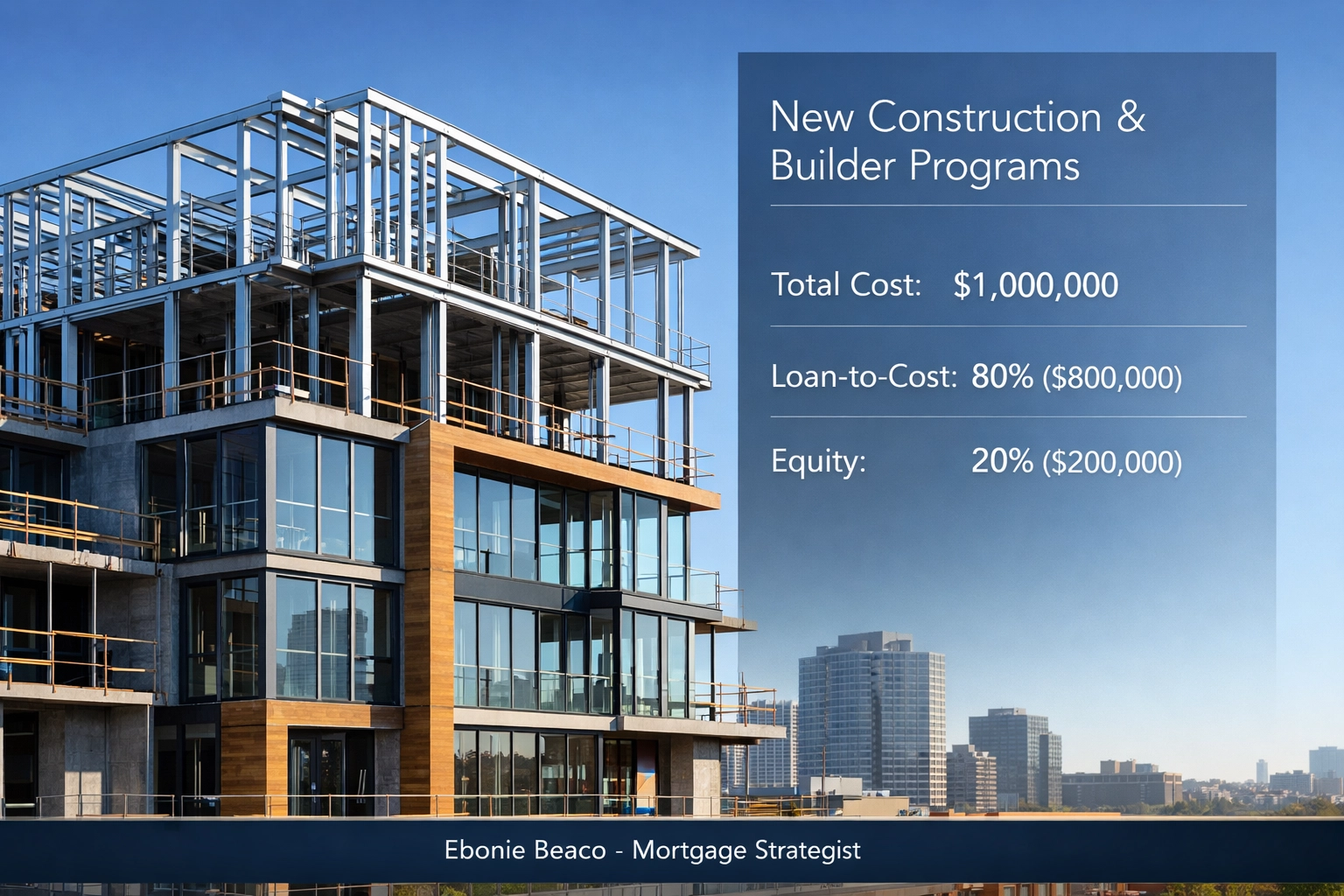
Visual: A financial breakdown showing a $1,000,000 construction project. Total Cost: $1,000,000. Loan-to-Cost (LTC): 80% ($800,000). Developer Equity: 20% ($200,000). Footer: Ebonie Beaco - Mortgage Strategist.
Case Study: Ground-Up Multi-Family Build in Chicago
Imagine an investor purchasing a vacant lot in Chicago for $150,000 with plans to build a 4-unit residential building costing $650,000.
- Total Project Cost: $800,000.
- Financing (75% LTC): The lender provides $600,000.
- Investor Contribution: $200,000 (often including the land equity).
- The Draw Phase: Over 10 months, the lender releases the $600,000 in five stages.
- The Exit: Upon completion, the investor refinances into a DSCR Loan based on the new appraised value, which might be $1,100,000.
This strategy allows the investor to "pull out" their initial capital while holding a brand-new, cash-flowing asset. You can read more about how this works on our FAQ page.
Builder Financing for Spec Homes
If you are a builder looking to expand, "Spec" (speculative) home financing is vital. You are building a home without a committed buyer under the assumption that it will sell quickly upon completion.
Spec Home Financing: A line of credit or loan specifically for builders to construct homes for future sale.
- This allows builders in active markets like Florida or Texas to keep crews working even between custom contracts.
Lenders look at the builder's "track record" and the "absorption rate" of the local market. If homes in a specific area of Alabama are selling in 30 days, a lender is much more likely to fund a spec project there than in a stagnant market.
Construction-to-Permanent for Homeowners
For those looking to build their "forever home" in Kentucky or Missouri, the process feels more personal. You aren't just looking for a return on investment; you are looking for a place to live.
The beauty of the Loan Process for new construction is that you can often lock in your interest rate before the hammer even hits the first nail. This protects you from market volatility during the six to twelve months it takes to build.
Soft Costs: Expenses like architectural fees, permits, and engineering reports.
- Knowing how much of these costs can be rolled into the loan is a key part of the initial strategy.
Hard Costs: The actual tangible costs of construction, including land, labor, and materials.
- These are the primary drivers of your draw requests.
Why Local Market Knowledge Matters (Without Using the Forbidden Word)
The requirements for a construction loan in Illinois are different than those in Arkansas. Local building codes, permit timelines, and seasonal weather patterns affect your draw schedule. As a strategist, I look at these regional factors to ensure your loan doesn't run out of time.
If you are building in a coastal area of Florida, your budget must account for specific hurricane-resistant materials. If you are building in a high-density area of Chicago, your "soft costs" for permits and city inspections will be higher. We provide About Us details that show our commitment to understanding these nuances.
Key Benefits of New Construction Programs
- Customization: You get exactly what you want, from the layout to the finishes.
- Lower Maintenance: New builds come with warranties and modern systems that won't break down next week.
- Energy Efficiency: Lower utility bills through modern insulation and HVAC tech.
- Equity Growth: In a rising market, the property may be worth more than the cost to build by the time it is finished.
Navigating the Challenges
Construction is rarely perfect. There are delays, material shortages, and weather issues. A transparent lending partner will help you build "contingency" into your loan.
Contingency Fund: A reserve of cash (usually 5-10% of the build cost) set aside for unexpected expenses.
- Having this built into your financing prevents the project from stalling if a supplier raises prices mid-build.
Explore our Mortgage Basics to understand how these reserves affect your overall debt-to-income ratio and loan eligibility.
Final Thoughts on Building Your Future
New construction is a powerful way to build wealth or create a home that perfectly fits your life. It requires a higher level of organization and a lender who understands the "dirt to door" process. Whether you are an experienced builder in Michigan or a first-time homebuyer in Virginia, we are here to guide you through the complexities.
The goal is to move from a vacant lot to a finished property with as little stress as possible. By structuring the financing correctly from day one, you ensure that the construction phase is a bridge to your goals, not a barrier.
Ready to start your build?
Schedule a 1 on 1 at https://calendly.com/homeloansnetwork
Ebonie Beaco
Mortgage Strategist | Senior Loan Officer
Home Loans Network powered by Loan Factory Inc.
NMLS #2389954
HomeLoansNetwork.com
312-392-0664