Multi-Unit Investing: Why More Doors Are Better Than One

If you have spent any time in the real estate world, you have likely heard the phrase "doors" thrown around quite a bit. Investors do not just say they own three properties; they say they have "twelve doors." This shift in language reflects a fundamental strategy in wealth building: moving from single-family homes to multi-unit properties.
Whether you are looking at a duplex in Chicago, a four-unit building in Indianapolis, or a twenty-unit complex in Tampa, the logic remains consistent. Scaling your portfolio by adding more units under a single roof offers a level of efficiency and risk protection that single-family rentals simply cannot match. At Home Loans Network, we see investors every day who make the jump to multi-unit properties to accelerate their path to financial independence.
In this guide, we will explore why multi-unit investing is a powerhouse strategy and how the right financing can turn a modest investment into a massive portfolio.
The Power of Scalability and Risk Mitigation
The most obvious benefit of multi-unit investing is the reduction of vacancy risk. If you own one single-family home and your tenant moves out, you are 100% vacant. Your income drops to zero while your mortgage, taxes, and insurance payments keep coming.
When you own a four-unit property, one vacancy only represents a 25% dip in gross income. The other three tenants are still paying rent, which often covers the entire mortgage and operating expenses. This "safety net" is why many seasoned investors in markets like Virginia and Georgia prefer multifamily assets. You can learn more about how we help navigate these risks on our About Us page.
Efficiency in Management
Managing ten single-family homes across ten different neighborhoods in Alabama or Michigan is a logistical hurdle. You have ten roofs to maintain, ten separate lawns to mow, and ten different tax bills to track.
With a 10-unit building, you have one roof, one yard, and one foundation. Professional property management companies often charge lower percentages for multi-unit buildings because their staff only has to travel to one location to handle multiple issues. This consolidation of expenses helps boost your bottom line significantly.
Financing Multi-Unit Properties: The "House Hacking" Edge
One of the best kept secrets in real estate is the ability to use residential financing for properties with up to four units. If you are a first-time investor or a homeowner looking to start a portfolio, you can purchase a duplex, triplex, or fourplex using an FHA loan with as little as 3.5% down.
This strategy, often called "house hacking," allows you to live in one unit while the tenants in the other units pay your mortgage. It is a fantastic way to acquire a high-value asset with minimal out-of-pocket costs. For those looking to scale without living on-site, DSCR investor loans are a game changer. These loans qualify the property based on the rental income it generates, rather than your personal debt-to-income ratio.
Residential vs. Commercial Multi-Unit
Properties with 2 to 4 units are considered residential. Properties with 5 or more units are considered commercial. The financing for a 5-unit building in Florida or California works differently than a 4-unit building. Commercial loans focus heavily on the building’s profitability and the experience of the investor.
Understanding the Numbers: The Cap Rate
In the world of multi-unit investing, the "Cap Rate" (Capitalization Rate) is the gold standard for measuring a property's potential return. It helps you compare different buildings across different markets, like comparing an apartment complex in Little Rock, Arkansas, to one in Richmond, Virginia.
Cap Rate Definition: The ratio of Net Operating Income (NOI) to the property's purchase price or current market value. This figure represents the estimated rate of return on a real estate investment property.
Calculating the Cap Rate
To find the Cap Rate, you first need to determine the Net Operating Income. This is your total annual rental income minus all operating expenses (taxes, insurance, maintenance, utilities, and management). Note that NOI does not include your mortgage payment.
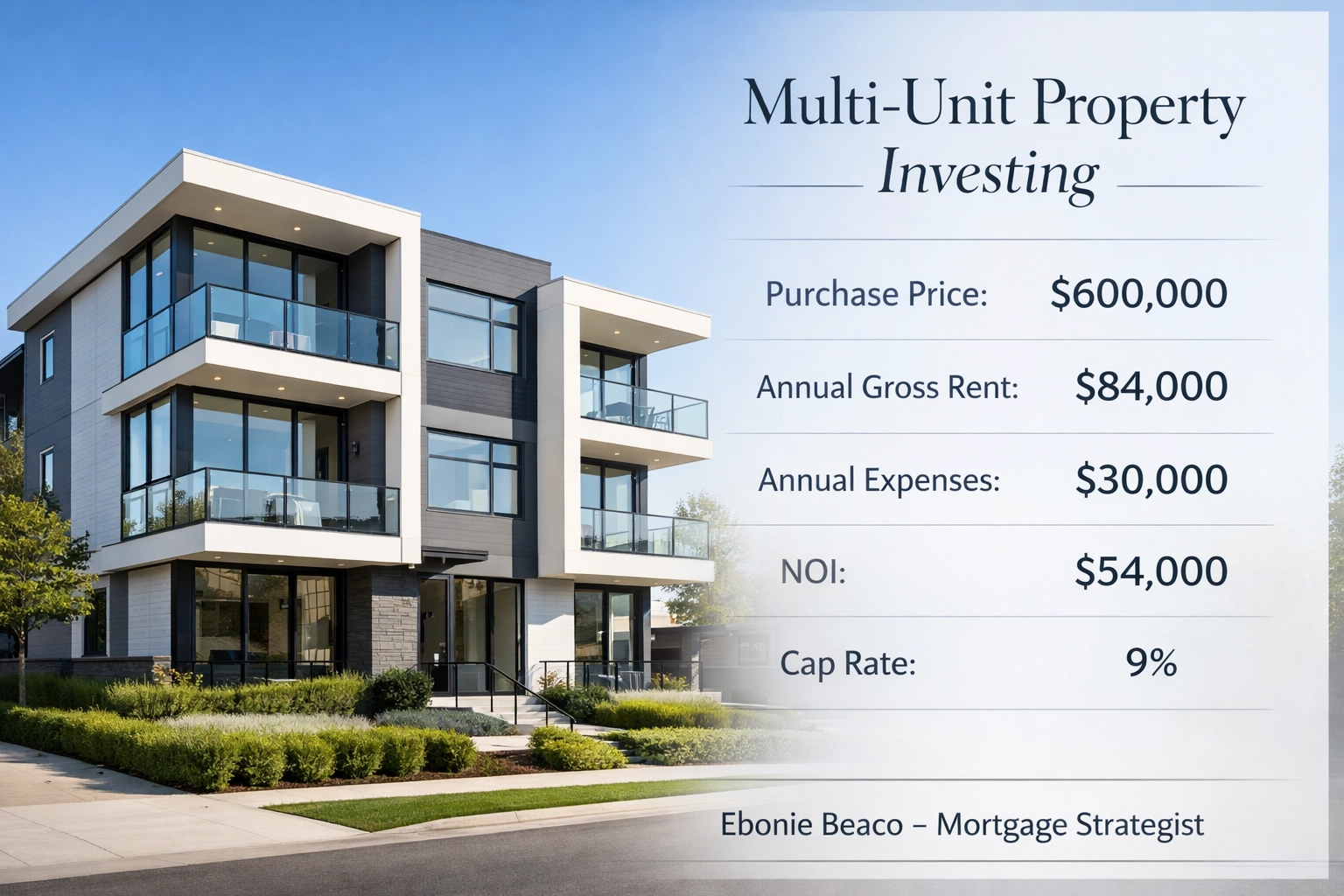 Title: Multi-Unit Property Investing
Calculation:
Purchase Price: $600,000
Annual Gross Rent: $84,000
Annual Operating Expenses: $30,000
Net Operating Income (NOI): $54,000
Cap Rate Formula: (NOI / Purchase Price) x 100
Calculation: ($54,000 / $600,000) = 0.09
Cap Rate: 9%
Ebonie Beaco - Mortgage Loan Officer
Title: Multi-Unit Property Investing
Calculation:
Purchase Price: $600,000
Annual Gross Rent: $84,000
Annual Operating Expenses: $30,000
Net Operating Income (NOI): $54,000
Cap Rate Formula: (NOI / Purchase Price) x 100
Calculation: ($54,000 / $600,000) = 0.09
Cap Rate: 9%
Ebonie Beaco - Mortgage Loan Officer
A 9% Cap Rate is generally considered a strong return in many markets today. Knowing this number allows you to see if a deal is overpriced or if it carries a high enough return to justify the effort of management. You can use our mortgage calculators to help run more of these scenarios.
Tax Advantages and Appreciation
Multi-unit properties provide substantial tax benefits. Because you are dealing with a larger asset, your depreciation deductions are typically much higher than with a single-family home. Investors often use "cost segregation" studies to accelerate depreciation on certain components of the building, which can offset a significant portion of the rental income from taxes.
Additionally, multi-unit properties in growing metro areas like Chicago or various cities in Florida tend to appreciate steadily. As you increase the rents over time, the value of the property often increases as well, because commercial property values are directly tied to the income they produce.
Expanding Your Portfolio with a Cash-Out Refinance
If you already own a single-family home with significant equity, you might be sitting on the down payment for your first multi-unit building. A cash-out refinance allows you to tap into that equity to fund your next acquisition.
Many of our clients in Illinois and Indiana use this strategy to transition from being a simple homeowner to becoming a professional landlord. By leveraging the equity in a primary residence, you can secure the funds needed for a 20% or 25% down payment on a profitable multi-unit investment.
Why Location carries significance in Multi-Unit Investing
When you are looking for multi-unit deals, you want to target areas with high renter demand and diverse job markets.
- Chicago, IL: Known for its classic 2-flat and 3-flat buildings, it is a prime market for house hacking.
- Florida Cities: High population growth makes multi-unit properties in places like Orlando or Jacksonville highly desirable.
- Virginia and Georgia: These states offer a mix of urban and suburban multi-unit opportunities with favorable landlord-tenant laws.
If you are unsure where to start, looking at our FAQ can provide clarity on common investor hurdles.
Moving Forward with Mentoring and Financing
Multi-unit investing is a major step toward building generational wealth, but it requires a strategic approach. It is not just about finding a building; it is about finding the right debt structure that allows the property to cash flow from day one.
Whether you are looking for home purchase options for a duplex or commercial financing for a large apartment complex, having an expert in your corner is essential. We don't just provide loans; we provide the strategy behind the investment.
Buying a multi-unit? Contact Ebonie Beaco for the best financing options and mentoring.
Explore your options and take the next step in your investment journey. Jump in by reviewing our loan process or reach out directly to discuss your specific scenario.
Scedule a 1 on 1 at https://calendly.com/homeloansnetwork
Ebonie Beaco Mortgage Strategist | Senior Loan Officer Home Loans Network powered by Loan Factory Inc. NMLS #2389954 HomeLoansNetwork.com 312-392-0664