Mortgage Rate Alert: Why Today’s Shift is Significant for Your California or Florida Refinance Strategy

As we close out May 2026, the mortgage landscape is presenting a unique set of variables for homeowners and investors alike. Navigating the current "higher-for-longer" environment requires a shift in perspective, moving away from waiting for historical lows and toward strategic equity management. Whether you are holding property in the high-value corridors of California or the booming coastal markets of Florida, understanding how current rates influence your bottom line is the first step toward financial optimization.
Current data suggests that 30-year fixed conforming rates have stabilized in the mid-6% range, hovering between 6.48% and 6.56%. While this represents a slight climb over the last month, it also creates a predictable window for those looking to restructure debt or tap into significant home equity gains. This stability allows for precise calculations when comparing traditional financing against more specialized products like DSCR rental property loans or cash-out refinancing.
Definitions and Key Terms
Refinance
The process of replacing an existing mortgage with a new loan, typically to secure a lower interest rate, change the loan term, or access cash from home equity.
Application: You use a refinance to lower your monthly obligation or to fund property improvements that increase your overall portfolio value.
Cash-Out Refinance
A mortgage refinancing option where the new loan is for a larger amount than the existing mortgage, and the borrower receives the difference in cash.
Application: This is a powerful tool for homeowners in appreciating markets like Miami or Los Angeles to access liquidity for further real estate acquisitions.
Debt Service Coverage Ratio (DSCR)
A measurement of a property's ability to cover its debt payments based on the income it generates, rather than the borrower's personal income.
Application: Real estate investors in Georgia or Michigan use DSCR loans to scale their portfolios without the restrictive DTI requirements of traditional financing.
HELOC (Home Equity Line of Credit)
A revolving line of credit that allows you to borrow against the equity in your home as needed, similar to a credit card.
Application: A HELOC provides a flexible safety net for homeowners in Virginia or Illinois who want to keep their low first-mortgage rate while still accessing funds for renovations.
National Rate Snapshot: May 2026 Trends
The national mortgage market is currently reacting to persistent inflation figures and a steady federal funds rate. While some sectors of the economy are showing signs of cooling, the housing market remains resilient due to limited inventory. For residents in states like Indiana, Kentucky, and Missouri, where home prices are often more accessible, these mid-6% rates still offer a path to sustainable homeownership and wealth building.
Recent reports from Bankrate indicate that while mortgage applications have seen a slight decrease, the demand for government-backed products like FHA and VA loans remains strong. These programs often offer rates slightly lower than conforming loans, providing a critical entry point for first-time buyers in Alabama and Arkansas. Understanding these nuances is essential for any homeowner evaluating whether to stay the course or move forward with a new financing strategy.

Strategic Refinancing in California: High Stakes and High Equity
In California, the real estate market operates on a scale of its own. With median home prices in cities like San Francisco, San Diego, and San Jose far exceeding national averages, even a fractional shift in interest rates can lead to thousands of dollars in annual savings. For many California homeowners, the "0.75% Rule" is a helpful benchmark: if you can lower your current rate by three-quarters of a percent, the long-term interest savings often outweigh the closing costs.
California’s unique tax environment, governed by property tax stabilization measures, makes refinancing an attractive alternative to selling. When you refinance, you retain your original tax base while adjusting your loan terms to match your current financial goals. This is particularly relevant for those looking to move from an Adjustable-Rate Mortgage (ARM) into a 30-year fixed product to ensure long-term payment stability as we look toward the latter half of 2026.
Florida Dynamics: Balancing Rates and Insurance Costs
Florida remains one of the most active real estate markets in the country, with significant migration to hubs like Orlando, Tampa, and Jacksonville. However, a Florida refinance strategy involves more than just looking at the interest rate. Property owners must account for the total PITI (Principal, Interest, Taxes, and Insurance) calculation, especially with the rising costs of homeowners and flood insurance across the peninsula.
When exploring a home refinance in Florida, it is vital to work with a strategist who understands local escrow requirements. If your property value has increased significantly, you may be able to eliminate Private Mortgage Insurance (PMI), which can offset the impact of a slightly higher interest rate. This "equity-driven refinance" is a common tactic for Florida homeowners who have seen double-digit appreciation over the last few years.

The Math Behind the Move: A Break-Even Analysis
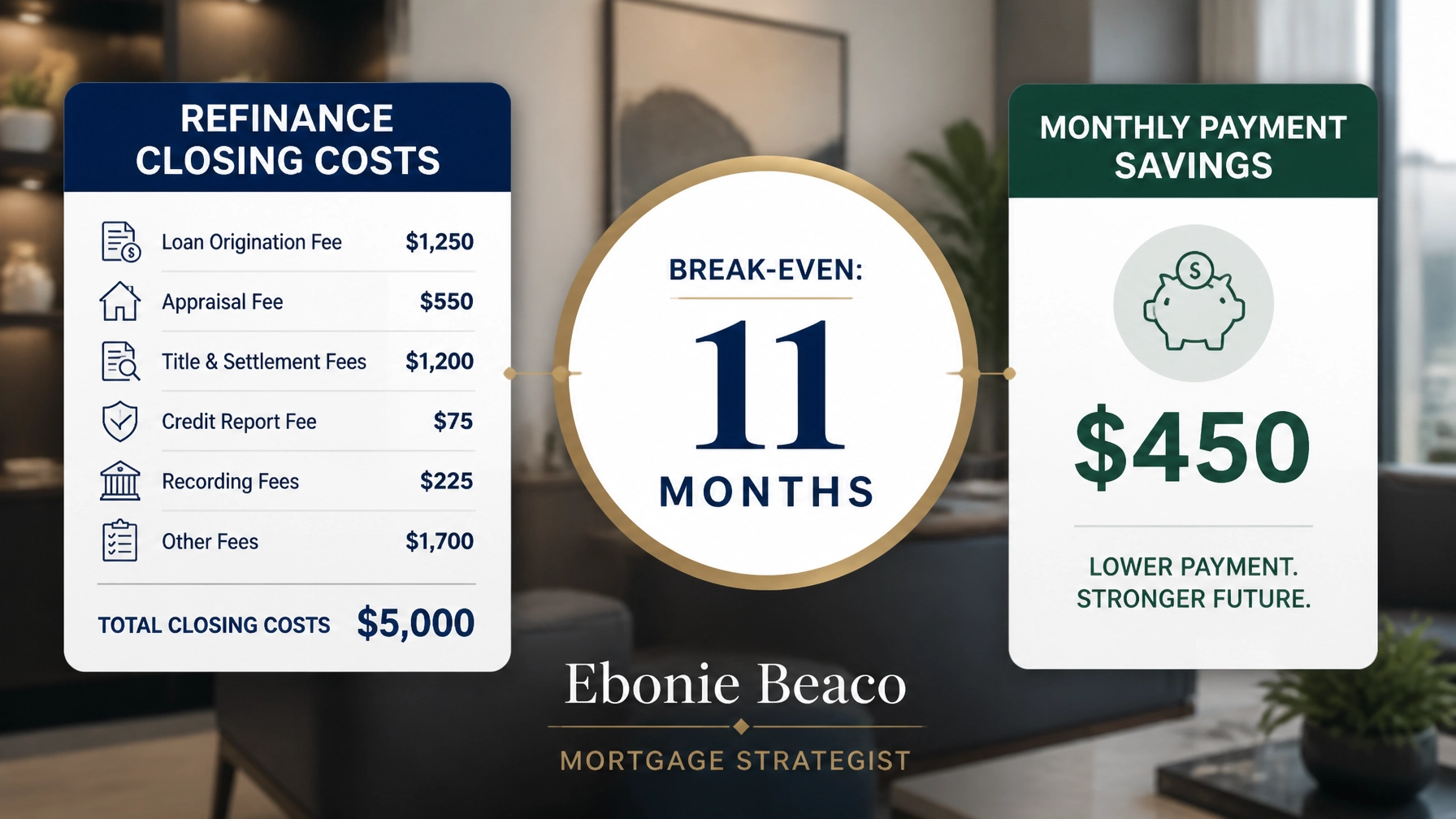
Determining if a refinance is a smart move requires a cold, hard look at the numbers. You must calculate your break-even point: the moment when the monthly savings from your new loan have fully paid for the costs of getting that loan. For example, if your closing costs are $5,400 and you are saving $450 per month, your break-even point is 12 months.
If you plan to stay in your home in Virginia or Georgia for at least five years, a 12-month break-even is an exceptional investment. Conversely, if you plan to relocate or sell within 18 months, the upfront costs may not be justified. We always recommend running these scenarios through a mortgage calculator to visualize the long-term trajectory of your debt.
Financial Example: The Equity Extraction Strategy
Let's look at a real-world scenario for a homeowner in Chicago, Illinois.
- Current Home Value: $650,000
- Current Mortgage Balance: $380,000
- Total Available Equity: $270,000
If this homeowner wants to fund a new investment property in Michigan, they might consider a cash-out refinance. By taking a new loan at 75% Loan-to-Value (LTV), they could secure a total loan of $487,500. After paying off the existing $380,000 mortgage and covering roughly $12,000 in closing costs, they would walk away with $95,500 in cash. This liquidity can then be used as a down payment on a multi-unit property, effectively turning dormant home equity into an active, income-producing asset.
Investment Financing: Beyond the Primary Residence
Real estate investors often play by a different set of rules. For those managing short-term rentals in Florida or fix-and-flip projects in California, traditional bank financing may not be the fastest or most efficient route. This is where Non-QM mortgage loans and DSCR loans provide a competitive edge.
DSCR loans focus on the cash flow of the property itself. If a rental property in Atlanta or Richmond generates enough monthly rent to cover the new mortgage payment (usually at a ratio of 1.2x or higher), the investor can qualify regardless of their personal income or tax returns. This is an ideal solution for self-employed entrepreneurs who have significant write-offs but strong asset portfolios.

Commercial and Multi-Unit Opportunities
As we navigate the 2026 market, there is a growing interest in small multifamily properties: duplexes, triplexes, and four-unit buildings. These "house hacking" opportunities allow owners in states like Illinois and Michigan to live in one unit while the rental income from the other units covers the majority of the mortgage.
For larger-scale investors, commercial real estate loans offer the capital needed to acquire apartment complexes or mixed-use buildings. These transactions require a deep understanding of capitalization rates (cap rates) and net operating income (NOI). By aligning your financing with a 15-year or 30-year strategy, you can lock in current rates and protect your cash flow against future volatility.

Navigating Today’s Rate Environment: Next Steps
The mortgage market is in a state of constant evolution. While the headline rates may seem high compared to the anomalies of 2020, they are historically moderate. The key to success in today’s environment is not timing the bottom of the market, but rather finding the specific loan product that aligns with your five-year or ten-year financial plan.
If you are a homeowner in California, Florida, or any of our served states, now is the time to audit your current mortgage. Explore your equity, compare the savings of a 15-year versus a 30-year term, and consider how a cash-out refinance could jumpstart your next investment.
Our commitment is to provide clear, honest guidance through every stage of the loan process. We help you cut through the noise of daily headlines to find the path that actually increases your net worth.
Jump in and explore your options today.
Schedule a 1 on 1 at https://calendly.com/homeloansnetwork
Ebonie Beaco
Mortgage Strategist | Senior Loan Officer
Home Loans Network powered by Loan Factory Inc.
NMLS #2389954
HomeLoansNetwork.com
312-392-0664