Morning Edition: How to Calculate Your Max Allowable Offer (MAO) in 5 Minutes?

In the high-stakes arena of real estate investing, the difference between a legacy-building asset and a financial anchor often comes down to a single number: the Max Allowable Offer (MAO). For the disciplined investor, the MAO is not a suggestion; it is the absolute ceiling of a transaction. Crossing it is not "aggressive bidding", it is a failure of risk management.
Many aspiring investors operate with what we call a "Commission Mindset," chasing the excitement of a closed deal rather than the "Residual Reality" of long-term cash flow. To build a sustainable portfolio, you must pivot toward a mentor-advisor stance, treating every acquisition with the cold logic of an underwriter.
Calculating your MAO shouldn't be an hour-long ordeal of spreadsheets and guesswork. With the right framework and tools like REI Vault Pro, you can determine your maximum offer in under five minutes.
The Logic of the 70% Rule: Safety vs. Speculation
The foundation of the MAO calculation is the 70% Rule. This is a pragmatic benchmark designed to bake in a margin of safety. It dictates that your total investment, including the purchase price, renovations, and holding costs, should not exceed 70% of the property's After Repair Value (ARV).
Why 70%? Because the remaining 30% accounts for:
- Target Profit Margin: Ensuring the effort and capital deployed yield a significant return.
- Selling Costs: Commissions, title fees, and marketing that eat into the exit price.
- Financing Fees: The cost of capital, whether using hard money or private equity.
- Contingency: The "unknown unknowns" of the renovation process.
Moreover, in a volatile market, this 30% buffer acts as a shield against price corrections. If the market dips 5%, the 70% rule investor is still in the black. The investor who paid 85% of ARV, however, is suddenly underwater.
Step 1: Establish the After Repair Value (ARV)
The ARV is the cornerstone of your calculation. This is not what the property is worth today; it is what it will be worth once it meets the highest and best use of the neighborhood.
To find an accurate ARV, you must look at comparable sales (comps) within a half-mile radius that have sold in the last six months. They must match the property in square footage, bedroom/bathroom count, and finish quality. Therefore, if your subject property is a 3-bedroom ranch, do not use a 2-story colonial as a comp, regardless of its proximity.
Step 2: Estimate Repair Costs with Precision
Underestimating repairs is the most common "timing problem" that destroys project timelines and profitability. A mentor-investor knows that a "light refresh" often hides structural or systemic issues.
When walking a property, categorize repairs into:
- CAPEX: Roof, HVAC, plumbing, and electrical.
- Cosmetic: Paint, flooring, cabinetry, and landscaping.
- Regulatory: Permits, inspections, and code compliance.
As a result of precise estimation, you move from "guessing" to "underwriting." If you are unsure of the costs, REI Vault Pro's professional calculators allow you to plug in square footage and finish levels to generate immediate, data-backed estimates.

Step 3: Account for Fixed and Holding Costs
Too many investors ignore the "friction" of a deal. You must account for the capital that leaks out of your bank account while the property is under construction. This includes:
- Closing Costs: Both on the buy-side and the eventual sell-side.
- Taxes & Insurance: These don't stop just because the house is empty.
- Utilities: Essential for the crew to perform the work.
- Debt Service: If you are using a loan, every day the property isn't sold is a day your profit margin shrinks.
The 5-Minute MAO Formula
Once you have these variables, the calculation is a simple exercise in subtraction.
The Formula:
(ARV × 0.70) - Estimated Repairs - Fixed/Holding Costs = Max Allowable Offer (MAO)
Example:
- ARV: $400,000
- Repair Estimate: $60,000
- Fixed/Holding Costs: $15,000
- The Math: ($400,000 × 0.70) = $280,000.
- Subtracting Costs: $280,000 - $60,000 - $15,000 = $205,000.
In this scenario, your offer is $205,000. If the seller demands $220,000, you don't "split the difference." You walk away. Thus, you protect your portfolio health by sticking to the data.

Automating the Process with REI Vault Pro
Manual calculations are prone to human error, especially when you are analyzing dozens of leads a week. REI Vault Pro was built to eliminate this friction. By utilizing the AI-powered Deal Analyzer, you can input basic property data and receive a comprehensive MAO report in seconds.
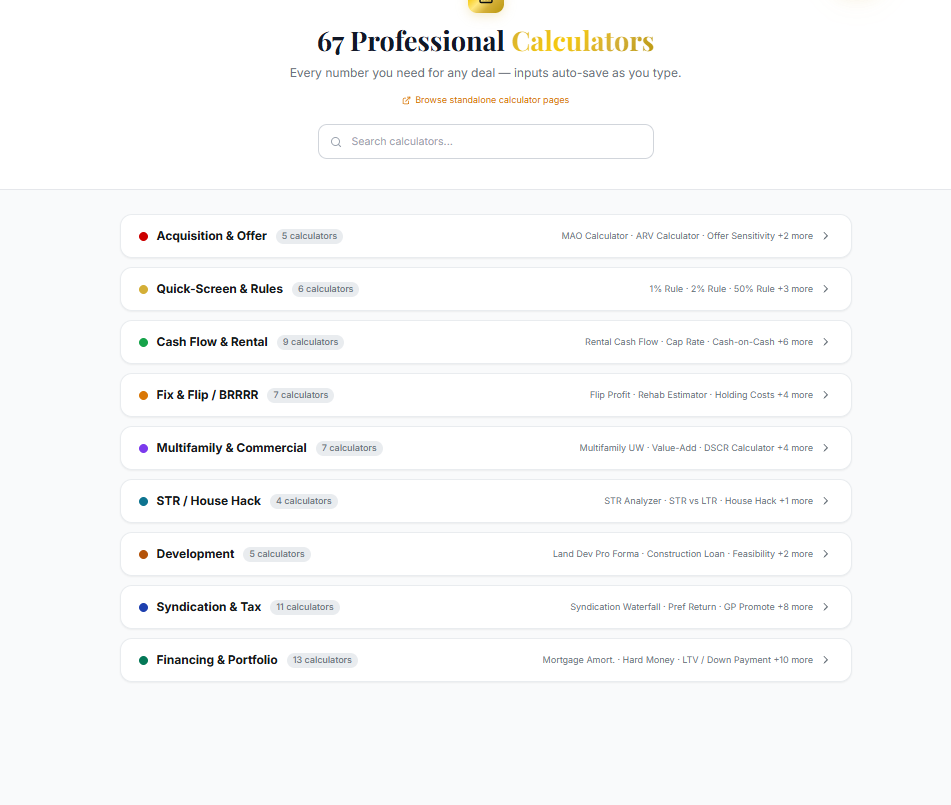
The platform integrates your CRM with 67+ professional real estate calculators, allowing you to transition from lead generation to offer submission without ever leaving your dashboard. This creates a "Residual Reality" where your time is spent negotiating deals that already work on paper, rather than fighting with spreadsheets.
Rigidity vs. Flexibility: When to Adjust
While the 70% rule is a standard, a sophisticated owner understands when to apply "Flexible Funding" logic.
- Hot Markets: In high-demand areas with rapid appreciation, investors might push their MAO to 75% or 80%.
- Slow Markets: In areas with high inventory and low demand, a 65% MAO may be necessary to offset the risk of a long holding period.
Regardless of the percentage, the methodology remains the same. You must define your profit target before you make the call.

Conclusion: The Owner's Discipline
Successful real estate investing is not about the properties you buy; it is about the bad deals you avoid. By calculating your MAO with surgical precision, you remove emotion from the equation. You aren't just buying a house; you are acquiring a future cash flow stream.
Ready to stop guessing and start scaling?
Take control of your deal flow with the tools the pros use. Join a community of serious investors who value data over hype.
Start Your Free Trial of REI Vault Pro Today
Frequently Asked Questions
What if the seller won't accept my MAO?
Then you do not have a deal. It is better to have no deal than a bad deal. Move the lead back into your REI Vault Pro CRM and set a follow-up task for 30 days. Situations change, and a "no" today often becomes a "yes" when the property has sat on the market for three months.
Should I include my wholesale fee in the MAO?
Absolutely. If you are wholesaling, your fee must be subtracted from the investor's MAO. Using the previous example, if the investor's MAO is $205,000 and you want a $10,000 fee, your purchase offer to the seller must be $195,000.
How often should I update my repair estimates?
Labor and material costs are dynamic. You should review your local price points quarterly. Therefore, always include a 10-15% contingency buffer in your repair estimates within your deal analyzer tools.
Contact Information:
Ebonie Beaco, Loan Officer (NMLS #2389954)
Phone: 312-392-0664
Website: www.HomeLoansNetwork.com
Powered by Loan Factory, Inc. (NMLS #320841)
Disclaimer: This content is for educational purposes only and does not constitute a loan approval or commitment. Loan programs, terms, and eligibility requirements are subject to change and vary by borrower and property.