Minimum Down Payment for Investment Properties
Getting started in real estate investing often begins with one major question: "How much cash do I actually need to get into a deal?" If you are looking to purchase your first rental property in Chicago or scaling a portfolio across Florida and Georgia, understanding the minimum down payment requirements is essential for your strategy.
The entry point for an investment property is not the same as a primary residence. While you might have bought your current home with 3% or 5% down, investment properties carry a different risk profile for lenders. Consequently, the requirements are stricter.
Explore the different tiers of down payments based on property types, loan programs, and how you plan to use the asset.
The Standard Benchmarks for Conventional Loans
For most investors using conventional financing: loans backed by Fannie Mae or Freddie Mac: the down payment requirements are standardized but vary based on the number of units.
Single-Family Homes: 15% Minimum If you are buying a single-family detached home or a warrantable condo as a long-term rental, the absolute minimum down payment is 15%. However, many investors choose to put down 20% or 25%.
2-4 Unit Properties: 25% Minimum When you move into the small multifamily space, such as duplexes, triplexes, or four-unit buildings, the risk increases for the lender. For a standard investment loan where you do not plan to live in one of the units, you are looking at a 25% minimum down payment.
Compare these requirements to your current liquid capital. If you are short on the 25% for a four-unit building in Alabama, you might consider starting with a single-family home in Indiana where the 15% entry point is more accessible.
Access more details on these programs through our mortgage basics page.
The House Hacking Exception: 3.5% to 5% Down
If the 15% to 25% down payment feels like a steep hill to climb, there is a legitimate strategy used by many successful investors to get started with much less. This is known as "house hacking."
FHA Loans: 3.5% Down If you purchase a 2-4 unit property and intend to live in one of the units as your primary residence for at least a year, you can utilize FHA financing. This allows you to acquire an investment-grade asset with as little as 3.5% down. This is a favorite strategy for young investors in high-cost markets like California or Virginia.
Conventional Primary: 5% Down Recent changes in conventional guidelines also allow for 5% down payments on 2-4 unit properties if they are owner-occupied. This is a game-changer because it allows you to avoid some of the stricter FHA self-sufficiency tests on triplexes and four-plexes.
Jump in and research how owner-occupied status changes your financing landscape at our home purchase section.
DSCR Loans: The Investor’s Choice
For seasoned landlords or those who do not want to provide tax returns and pay stubs, the Debt Service Coverage Ratio (DSCR) loan is a powerful tool.
DSCR Down Payment: 20% to 25% DSCR loans focus on the property’s ability to cover the mortgage payment rather than your personal income. While some programs allow for 20% down, the 25% mark often unlocks the most competitive interest rates.
These loans are popular for Airbnb and short-term rental financing in vacation markets throughout Florida and Missouri. Since the lender is looking at the rental income potential, the down payment acts as the primary layer of protection for the bank.
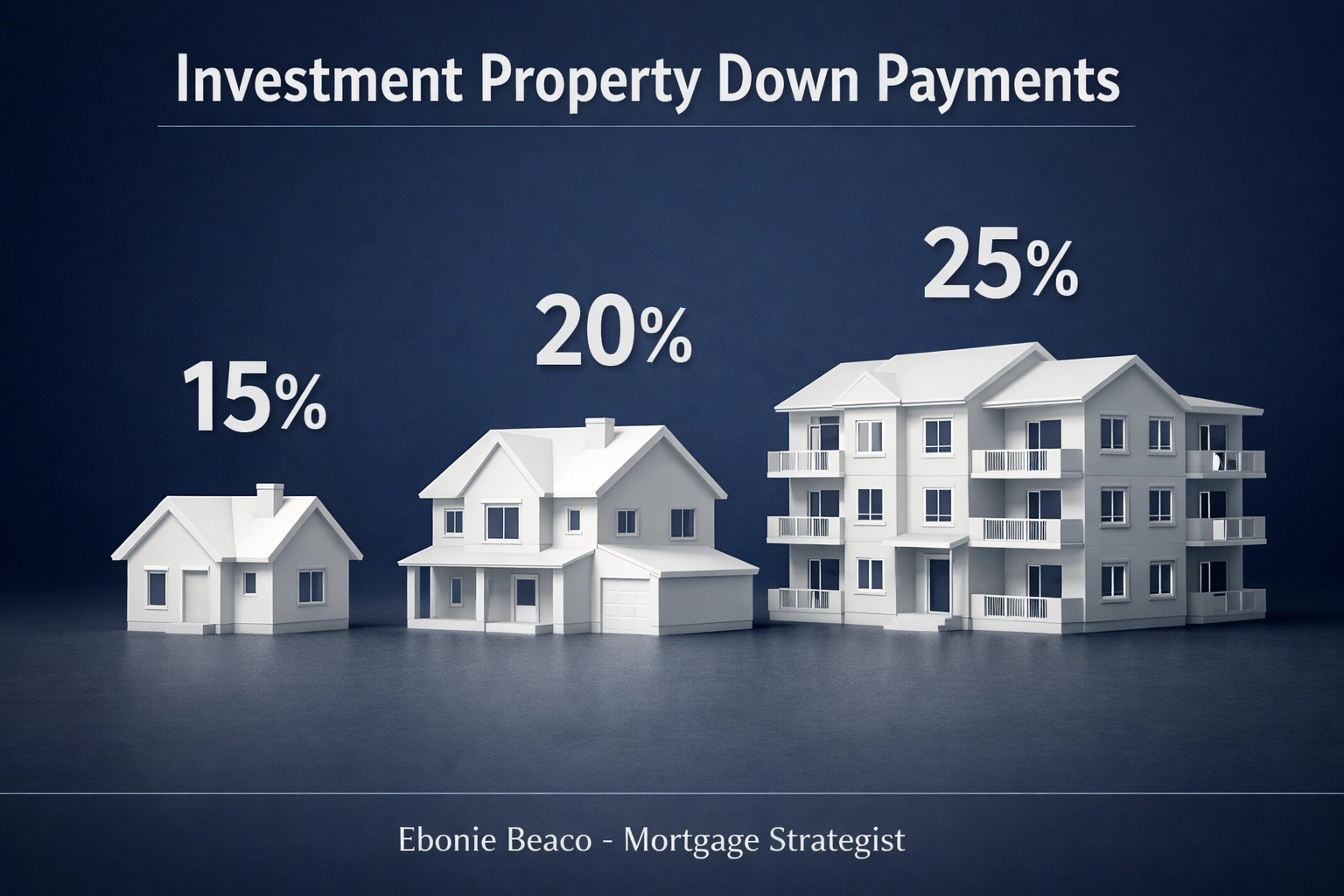 Title: Investment Property Down Payments. Breakdown: 15% (Single Family), 20% (Competitive Rates), 25% (2-4 Units). Ebonie Beaco - Mortgage Loan Officer.
Real-World Calculation: The Cost of Entry
Let’s look at a practical example of how these percentages translate into actual dollars. Suppose you are looking at a duplex in Michigan priced at $300,000.
Scenario A: Investment Property (Non-Owner Occupied)
- Purchase Price: $300,000
- Minimum Down Payment (25%): $75,000
- Estimated Closing Costs (3%): $9,000
- Total Cash Needed: $84,000
Scenario B: House Hacking (Owner Occupied FHA)
- Purchase Price: $300,000
- Minimum Down Payment (3.5%): $10,500
- Estimated Closing Costs (3%): $9,000
- Total Cash Needed: $19,500
In this comparison, you can see how the choice of strategy drastically alters your capital requirements. If you are a first-time investor, the $19,500 entry point is far more attainable than the $84,000 required for a straight investment deal.
Use our mortgage calculators to run these numbers for your specific market.
Why Lenders Demand More for Investment Properties
You might wonder why a lender requires 15-25% down for a rental but only 3% for a home you live in. It comes down to "skin in the game."
Statistically, when a homeowner faces financial hardship, the last thing they stop paying is the mortgage on the roof over their head. However, if an investor sees a rental property go "underwater" (meaning they owe more than it is worth), they are statistically more likely to walk away from that loan.
The higher down payment creates a buffer. It ensures that the investor has significant equity, making them less likely to default. This logic applies whether you are buying a fix-and-flip in Arkansas or a long-term rental in Kentucky.
Credit Score and Reserve Requirements
The down payment is only one part of the equation. To qualify for the minimum down payment amounts, you generally need a strong financial profile.
Credit Score: 680+ While you can get a primary residence loan with a 620 score, most investment property programs want to see at least a 680. If you want the absolute best terms at the 15% or 20% down levels, a score of 740 or higher is ideal.
Cash Reserves: 6 to 12 Months Lenders want to see that you won't go broke the moment a tenant moves out or a water heater breaks. They typically require "reserves," which is liquid cash (or retirement funds) equal to 6 to 12 months of the property’s PITI (Principal, Interest, Taxes, and Insurance) payments.
Learn about the full loan process to see how these requirements fit into your timeline.
Strategies to Source Your Down Payment
If you are a current homeowner, you might be sitting on the "seed money" for your first investment property without even realizing it.
Cash-Out Refinance You can refinance your current primary residence in a market like Virginia or Illinois and pull out equity to use as a down payment for a rental. This is a common way for landlords to scale their portfolios.
HELOC (Home Equity Line of Credit) A HELOC allows you to access your home’s equity as a revolving line of credit. You can use this to make a down payment on an investment property, then pay the line back as the rental generates cash flow or after you execute a BRRRR (Buy, Rehab, Rent, Refinance, Repeat) strategy.
Explore your equity options on our home refinance page.
The Impact of Down Payment on Cash Flow
While the "minimum" down payment is what most people ask about, the "optimal" down payment is what successful investors focus on.
Putting down the bare minimum (15%) means you have a higher loan balance and a higher monthly payment. This can result in lower monthly cash flow. Conversely, putting down 25% reduces your monthly obligation and increases your "cash-on-cash" return in many scenarios.
In competitive markets like Chicago or major cities in Florida, where property taxes can be high, putting more than the minimum down is often the only way to ensure the property "cash flows" (the income exceeds all expenses).
Final Thoughts for Aspiring Landlords
Deciding on your down payment is a strategic move that affects your leverage, your risk, and your growth speed. Whether you are looking for fix-and-flip financing, landlord loans, or bridge loans to get a deal closed quickly, knowing your numbers is the first step.
If you are unsure which path is best for your specific situation in Alabama, Georgia, or any of our served states, reaching out for professional guidance is a smart move. We help investors navigate the complexities of non-QM mortgage loans, bank statement loans for the self-employed, and traditional financing.
Scedule a 1 on 1 at https://calendly.com/homeloansnetwork
Ebonie Beaco Mortgage Strategist | Senior Loan Officer Home Loans Network powered by Loan Factory Inc. NMLS #2389954 HomeLoansNetwork.com 312-392-0664