Michigan Real Estate: Finding Value in the Great Lakes State

Michigan real estate in 2026 is all about balance.
While some markets across the country are seeing wild swings, the Great Lakes State continues to offer steady, sustainable growth.
Whether you are a seasoned landlord looking to expand a portfolio or a first time investor ready to jump in, understanding the regional nuances is the first step toward success.
Current data shows statewide home values sitting in the mid $250,000s, with a projected annual appreciation of around 3% to 10% depending on the specific city.
According to market research from Michigan Realtors, inventory levels have seen a modest 8% increase year over year, providing a bit more breathing room for buyers than in previous cycles.
Explore how different financing strategies can help you navigate this environment and secure assets that generate long term wealth.
The Regional Landscape: Where to Look
Michigan is not a monolithic market; the strategy you use in Detroit will look very different from the one you apply in Grand Rapids.
Southeast Michigan and the Detroit Comeback
Metro Detroit is currently a powerhouse for appreciation.
Forecasts suggest Detroit proper could see growth north of 10% in 2026, while the surrounding suburbs remain strong at 6% to 8%.
Investors often target these areas for Fix and Flip projects or DSCR Investor Loans because the entry price points remain relatively accessible compared to the national average.
West Michigan: The Grand Rapids Surge
Grand Rapids and the surrounding West Michigan area show incredible stability.
Average sale prices here hover around $395,000, and while inventory has increased by nearly 17%, demand remains high due to a robust local economy.
Many investors here utilize the BRRRR method (Buy, Rehab, Rent, Refinance, Repeat) to scale their portfolios in high demand neighborhoods.
Mid-Michigan: Stability in Lansing
The state capital offers a unique "recession resistant" profile.
With a workforce anchored by government, healthcare, and Michigan State University, the rental market in Lansing is consistently tight.
This makes it an ideal spot for Landlord Loans and long term residential holds.
Navigating Property Taxes: The Uncapping Effect
One of the most critical aspects of Michigan real estate is the way property taxes are calculated.
In Michigan, the "Taxable Value" of a property is capped and can only increase by 5% or the rate of inflation (whichever is less) as long as the same person owns the home.
However, when a property is sold, the taxes "uncap."
This means the Taxable Value resets to 50% of the property's State Equalized Value (SEV), which usually tracks with the current market value.
If you do not account for this jump in your overhead, your cash flow projections will be inaccurate.
Property Tax Impact Calculation
Let’s look at a real world scenario for an investor purchasing a rental property.
The Scenario:
- Purchase Price: $260,000
- Previous Owner’s Taxable Value: $90,000
- Local Millage Rate: 50 mills (0.050)
- New Estimated Taxable Value (50% of purchase): $130,000
The Math:
- Old Annual Tax: $90,000 x 0.050 = $4,500
- New Annual Tax after Uncapping: $130,000 x 0.050 = $6,500
- Annual Cash Flow Impact: $2,000 decrease
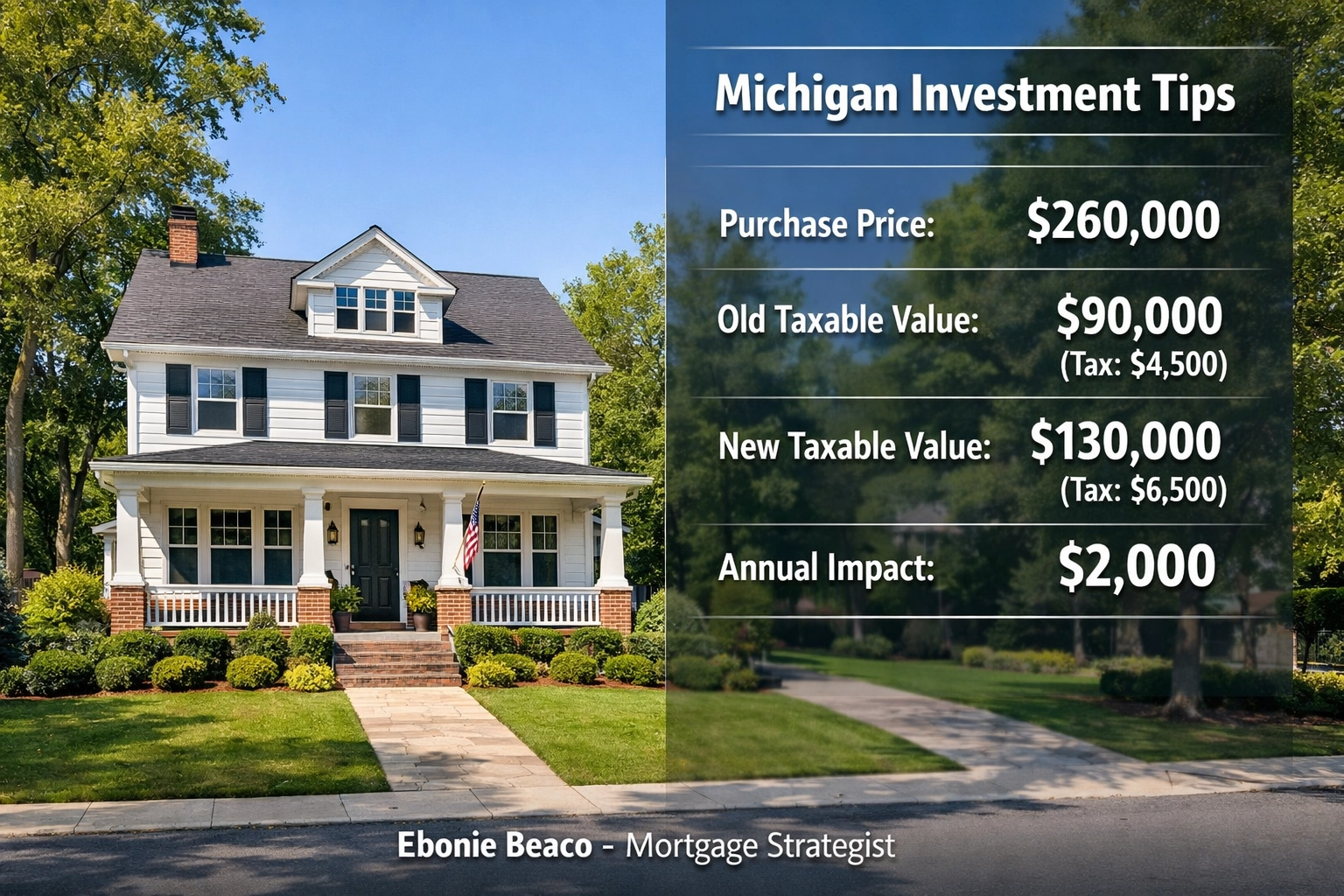 Title: Michigan Investment Tips
Calculation: Property Tax Uncapping
Purchase Price: $260,000
Current Taxable Value: $90,000 (Tax: $4,500)
New Taxable Value: $130,000 (Tax: $6,500)
Annual Increase: $2,000
Ebonie Beaco - Mortgage Loan Officer
Title: Michigan Investment Tips
Calculation: Property Tax Uncapping
Purchase Price: $260,000
Current Taxable Value: $90,000 (Tax: $4,500)
New Taxable Value: $130,000 (Tax: $6,500)
Annual Increase: $2,000
Ebonie Beaco - Mortgage Loan Officer
Financing Strategies for Michigan Investors
To win in this market, you need the right capital structure.
Standard conventional loans are great, but they often come with strict debt-to-income (DTI) requirements that can limit your growth.
DSCR Investor Loans
Debt Service Coverage Ratio (DSCR) loans are a favorite for landlords.
Instead of looking at your personal income or tax returns, the lender looks at the rental income of the property itself.
If the rent covers the mortgage payment (and then some), the loan is viable.
This allows you to scale your portfolio without the roadblocks of traditional employment verification.
Fix and Flip Loans
With Michigan’s aging housing stock in areas like Pontiac or Flint, there is ample opportunity for renovation.
Fix and Flip Loans provide the capital needed to purchase distressed properties and fund the construction.
These are typically short term, interest only bridge loans designed to be paid off once the property is sold or refinanced into a long term rental loan.
HELOC and Cash-Out Refinance
If you are a current homeowner in Michigan, you likely have a significant amount of equity sitting in your primary residence.
You can access this through a HELOC (Home Equity Line of Credit) or a Cash-Out Refinance.
Many investors use these funds to cover the down payment on their first or fifth investment property.
Access your equity to build a bridge to your next deal.
Specialized Loan Programs
Not every borrower fits into a neat little box, and the Michigan market reflects that diversity.
- Bank Statement Loans: Perfect for self employed investors who have plenty of cash flow but take significant tax deductions. We use your bank statements to verify income rather than your 1040s.
- ITIN Mortgage Loans: We provide financing options for individuals with an Individual Taxpayer Identification Number who want to invest in US real estate.
- Non-QM Mortgage Loans: These "Non-Qualified Mortgage" products offer flexibility for unique scenarios that don't meet Fannie Mae or Freddie Mac guidelines.
- Airbnb and Short-Term Rental Financing: Michigan’s "Lake Life" makes it a prime spot for vacation rentals. We offer specific programs that use projected short term rental income to qualify.
The "Rate-Lock Effect" and Timing
Many homeowners are currently holding onto 2% or 3% interest rates, which has kept inventory lower than normal.
However, as we move through 2026, more sellers are beginning to accept the "new normal" of mid-range rates.
Waiting for rates to drop back to historic lows might mean missing out on current prices.
Usually, when rates drop, buyer competition spikes, which drives prices even higher.
Buying now and planning for a future refinance is often the more profitable strategy.
Final Steps for Michigan Investors
Success in the Great Lakes State requires a mix of local knowledge and creative financing.
Always verify the local millage rates for the specific township where you are buying, as these vary wildly across the state.
Check the Michigan Department of Treasury for the latest tax guidelines and property search tools.
If you are ready to evaluate a deal or need a roadmap for your first investment, getting a clear picture of your financing options is the best place to start.
Compare different loan products to see which one aligns with your five year plan.
Investing in Michigan? Contact Ebonie Beaco for mortgage financing and mentoring.
Scedule a 1 on 1 at https://calendly.com/homeloansnetwork
Ebonie Beaco Mortgage Strategist | Senior Loan Officer Home Loans Network powered by Loan Factory Inc. NMLS #2389954 HomeLoansNetwork.com 312-392-0664