Michigan and Virginia HELOC Secrets Revealed: What Experts Don’t Want You to Know

Accessing the equity in your home often feels like trying to unlock a vault without the combination.
Many homeowners in markets like Michigan and Virginia believe that a traditional cash out refinance is their only path to liquidity.
They are often surprised to find that a Home Equity Line of Credit (HELOC) offers a level of flexibility and cost savings that most big-box banks rarely advertise.
Explore the reality behind these financing tools and why working with a specialized Michigan HELOC lender or Virginia HELOC lender can change your entire financial trajectory.
The Stealth Advantage of the Draw Period
Draw Period: A set timeframe, typically ten years, during which a borrower can withdraw funds from their credit line as needed.
This allows you to pay interest only on the amount you actually use rather than the full line amount.
Most experts focus on the interest rate, but they often gloss over the benefit of interest-only payments during the draw period.
If you are a homeowner in Richmond, Virginia, or Grand Rapids, Michigan, this structure provides a significant cash flow advantage.
You can access funds for a renovation or an investment property deposit without the immediate pressure of full principal and interest payments.
Jump in to your equity potential by visiting our mortgage calculators to see how these numbers look for your specific home value.
The 95% LTV Secret: Why Your Bank Said No
LTV (Loan-to-Value): The ratio of a loan to the value of an asset purchased.
It represents the percentage of the home's value that is being borrowed against.
Standard lenders typically cap a HELOC at 80% or 85% of your home’s value.
However, some specialized lenders in the Michigan market allow borrowers to access up to 95% of their equity.
This is a game-changer for homeowners who have seen rapid appreciation in cities like Detroit or Ann Arbor but still have a significant primary mortgage balance.
If your home is worth $400,000 and you owe $300,000, an 80% LTV cap only gives you $20,000 in credit.
A 95% LTV threshold expands that credit line to $80,000.
That extra $60,000 is the difference between a small kitchen update and a full-scale real estate investment.

Michigan HELOC Lender Insights: Waiving the Appraisal
The cost and time associated with appraisals often discourage homeowners from pursuing equity lines.
Specialized lenders in Michigan and Virginia have begun utilizing Automated Valuation Models (AVMs) to streamline the process.
In many cases, if your loan amount falls below a certain threshold or your equity position is strong, the appraisal requirement is waived entirely.
This reduces your closing costs and slashes the approval timeline from weeks to days.
Compare this to a traditional refinance where a full interior appraisal is almost always mandatory and costly.
Virginia HELOC Lender Tactics: The Relationship Pricing Play
In Virginia, particularly in high-value areas like Northern Virginia and Virginia Beach, relationship-based pricing is a powerful "secret" weapon.
Some institutions offer "margin discounts" based on your existing financial footprint or the size of the line you are opening.
A margin is the fixed percentage added to the Prime Rate to determine your total interest rate.
Securing a lower margin through a strategic Virginia HELOC lender can save you thousands of dollars over the life of the draw period.
Access professional guidance on these specific state programs by visiting our about us page.
The Debt Consolidation Math That Saves Thousands
Debt Consolidation: The process of combining multiple high-interest debts into a single, lower-interest loan.
This strategy reduces monthly outflows and simplifies financial management.
Consider a homeowner in Alabama or Arkansas carrying $50,000 in credit card debt at a 22% interest rate.
The annual interest cost alone is $11,000.
By shifting that debt to a HELOC at a 10% rate, the annual interest drops to $5,000.
That is $6,000 in immediate annual savings that can be redirected toward principal reduction or further investments.
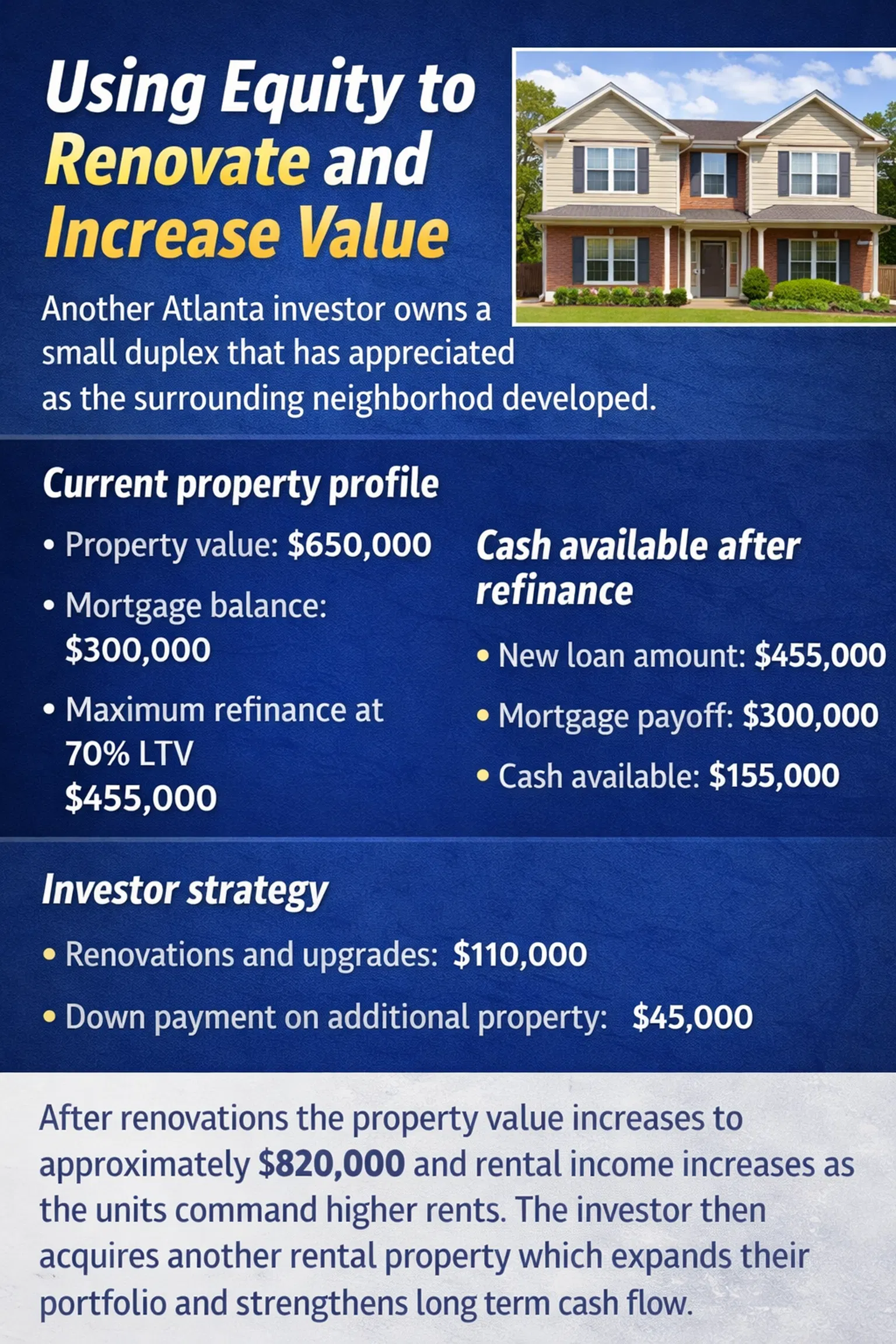
Tactical Uses for Real Estate Investors
Investors in California, Florida, and Georgia frequently use HELOCs as a "ready-to-go" source of capital for down payments.
When a deal appears in a competitive market like Atlanta or Orlando, waiting for a new loan approval can mean losing the property.
A HELOC allows you to act as a cash buyer or provide a significant down payment instantly.
Once the new property is stabilized, many investors use a DSCR rental property loan to pay back the HELOC and reset their credit line for the next deal.
This "recycle and repeat" strategy is a core component of the BRRRR method used by successful landlords across Illinois, Indiana, and Kentucky.

Is Your HELOC Tax Deductible?
The Tax Cuts and Jobs Act of 2017 changed the rules for interest deductions, but it did not eliminate them.
If you use your HELOC funds to buy, build, or substantially improve the home that secures the loan, the interest remains deductible in most cases.
Using the funds for a new roof in Missouri or a basement finish in Michigan keeps that tax advantage intact.
Using the funds to pay off a car or go on vacation does not.
Always consult a tax professional to confirm how these rules apply to your specific situation in your state.
Comparing HELOC vs. Cash-Out Refinance
Cash-Out Refinance: Replacing an existing mortgage with a new loan for more than you owe and taking the difference in cash.
This results in a new primary mortgage at current market rates.
If you currently have a 3% interest rate on your primary mortgage, a cash-out refinance is often a poor financial move.
Refinancing would force your entire balance into a higher current market rate.
A HELOC allows you to keep that 3% rate on your main mortgage while only paying the higher rate on the small portion of equity you actually use.
This preservation of low-rate debt is a primary reason why homeowners in Florida and California are flocking to HELOC options today.
Explore your refinancing alternatives at home refinance basics.
Avoiding the "Frozen Line" Trap
Lenders have the right to freeze or reduce your credit line if the value of your home drops significantly.
This happened to many homeowners during the 2008 financial crisis.
The "secret" to avoiding this is to choose lenders with "non-callable" or more stable terms.
Monitoring your local market trends in cities like Chicago or St. Louis helps you understand when to draw your funds before a potential market shift.

Defining the Terms You Need to Know
Prime Rate: The base interest rate that commercial banks charge their most creditworthy corporate customers.
HELOC rates are almost always tied to this index.
Margin: The percentage points a lender adds to the Prime Rate to set your actual interest rate.
Your credit score and LTV significantly influence the margin you are offered.
Appraisal: An expert estimate of the value of a property.
Lenders use this to determine how much equity is available for you to borrow.
Learn more about the technical side of the process at our mortgage glossary.
How to Calculate Your Potential Equity
Calculating your available credit line requires a simple formula.
- Multiply your home value by the lender's LTV limit (e.g., 85%).
- Subtract your current mortgage balance.
- The remaining number is your maximum HELOC limit.
Example:
Value: $500,000
LTV Limit (85%): $425,000
Current Mortgage: $280,000
Available HELOC: $145,000
This formula applies whether you are looking for a Michigan HELOC lender or navigating the market in Virginia.
Getting Started with Your Strategy
Whether you are a seasoned investor in Georgia or a first-time homeowner in Indiana, your equity is your greatest financial tool.
Don't let traditional banking myths stop you from accessing the capital you've built through years of mortgage payments and market appreciation.
If you are ready to explore how these "secrets" can work for your specific property, the next step is a direct conversation.
Compare your options, analyze the math, and choose a path that aligns with your long-term wealth goals.
Access our online forms to begin the evaluation process today.

Schedule a 1 on 1 at https://calendly.com/homeloansnetwork
Ebonie Beaco
Mortgage Strategist | Senior Loan Officer
Home Loans Network powered by Loan Factory Inc.
NMLS #2389954
HomeLoansNetwork.com
312-392-0664