Mastering the 1031 Exchange: The Ultimate Long-Form Guide to Building Infinite Wealth in 2026

Scaling a real estate portfolio requires more than just finding good deals; it requires a strategy that keeps your capital working for you rather than handing it over to the IRS. In the world of real estate finance, the 1031 Exchange stands as the single most effective tool for building long-term wealth. By deferring capital gains taxes, you can reinvest 100% of your equity into larger, higher-performing assets, effectively compounding your growth at a rate that traditional savings or stock investments cannot match.
Explore how the 1031 exchange works, the strict rules you must follow in 2026, and how to use advanced strategies like reverse and improvement exchanges to stay ahead of the market. Jump in to see how you can transform a single rental property into a massive portfolio.
The Power of Deferral: Why the 1031 Exchange is Vital
The 1031 Exchange, named after Section 1031 of the Internal Revenue Code, allows you to sell an investment property and buy another "like-kind" property while deferring all capital gains taxes. Think of it as an interest-free loan from the government. Instead of paying 15% to 20% in federal capital gains taxes: plus depreciation recapture and potential state taxes: you keep that money and use it as a down payment for your next acquisition.
In high-growth markets like Florida, Georgia, and Virginia, where property values have soared, the tax bill on a sale can be staggering. Using a 1031 exchange ensures your momentum never slows down. You aren't just saving money; you are magnifying your purchasing power.
The Core Mechanics: How the Exchange Works
To successfully navigate a 1031 exchange, you must understand the mechanical framework. This is not a simple "sell and buy" transaction; it is a legal swap orchestrated by professionals.
What Qualifies? (The Like-Kind Definition)
Like-Kind Property: A broad classification of real estate held for investment or business use that can be exchanged for other investment real estate.
Many investors mistakenly believe "like-kind" means you must swap a single-family home for another single-family home. This is incorrect. You can exchange a duplex in Chicago for a commercial retail strip in Atlanta, or a plot of raw land in California for a short-term rental property in Orlando. As long as both properties are held for productive use in a trade, business, or for investment, they qualify.
The Role of the Qualified Intermediary (QI)
Qualified Intermediary: An independent third-party professional who facilitates the exchange by holding the sale proceeds to prevent the investor from taking constructive receipt.
The QI is the most critical partner in your exchange. You cannot touch the money from your sale. If even one dollar of the sale proceeds hits your personal bank account, the IRS considers the exchange "blown," and the entire gain becomes taxable. The QI enters into an exchange agreement with you, takes the funds directly from the closing agent, and then wires them to the closing agent for your new property.
The Strict "No-Touch" Fund Rule
The IRS is uncompromising regarding the control of funds. You must have no "constructive receipt" of the money. This means you cannot use the proceeds to pay off personal debts, even for a few days, before buying the next property. The QI ensures the chain of custody remains unbroken.
The Three Critical Deadlines You Cannot Miss
The 1031 exchange is a race against the clock. Missing a deadline by even one minute results in a failed exchange.
1. The 45-Day Identification Period
From the day you close on your "relinquished" (sold) property, you have exactly 45 calendar days to identify potential replacement properties. This includes weekends and holidays. You must provide a written list, signed by you, to your QI.
2. The 180-Day Closing Deadline
You must close on your replacement property within 180 calendar days of the sale of your relinquished property, or by the due date of your tax return for that year, whichever is earlier.
3. The Identification Rules
You cannot simply identify every building in the city. You must follow one of these three rules:
- The 3-Property Rule: You can identify up to three properties of any value. This is the most common choice for most investors.
- The 200% Rule: You can identify any number of properties, provided their total combined fair market value does not exceed 200% of the value of the property you sold.
- The 95% Rule: You can identify more than three properties with a value exceeding 200%, but only if you actually close on 95% of the total value of everything you identified. This is rare and extremely risky.
Avoiding the 'Boot': Protecting Your Tax-Free Status
The goal of a 1031 exchange is to defer 100% of your taxes. If you receive anything other than like-kind real estate in the deal, it is called "boot," and it is taxable.
Cash Boot vs. Mortgage Boot
- Cash Boot: Any leftover cash held by the QI after the purchase of your replacement property that is returned to you.
- Mortgage Boot: Also known as debt relief. If the mortgage on your new property is smaller than the mortgage you paid off on the old property, the difference is considered a "gain" and is taxed.
To achieve a totally tax-free exchange, you must follow two simple rules:
- Buy a property of equal or greater value than the one you sold.
- Reinvest all net proceeds and carry equal or greater debt on the new property.
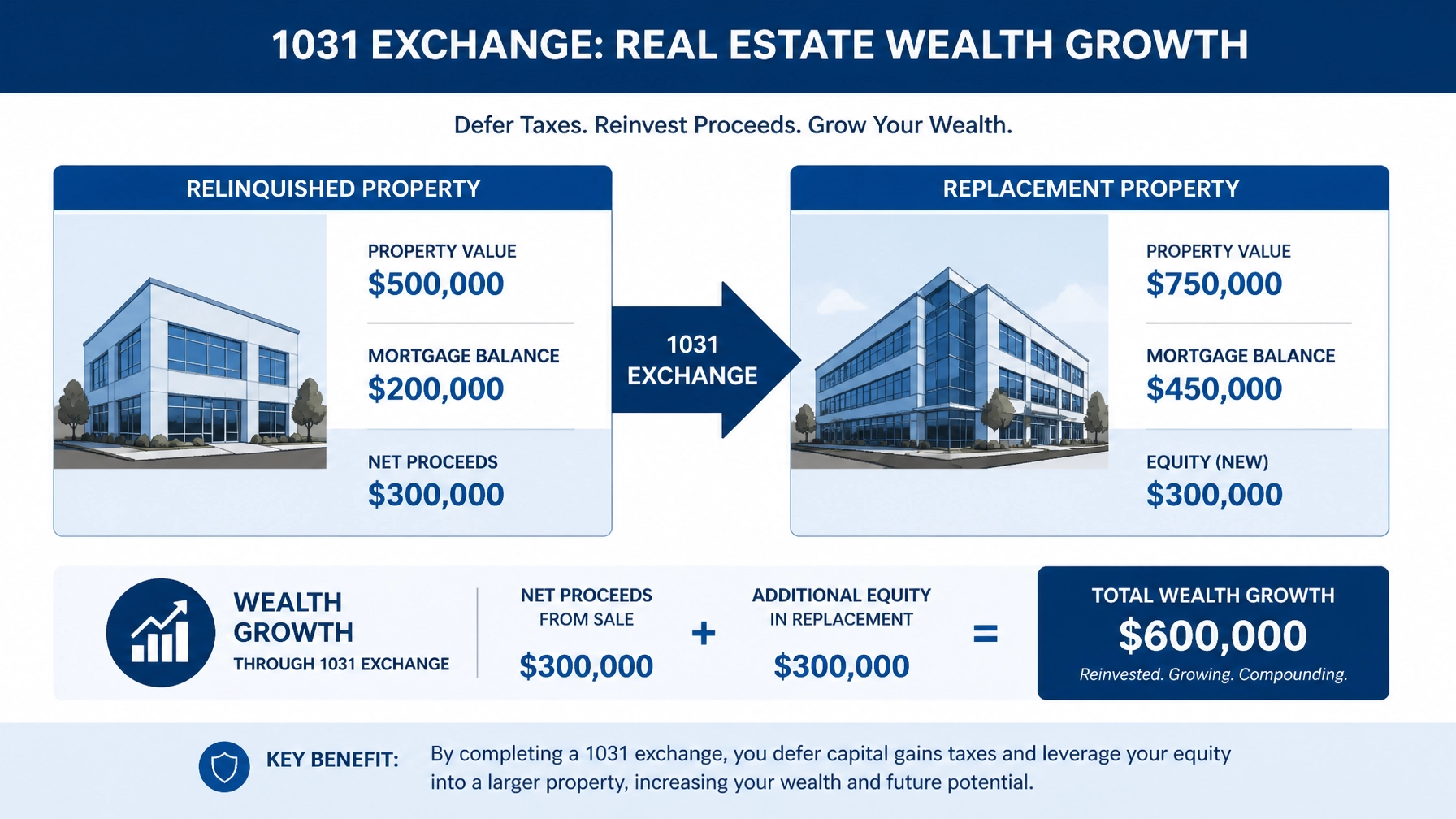
Example Calculation: Imagine you sell a rental property in Indiana for $500,000. You have a $200,000 mortgage and $300,000 in equity. To avoid all taxes, you must buy a replacement property for at least $500,000. If you decide to scale and buy a $750,000 multi-family unit in Michigan, you reinvest your $300,000 of equity and take out a new mortgage of $450,000. Because your new purchase price ($750k) is higher than your sale price ($500k) and your new debt ($450k) is higher than your old debt ($200k), you pay zero taxes.
Access our mortgage calculators to run your own scenarios and see how much equity you can move into your next deal.
Advanced Strategies for 2026: Scaling Your Portfolio
As the 2026 real estate market evolves, sophisticated investors are moving beyond the basic forward exchange.
Reverse Exchanges: Buying Before You Sell
In a competitive market like Chicago or Northern Virginia, you might find the perfect deal before you’ve even listed your current property for sale. A Reverse Exchange allows you to acquire the new property first. A specialized entity, called an Exchange Accommodation Titleholder (EAT), "parks" the title of either the new or old property for up to 180 days while you finish your sale. This is a powerful way to secure prime assets without the stress of the 45-day clock.
Improvement and Construction Exchanges
Improvement Exchange: A strategy where you use the tax-deferred proceeds from your sale to build improvements or renovations on the replacement property.
If you sell a property for $1,000,000 but the replacement property you want is only $700,000, you would normally have $300,000 of taxable boot. With an improvement exchange, the QI or EAT can use that $300,000 to fund a major renovation, addition, or ground-up construction on the new site. By the time you take title (within the 180-day window), the value of the property has increased to $1,000,000, and you have successfully deferred all taxes.

Moving Capital Between Markets
Many investors are currently using 1031 exchanges to migrate capital from high-tax or low-yield states like California and Illinois into high-growth, landlord-friendly markets like Alabama, Arkansas, and Missouri. This "equity migration" allows you to trade a low-cash-flow property for multiple high-yield rentals in emerging secondary markets.
Financing Your Replacement Property
The key to a successful 1031 exchange often lies in the financing. Because you must replace your debt, you need a lender who understands the speed and complexity of these transactions.
Using DSCR and Non-QM Loans
For real estate investors, Debt Service Coverage Ratio (DSCR) loans are a game-changer. These loans qualify you based on the rental income of the property rather than your personal W-2 income. This allows you to scale your portfolio much faster than traditional financing would allow. We offer a wide variety of loan programs tailored specifically for investors who are mid-exchange.
Bridge Loans for Timing Issues
If your 180-day window is closing and your long-term financing is delayed, a bridge loan can provide the short-term capital needed to "save" the exchange. Missing that 180-day mark is a catastrophic tax event; having a reliable lender like Home Loans Network in your corner ensures that doesn't happen.
Whether you are looking for conventional loans or creative investor financing, we structure our products to align with your 1031 timelines.
Conclusion: Building Your Legacy
The 1031 exchange is more than a tax loophole; it is the ultimate wealth-building engine. It allows you to move from single-family homes to apartment complexes, from low-growth regions to booming metropolitan areas, and from small equity positions to massive real estate empires: all while keeping your money away from the taxman.
Navigating these rules requires precision. One wrong move with a deadline or a fund transfer can cost you hundreds of thousands of dollars in taxes. At Home Loans Network, we specialize in helping investors in IL, AL, AR, CA, FL, GA, IN, KY, MI, MO, and VA navigate the complex intersection of 1031 exchanges and mortgage financing.

Compare your options and see how you can use these strategies to dominate the 2026 market. Explore the possibilities and let us guide you clearly and confidently through your next acquisition.
Schedule a 1 on 1 at https://calendly.com/homeloansnetwork
Ebonie Beaco Mortgage Strategist | Senior Loan Officer Home Loans Network powered by Loan Factory Inc. NMLS #2389954 HomeLoansNetwork.com 312-392-0664