Managing Multiple Mortgages: Tips for Scaling Your Portfolio

Scaling a real estate portfolio is an exciting journey that transforms a single property owner into a high-level investor. Whether you are looking at your second rental in Chicago or your tenth short-term rental in Florida, the transition requires a shift in how you view debt. Managing multiple mortgages is less about the number of loans you have and more about the strategy behind them.
When you move beyond a primary residence, the rules of the game change. Lenders look at you differently, and your financial structure needs to be more robust. If you want to grow without hitting a wall, you need to understand how to leverage equity, navigate different loan products, and keep your cash flow healthy.
Assessing Your Financial Foundation
Before you sign for your next property, take an honest look at your current financial health. Lenders in the investment space prioritize stability and liquid reserves.
Debt-to-Income Ratio (DTI)
DTI is a percentage that shows how much of your gross monthly income goes toward paying debts. For conventional loans on multiple properties, keeping this below 43% to 45% is generally required. However, as you scale, personal DTI can become a bottleneck, which is where specialized investor products come into play.
Credit Score Requirements
While you might get a primary home loan with a lower score, scaling a portfolio usually requires higher benchmarks.
- 670+: Often required for conventional loans up to four properties.
- 720+: Typically needed once you move into the five to ten property range.
Liquid Reserves
Lenders want to see that you can handle vacancies or unexpected repairs. You may need to show six months of PITIA (Principal, Interest, Taxes, Insurance, and Association dues) for every property you own. You can check your potential payments using our mortgage calculators to ensure your reserves match your reality.
Advanced Financing Strategies for Scaling
Relying solely on standard 30-year fixed conventional loans can limit your growth. Successful investors in markets like California and Virginia often use a mix of products to keep moving.
DSCR (Debt Service Coverage Ratio) Loans
DSCR: A loan qualification method based on the property’s rental income rather than the borrower’s personal income. Benefit: This allows you to scale indefinitely because your personal DTI does not restrict the loan approval. If the property pays for itself, you are in a good position to qualify.
Portfolio Lending and Blanket Loans
Portfolio Lending: A strategy where a lender keeps the loans on their own books rather than selling them to the secondary market. Blanket Loans: A single mortgage that covers multiple properties at once. Benefit: This simplifies your life by consolidating multiple payments into one and often allows for a "release clause" so you can sell one property without paying off the entire loan.
Cash-Out Refinance and HELOCs
If you have properties in high-appreciation areas like Florida or Georgia, you likely have significant equity sitting idle.
- Cash-Out Refinance: Replacing your current mortgage with a larger one and taking the difference in cash to fund your next down payment.
- HELOC (Home Equity Line of Credit): A revolving line of credit tied to your property equity that you can draw from as needed.
Explore our home refinance options to see how equity can be your greatest scaling tool.
A Practical Example: The DSCR Calculation
Let's look at how an investor might qualify for a 4-unit property in Chicago using a DSCR loan. Unlike a traditional loan, we aren't looking at your tax returns; we are looking at the building's performance.
The Scenario:
- Purchase Price: $600,000
- Down Payment (25%): $150,000
- Loan Amount: $450,000
- Total Monthly Rental Income: $5,200
- Estimated Monthly PITIA (Mortgage, Tax, Insurance, HOA): $3,900
The Calculation: DSCR = Monthly Rental Income / Monthly Debt Service DSCR = $5,200 / $3,900 DSCR = 1.33
Most lenders look for a DSCR of 1.20 or higher. In this case, at 1.33, the property is "cash-flow positive" in the eyes of the lender, making it a strong candidate for financing without using your personal salary to qualify.
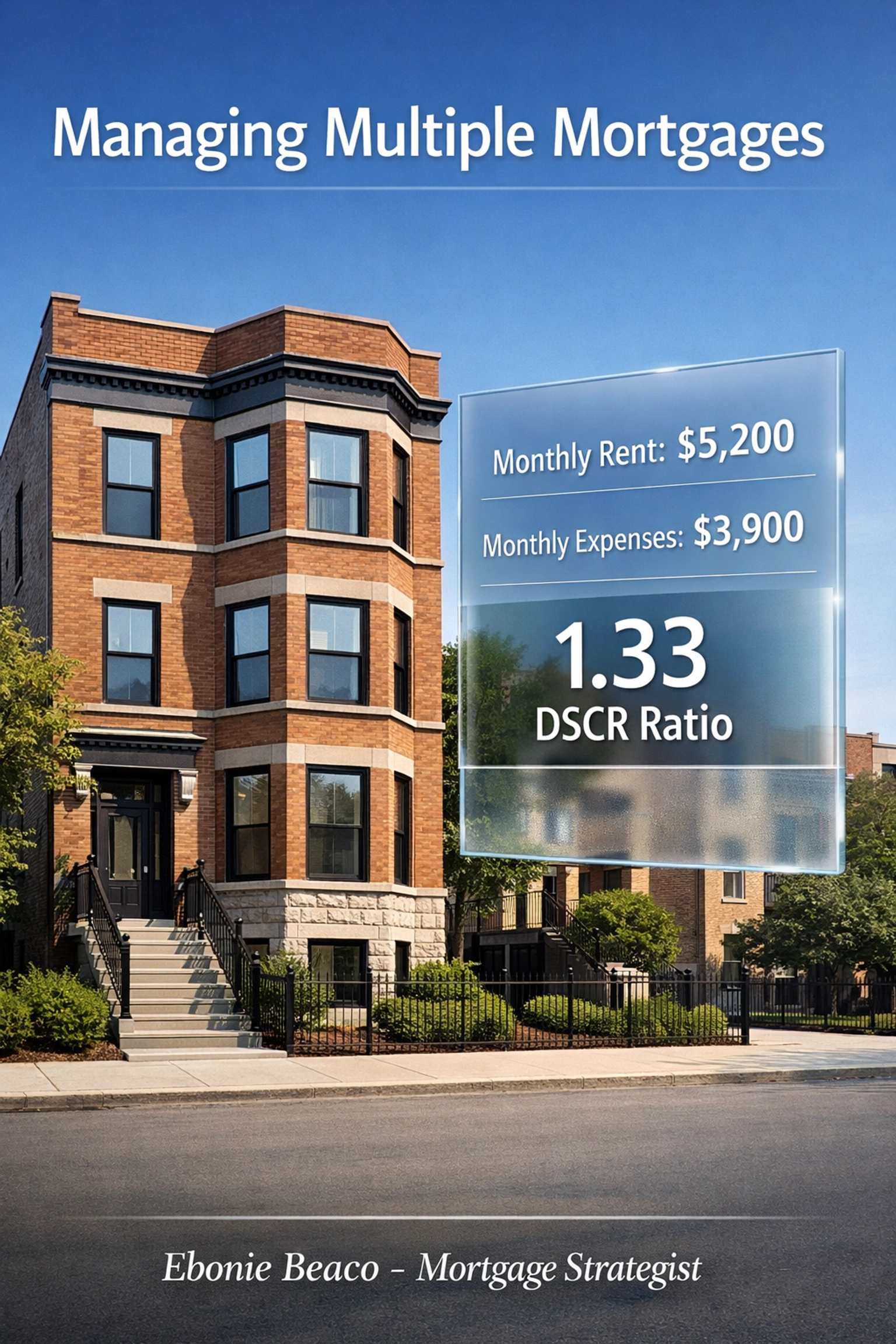 Image Description: A financial breakdown chart showing the DSCR calculation: $5,200 (Rental Income) divided by $3,900 (PITIA) equals a 1.33 DSCR Ratio. Labels include Property Value $600k and Loan Amount $450k.
Managing the Logistics of a Growing Portfolio
Once you have three, five, or ten mortgages, the administrative side becomes a job in itself. You must stay organized to avoid missing payments or losing track of tax obligations.
- Separate Your Finances: Never mix your personal checking account with your investment accounts. Open a dedicated business account for every property or for your entire real estate entity.
- Automate Everything: Set up automatic mortgage payments for every loan. Missing a single payment on one rental property can damage your ability to get financing for the next three properties.
- Track Your Escrow: Property taxes and insurance premiums change. Monitor your escrow statements annually to ensure your monthly payments are adjusted correctly, preventing a massive "catch-up" bill at the end of the year.
- Professional Property Management: In states like Michigan or Arkansas where you might be an out-of-state investor, a professional manager is vital. They ensure the rent comes in on time, which ensures your mortgages are paid on time.
Risk Management and Diversification
Scaling isn't just about buying more; it’s about protecting what you already have.
Diversify Your Geography
Don't put all your eggs in one city. If you own several properties in a single Florida coastal town, a single hurricane season could impact your entire portfolio's income. Spreading your investments across different states like Indiana, Kentucky, or Missouri can provide a hedge against local economic downturns.
Insurance Coverage
Ensure you have "Loss of Rent" coverage on your landlord policies. If a fire or flood makes your property uninhabitable, this coverage will pay the monthly rent to the bank while the property is being repaired, keeping your mortgages current.
Tax Preparation
Managing multiple mortgages means managing multiple 1098 statements. Start a digital folder for every property and save your closing disclosures and interest statements as they arrive. This will make your life much easier when you visit our online forms or speak with your CPA.
The Path Forward
Scaling a portfolio is a chess match. Each move should set up the next one. If you find yourself stuck at the "four-property limit" of conventional lending, it is time to look at Non-QM options like Bank Statement loans or DSCR programs.
You can learn more about the transition from a standard buyer to a portfolio investor in our mortgage basics guide. Every property added to your portfolio is a step toward long-term wealth, provided the debt is managed with transparency and a clear plan.
If you are feeling overwhelmed by the paperwork or aren't sure which loan product fits your next move in the Alabama or Virginia markets, reaching out for a strategy session can clear the path. Understanding the loan process is the first step toward mastering it.
Scedule a 1 on 1 at https://calendly.com/homeloansnetwork
Ebonie Beaco Mortgage Strategist | Senior Loan Officer Home Loans Network powered by Loan Factory Inc. NMLS #2389954 HomeLoansNetwork.com 312-392-0664