June 6 Mortgage News: The Latest National Inventory Trends Explained in Under 3 Minutes

As we enter the heart of the summer season on June 6, 2026, the national housing market is showing clear signs of structural change. After years of record-low supply, the inventory of homes for sale is finally regaining ground, creating fresh opportunities for both homebuyers and real estate investors. National active listings have grown by approximately 7.9% to 10.5% compared to this time last year, indicating a persistent, albeit slow, recovery in available housing stock. While the market remains tighter than the pre-pandemic era, the shift toward a more balanced environment is undeniable.
Understanding these inventory movements is essential for navigating today's financing landscape. Mortgage rates are currently stabilizing in the mid-6% range, specifically between 6.4% and 6.6%, which has brought a level of predictability to the market that was missing in previous years. This stability, combined with rising inventory, allows for more strategic negotiations and creative financing structures. Whether you are a first-time homebuyer or a seasoned investor looking to scale a rental portfolio, today’s data suggests a market that is opening up for those who know how to analyze the numbers.
Defining the Current Supply Landscape
To understand where the market is headed, we must first define the metrics that drive these trends.
- Active Listings: The total number of homes currently available for sale on the market at a specific point in time. Use this figure to gauge the level of competition you will face from other buyers in your local area.
- Months of Supply: An estimate of how long it would take for all current listings to sell at the current sales pace if no new homes were added. Refer to this to determine if you are in a seller’s market (low supply) or a buyer’s market (high supply).
- Seller Concessions: Financial incentives offered by a seller to a buyer to facilitate a closing, such as paying for closing costs or mortgage rate buydowns. Utilize these concessions to reduce your upfront cash requirements or lower your monthly mortgage payment.
National Inventory Analysis for June 2026
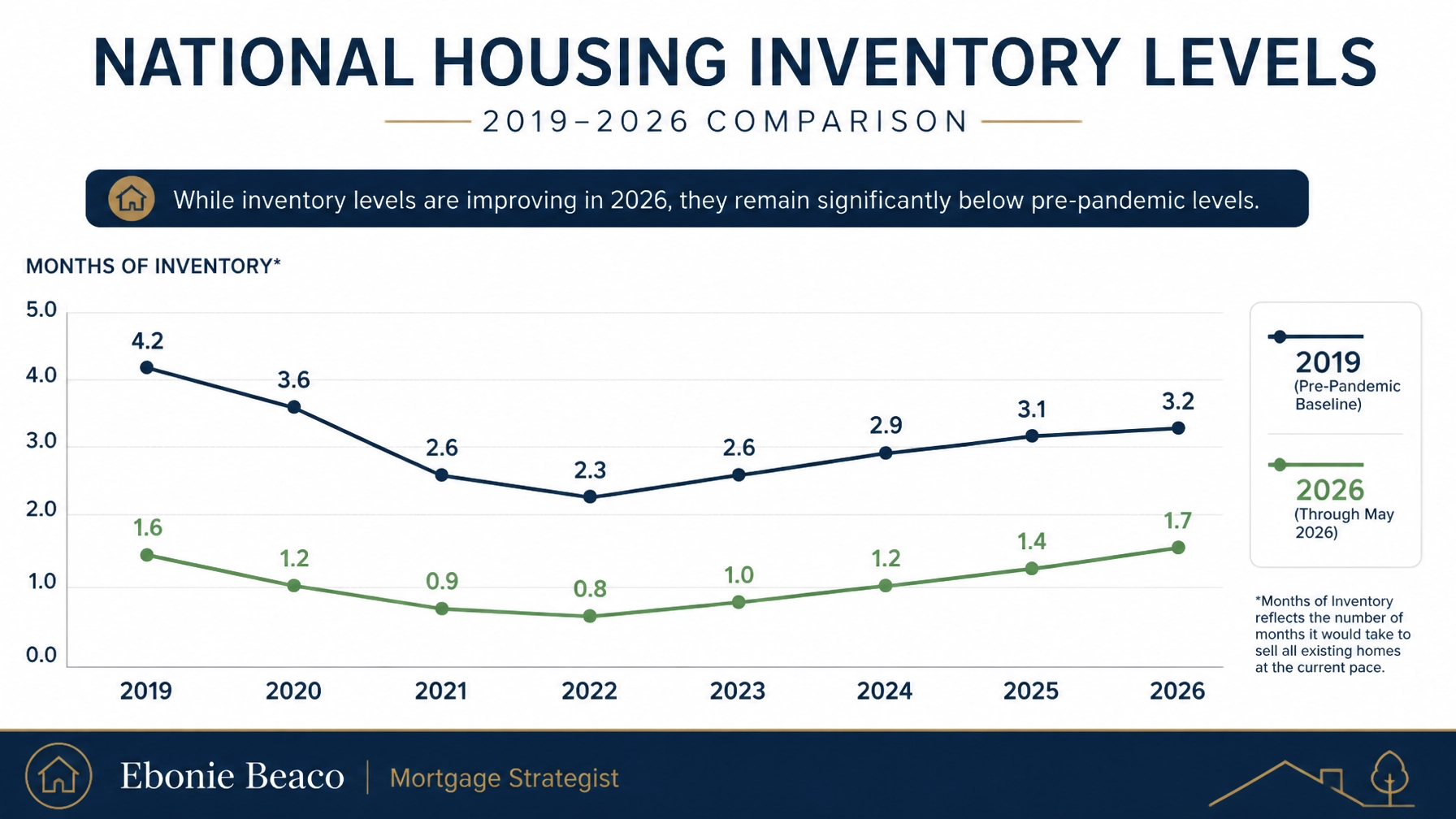
The national housing inventory is currently at approximately 1,058,693 active listings as of late May and early June 2026. This represents a significant increase from the lows of 2023, yet it is important to note that supply remains roughly 17% below the levels seen in 2019. This "inventory gap" is the primary reason home prices have remained resilient despite higher mortgage rates. According to Realtor.com Research, inventory is expected to continue its upward trajectory throughout the remainder of the year.
For consumers and investors, this means the days of extreme bidding wars are largely behind us. The market is moving toward a state of equilibrium where homes stay on the market longer: averaging about 30 days: giving buyers more time to perform due diligence and inspections. Explore the Home Purchase options available today to see how these inventory gains can work in your favor.
Regional Trends: A Tale of Two Markets
While the national trend is upward, the reality on the ground varies significantly by state.
Florida (FL)
Florida stands out as one of the few states where inventory has fully recovered to pre-pandemic levels. While listings in Florida dipped slightly year-over-year in early 2026, the overall supply remains high compared to other regions. This creates a favorable environment for Airbnb and short-term rental financing as well as traditional long-term rentals.
Midwest Markets (IL, IN, MI, MO)
In states like Illinois, Indiana, Michigan, and Missouri, inventory remains much tighter. These regions have not yet reached 2019 supply levels, keeping competition steady for well-priced properties. Chicago, in particular, continues to see robust demand for multi-unit buildings. Investors in these areas often utilize DSCR Investor Loans to secure properties without relying on personal income verification.
Southern and Coastal Markets (AL, AR, CA, GA, KY, VA)
Alabama, Arkansas, Georgia, Kentucky, and Virginia are seeing a moderate build-up of supply. These markets are shifting toward balance, with sellers increasingly willing to offer concessions. In California, the market remains highly competitive, but the increase in inventory provides much-needed relief for those looking to utilize a cash-out refinance to access equity for further investments.

Leveraging Home Equity in a Rising Inventory Market
As property values remain stable and inventory grows, many homeowners are finding themselves in a position of significant equity. This equity can be a powerful tool for those looking to expand their real estate footprint or consolidate higher-interest debt. Accessing this capital through a HELOC (Home Equity Line of Credit) or a Cash-Out Refinance allows you to act quickly when new listings hit the market.
Practical Financial Example: Home Equity Access
Consider a homeowner in Atlanta, Georgia, or Chicago, Illinois, who has seen their property value appreciate over the last several years. By understanding the math behind equity access, you can plan your next investment move with precision.
Scenario: Accessing Equity for a New Investment Property
- Current Home Value: $600,000
- Existing Mortgage Balance: $320,000
- Maximum Loan-to-Value (80%): $480,000
- Accessible Equity Calculation: $480,000 (Max LTV) - $320,000 (Current Balance) = $160,000
In this scenario, the homeowner can potentially access $160,000 in liquid capital. This tax-free cash can be used as a down payment for a fix-and-flip loan, to purchase a DSCR rental property, or to fund a renovation project that increases the value of their current portfolio.

Mortgage Strategies for the Current Climate
With inventory rising and rates in the mid-6s, the way you structure your financing is more critical than ever. We focus on aligning your loan with your long-term wealth-building goals. Jump in and compare these strategies to see which fits your current profile:
- 2-1 Buydown: A financing strategy where the seller pays to lower your interest rate by 2% in the first year and 1% in the second year. Apply this to manage your cash flow during the initial years of ownership.
- DSCR Loans: Debt Service Coverage Ratio loans that qualify you based on the property’s rental income rather than your personal DTI. Use these to scale your portfolio quickly without the constraints of traditional underwriting.
- Non-QM Loans: Specialized mortgage solutions for self-employed borrowers or those with unique income structures. Access these programs if you have a complex financial profile that doesn't fit conventional guidelines.
- Fix-and-Flip Financing: Short-term bridge loans designed for investors who purchase, renovate, and resell properties. Utilize this capital to move fast on distressed inventory.
The Role of Real Estate Investors in 2026
Investors are playing a vital role in stabilizing the 2026 housing market. With more inventory available, buy-and-hold landlords and BRRRR (Buy, Rehab, Rent, Refinance, Repeat) investors are finding it easier to source deals that meet their yield requirements. The increase in listings has also benefited wholesalers and developers who are looking for their next project in high-growth states like Georgia and Virginia.
As a trusted mortgage strategist, I help you navigate the complexities of these transactions. From understanding the Loan Process to choosing between a bridge loan and a long-term commercial mortgage, our goal is to provide the educational resources you need to succeed. The data from the National Association of Realtors (NAR) confirms that while the market is challenging, the opportunities for disciplined investors are expanding.
Final Outlook: Preparation is Key
The mortgage news for June 6, 2026, is optimistic. Inventory is recovering, rates have found a temporary floor, and the shift toward a balanced market is giving buyers and investors the leverage they haven't had in years. However, success in this environment requires a proactive approach to financing.
Explore your options, analyze your equity, and stay informed on the latest trends in your specific state. Whether you are dealing with the high-inventory landscape of Florida or the competitive corridors of the Midwest, having a clear financing strategy is what separates successful homeowners and investors from the rest.

Schedule a 1 on 1 at https://calendly.com/homeloansnetwork
Ebonie Beaco
Mortgage Strategist | Senior Loan Officer
Home Loans Network powered by Loan Factory Inc.
NMLS #2389954
HomeLoansNetwork.com
312-392-0664